
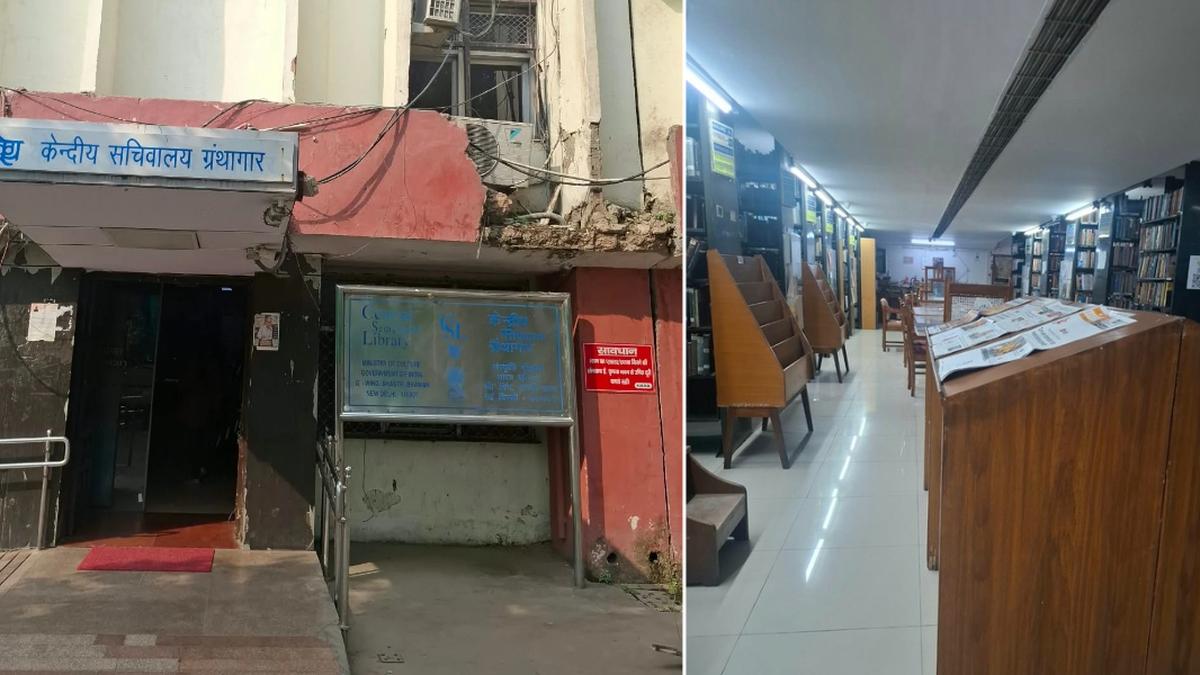
In an affidavit filed in the Supreme Court on November 16, 2026, the government stated that 5,583 sq.m. across two floors would be provided for the Central Secretariat Library in Kartavya Bhawan-4, scheduled for completion only by December 2028. | Photo Credit: All photos by Sobhana K. Nair In its 135 years of existence, the Central Secretariat Library has moved thrice, each time coinciding with a political shift in Delhi. It is awaiting yet another move as the Narendra Modi government continues to remake New Delhi.The move would require packing up a collection of 8.5 lakh books, including 5,545 rare titles dating back to the 18th, 19th and early 20th centuries. Then there are nearly 3,000 commission and committee reports, from both imperial and post-Independence India. All of these sit in the library’s Shastri Bhawan premises, which is marked for demolition for the next round of new office complexes, uniformly named ‘Kartavya Bhawan’.The library complex, a three-storey building behind the main office complex of Shastri Bhawan (in the G-Wing), requires one to cross a swathe of empty parking space where once cars raced to get the last vacant spot. Now, troops of monkeys patrol while the demolition crews stand ready, waiting for the final whistle.Caught in this strange interlude is a three-storeyed structure, a tiramisu of a library that serves all three categories: casual readers who may stroll in accidentally, regular ones who walk in with an air of surety, and scholars, a far smaller group, who come here for the rare records.The ground floor is an unruly jumble. Four Rajasthani dwarpal (doorkeeper) figures stand guard at the door. On the shelves, Walt Whitman’s poems sit beside Danielle Steel’s romances and Mario Puzo’s The Godfather, all crammed together beneath flickering tubelights. There are books that you fear to touch because years of neglect come away on your fingers. Nearby stand relics from another age. In a 1957 manual, How to Use a Tape Recorder, the author spends more than 200 pages explaining why the tape recorder is to sound recording what “the automobile was to the horse and buggy”. Its requisition slip remains blank. Published - November 19, 2026 06:12 pm IST
Delhi’s Central Secretariat Library: a century of displacement
Full Article
Original Source
Read the full article at Thehindu →KhanList aggregates and links to publicly available news content. We do not host full articles from third-party sources. Always verify important information with original sources.