
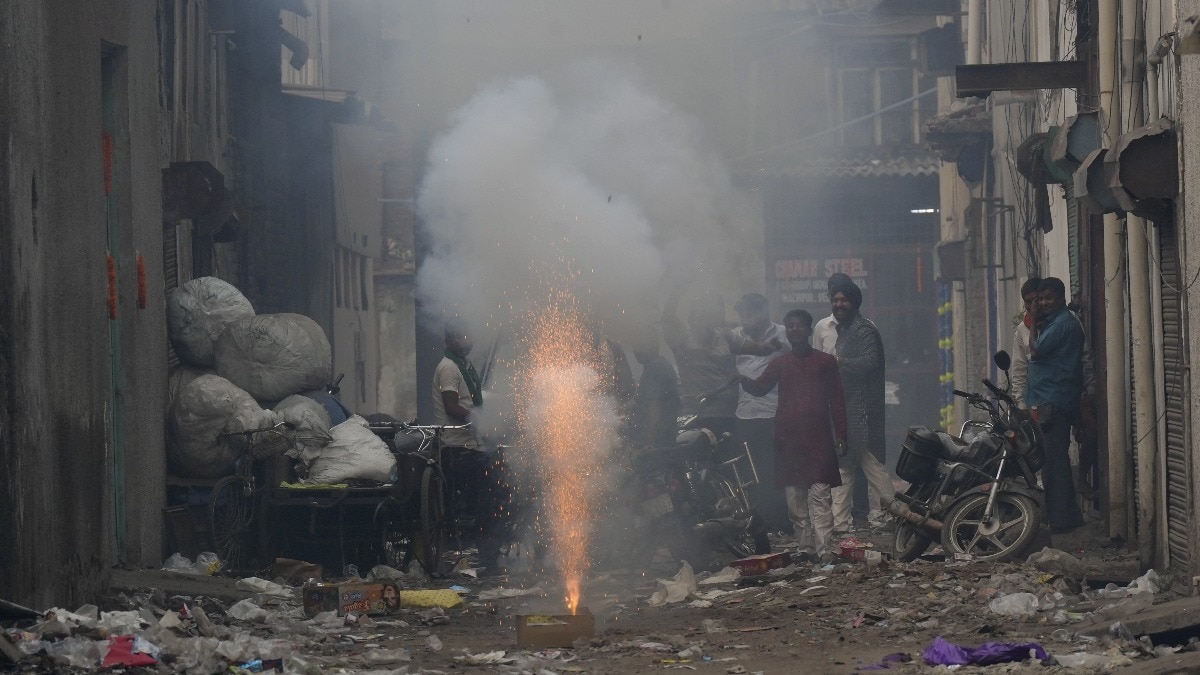
Delhi's air pollution has reached levels that warrant far more than warnings and curbs, with the Air Quality Index (AQI) touching 488 at 11:00 am on November 4, according to AQI.in.At this level, breathing the capital's air is equivalent to smoking around 14 cigarettes a day, as per AQI.in, highlighting the severity of the pollution gripping the city.The reading comes after Delhi recorded an average daily AQI of 410 on Tuesday, November 3, adding yet another severe deterioration in air quality just days before Diwali. People play and walk in a ground shrouded in smog as air pollution spikes, in New Delhi. (Photo: Reuters) The latest numbers paint a troubling picture. Delhi's air in the last two days, from November 3-4, has shot past the AQI recorded on Diwali last year on October 20, when firecrackers shrouded the capital with haze and smoke, and the day after the festival.The air has been polluted even though Diwali 2026 is still four days away, on November 8. The comparison raises concerns about how much worse the air could become as celebrations begin, particularly when pollution levels typically climb around the festival. A graph illustrating Delhi's AQI in the last 24 hours. (Photo: AQI.in) DELHI TURNS TOXIC BEFORE DIWALIAccording to AQI.in data, Delhi recorded an average daily AQI of 376 on October 20, 2025, the day of Diwali, and the AQI reading climbed further to 393 on October 21, the day after the festival.This year, the capital's average daily AQI was already at 410 on November 3, exceeding both last year's festival-day readings. The situation worsened on Wednesday, with the AQI touching 488 at around 11:00 am.In other words, Delhi's pollution has crossed last year's post-Diwali levels before the festival has even arrived, with the numbers illustrating how quickly the city's air quality has worsened over the past few days.WHY DOES POLLUTION RISE AFTER DIWALI?Diwali is a period when Delhi tends to remain vigilant. Or at lest it tries to be.Firecrackers bursting around the city add substantial amounts of smoke and fine particles to the air during Diwali celebrations. These same particles can remain suspended in the air and add to the pollution the following morning.However, fireworks are only one part of Delhi's winter pollution problem. A worker makes firecrackers at a factory ahead of Diwali. (Photo: Reuters) Vehicle emissions, construction dust, industrial pollution and waste burning also contribute to the city's polluted air.As temperatures fall, calm winds and cooler nights make it harder for pollutants to disperse. They accumulate closer to the ground, allowing pollution to build up over several days.NEW ANTI-POLLUTION LAWS PROVE FUTILEThis year, however, was supposed to be better, if not the same. A man meditates in a ground shrouded in smog in Delhi. (Photo: Reuters) Authorities have introduced stricter pollution-control measures ahead of Diwali in the form of a new winter action plan that includes restrictions on certain vehicles entering the capital, construction curbs, the 'No PUC, No Fuel' rule and measures to promote public transport.The Commission for Air Quality Management (CAQM) also invoked Stage 2 of the Graded Response Action Plan (GRAP) on November 2, following a sharp rise in pollution.Measures include higher parking fees, restrictions on coal and firewood use in eateries, tighter controls on diesel generators and intensified road dust management. Commuters move along a road littered with firecracker waste after Diwali. (Photo: PTI) Despite these steps, the latest readings show that Delhi is already battling severe pollution before the festival.With Diwali still days away, the thought of the festival of light and the hazy morning that is bound to follow invokes anything but the festive spirit, and raises questions about just how much worse the city's air becomes.- Ends
Delhi's AQI is above 450 with Diwali yet to come. Was it this bad last year?
Full Article
Original Source
Read the full article at Indiatoday →KhanList aggregates and links to publicly available news content. We do not host full articles from third-party sources. Always verify important information with original sources.