
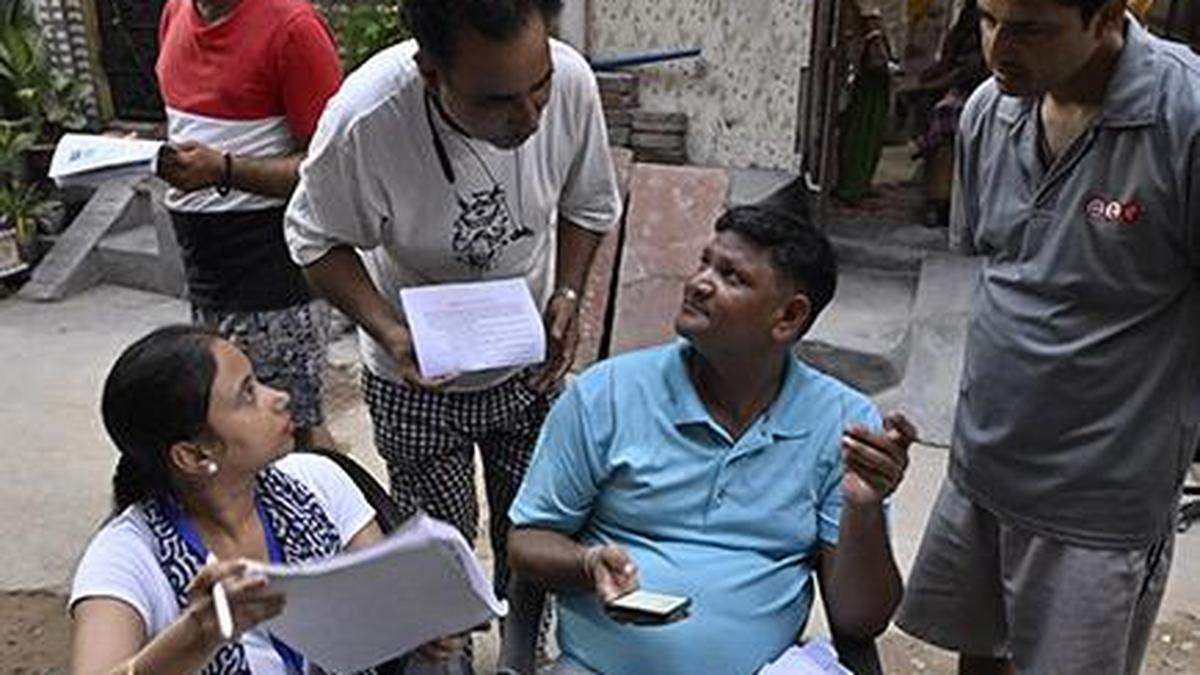
Story so far: The enumeration phase of the Special Intensive Revision (SIR) of electoral rolls in Delhi ended on August 17 after two extensions, paving way for the publication of the draft electoral roll on August 31.The 49-day period, marred with voters’ confusion, low awareness, and conflicting information among Booth Level Officers (BLOs), has divided Delhi’s 1.45 crore electors into different categories depending on whether their enumeration forms (EF) were collected and verified, whether their details could be mapped to the previous SIR roll, and whether discrepancies were found in their forms. At the end of it, there are 97.5 lakh voters or 67.2% whose enumeration forms were collected, digitised and verified which will feature in the draft roll. This includes over 33 lakh voters, or a third, who may face document verification because their details were either unmapped or flagged for anomalies. The remaining 47.56 lakh entries or 32.8% have been categorised as Absent, Shifted, Dead, Duplicate and “Others” (ASDDO) and will not be included in the draft at this stage. They risk exclusion from the final roll.The Delhi Chief Electoral Officer’s (CEO) office said 100% of the enumeration forms had been distributed among the city’s 1,45,0299 electors, with 13,033 BLOs and over 39,000 party appointed Booth Level Agents (BLAs) involved in the exercise. Even as responsibility of proving eligibility for inclusion, through mapping with previous SIR rolls in this phase and through documents in later phases, lies with the voter — BLOs reported facing challenges in mapping voters (especially migrants) with previous roll, where the voter was either not aware or apathetic – thus widening gap in the mapped and unmapped voters. The majority of voters who have been mapped (57.6%) were linked with Delhi SIR roll of 2002. Delhi is consequently set to record the highest draft-stage deletions among Mumbai, Bengaluru, Chennai, Kolkata, and Hyderabad. Here is what the different categories mean and what voters need to do after August 31.Who will appear in the draft electoral roll? Only voters whose enumeration forms were digitised and verified by BLOs will appear in the draft roll on August 31.The roll will be searchable, enabling voters to find their details using their EPIC number, said a senior official. There are 97.51 lakh names or 67.1% of Delhi’s electorate whose details are expected to feature in the draft. A voter does not need to be ‘mapped’ to appear in the draft. Of these, 9.50% are unmapped and 57.69% are mapped voters. The mapped voters have either linked to ‘self’ providing details from previous SIR roll or as progeny to their blood relatives — parent, grandparent, siblings, and in case of married woman, to husband. If a voter was unable to establish such a link but submitted the enumeration form with their current EPIC details, passport-sized photograph and signature — either to the BLO, a Voter Service Centre or through the online portal — their name can still appear in the draft roll. They are unmapped voters who will receive notices to appear before the Election Registration Officer (ERO) and Assistant Registration Officers (AEROs) of their constituency for a hearing between August 31 to October 29. Who will not appear in the draft roll? The data as of August 18 puts the number at 47.56 lakh who have been categorised as ASDDO. Their forms have been marked “uncollectable” and their names will not feature in the draft roll. These voters will also not be served individual notices at this stage. What if one doesn’t find their name in the draft roll? Check the ASDDO list and the pre-SIR deleted names in the roll.If an elector whose name was in the roll frozen on June 16 does not find their name in the draft roll, they can look for it in the separate list of ASDDO voters. According to election officials, the list is expected to be published only a couple of days before the draft roll.There is no set deadline for publishing the ASDDO list, while citizen groups had demanded that the list be published during the enumeration phase so that voters could check it and seek corrections from the BLO. States including Karnataka published the ASDDO list during the enumeration phase, before the deadline. The constituency wise compiled list will be published in pdf format, and the reason for deletion will be stated. On the delay in publishing it, officials said it would be released after a physical copy of the ASDDO voters was shared with the BLAs of political parties, a process that is ongoing. The Minutes of the BLO-BLA meetings will also be published alongside the draft roll on August 31. If one is unable to locate their name in either the draft roll or the ASDDO list, their name might have been deleted during pre-SIR mapping for the same reasons. It can then be found in the routine month-wise deleted voters’ list published on the Delhi CEO’s website. If a voter finds their names to be wrongly deleted, they can file a claim in the next phase. Which voter entries risk exclusion, the ASDD and O? There are 47.65 lakh names which will not be in the draft roll and will not be served notice. These include voters whose filled forms were not returned. They were either identified as absent during the three visits by the BLOs, had shifted from the address, were untraceable — such as voters whose houses were demolished in the months leading up to the enumeration phase — or were found to be dead or duplicate entries. Officials said the majority were voters who had shifted, but exact figures were not shared. Duplicate entries have been found in the case of 10.28 lakh voters. The fifth category is “Others” — voters who allegedly refused to share details or fill the form. BLOs said they are reporting suspected foreigners under this category. There are 2 lakh to 3 lakh such voters. In Delhi, officials are assuring that every deletion is accounted for and there is no scope for error. Apart from them, among the 33 lakh voters who either lack the required documents or do not respond to the notice risk exclusion. This majorly includes marginalised groups of voters, including sex workers who do not have family documents or other details apart from basic identity documents, and homeless persons who have vague addresses and have largely been marked as shifted without visits. Similarly, in the case of sex workers, over 69% were marked as shifted even though they are least likely to move out of the area. They possess only basic documents such as Aadhaar, PAN and Voter ID, which are not valid documents for the verification process.In fact, even in unauthorised colonies and urban villages, where BLOs mostly delivered and collected forms through camps, people have complained of no door-to-door visits or not receiving enumeration forms. What can a voter do if their name is wrongly excluded in ASDDO or deleted? The next phase from August 31 is important for filing claims and objections. The fliling of claims and objections period will run for one month, from August 31 to September 30. For a name which wrongly appears in the ASDDO list, or is missing from the electoral roll because of deletion, or who wants to enrol as a first-time voter in Delhi can file a claim through Form 6. The form has to be accompanied by the prescribed declaration and one of the 12 documents required by the EC for verification. It can be submitted online or at a Voter Service Centre. During the same period: Form 7 can be used to object to the inclusion of another voter’s name in the draft roll, with supporting documents. Form 8 can be used to correct an error, make changes or update a voter’s address. Form 7 or deletion requests are to be disposed of within 15 days, while Forms 6 and 8 are to be disposed of within seven days. A political party-appointed BLA can submit up to 10 forms a day on behalf of citizens during this period. How will a voter know if an anomaly has been flagged? Since the exercise started, the senior officials and the BLOs could not offer clarity to the voters about the types of anomalies. While no separate list of anomalies/logical discrepancies has ever been released by the Delhi CEO’s office, officials said they are following the prescribed 11 anomalies being flagged in other States and Union Territories in the third phase of SIR. However, an additional anomaly has been reported by voters who tried to fill out their forms online — a mismatch between the name on their EPIC and Aadhaar card. This has also been flagged in the details of voters whose forms were digitized later. The software has also flagged false positives, like mismatch between EPIC and Aadhar address, which is not an anomaly. Though the anomaly found will not be mentioned in the draft roll, notices will be prepared describing the same. BLOs will be responsible for delivering the notice. The voter can either hand over the document to the BLO or appear before the ERO with any of the prescribed 11 documents to verify or justify the discrepancy. In Delhi, anomalies have been reported in over 19 lakh voters, higher than enumeration forms found unmapped. Of these, 3 lakh voters are alone in the North-East district. List of indicative discrepancies Less than nine months’ age gap between progenies. Less than 15 years’ age gap between parent and progeny. Greater than 50 years’ age gap between progeny and parent. Less than 40 years’ age gap between elector and grandparent. Different parent name between the current electoral roll and the last SIR. Mapped with a different relative type between the current electoral roll and the last SIR (father/mother). Mapped with father in the current electoral roll and husband in the last SIR. Different father in the current electoral roll and the last SIR in case of self. Incorrect age difference between the current and last SIR for self. Zero documents. Only Aadhaar. What if you receive a notice ? A notice will be served either in case of being unmapped with the previous SIR roll or in case of logical discrepancies/anomalies, to at least every third person who has submitted their form. Within a 15-day period, a hearing will be scheduled with the constituency ERO to verify the details. An elector can submit the documents to the BLO and appear through them, or carry their documents on the prescribed date and time. Since the documents list is not exhaustive, the ERO is competent to decide eligibility in case of a lack of prescribed documents. However, one of the major controversies has been that a significant population might not have these documents. Aadhaar, PAN and Voter ID are not included in the list and are only considered identity proofs. With Aadhaar, one more document from the 11 prescribed documents is required. Indicative list of designated documents Identity card/Pension Payment Order issued to a regular employee/pensioner of any Central Government, State Government or PSU. Identity Card/Certificate/Document issued in India by the Government, local authorities, banks, Post Office, LIC or PSUs prior to July 1, 1987. Birth Certificate. Passport. Recognised matriculation/Educational Certificate. Permanent Residence Certificate. Forest Right Certificate. OBC/SC/ST or any caste certificate. National Register of Citizens (NRC), wherever applicable. Family Register maintained by Government officials under any statutory/administrative regulation. Land/House Allotment Certificate. If the ERO decides that they could not verify eligibility, the name might be struck off the final roll.Why is Delhi seeing the highest city-wise deletion at draft stage? Officials were not surprised by the scale of the indicated deletions and has initially expected around 20% to 40% deletion. Their reasoning is Delhi has a large migrant population. While BLOs reported low awareness and difficulties in tracing details from other states to map with previous SIR rolls, particularly among migrant workers, urban villages, slums and unauthorized colonies — who relied on them to fill their forms. Officials also said a significant population is ‘floating’ because many people live in rented accommodation.BLOs also reported hostility and unwillingness among voters of affluent colonies to share details or fill their forms. The mapping exercise had begun before the enumeration phase. By June, 43% of voters had already been mapped. During the enumeration period, the mapping figure increased by only 14.69%, majority of whom were in the Delhi 2002 roll. Is this a concern? During the pre-SIR mapping, between January and June 16, over 10 lakh voters were already removed, freezing the rolls at 1.45 crore voters. While voters whose numbers were linked received an SMS asking them to appear for an ERO hearing before their names were struck off, many reported not receiving any such notice and only found out when they did not get an enumeration form. Many also alleged they were wrongly marked as absent/shifted. For example, across parts of South Delhi, voters who reported difficulty in locating their BLOs to get a form were allegedly told to simply fill a new form during the claims and objections period. This would mean being removed as a voter and then registering as a new voter. Officials also admitted that initially, BLOs were not going door-to-door, either because addresses were vague or as per RWA restrictions, or citing time constraints. BLOs could effectively help only those whose names they could find in Delhi’s SIR roll of 2002. For migrant workers, officers said their homes were mostly locked during daytime till evening. The Delhi CEO’s office itself sought a second extension, from August 8 to August 17, citing “slow progress”. This eventually resulted in over 47 lakh voters being reported as ASDDO. In addition, 13.78 lakh voters who are unmapped will have to produce documents to prove their eligibility. Can SIR data be used for purposes other than elections? The question has become a concern among voters and citizen groups because experiences in other States and accounts from individuals whose names have been affected by SIR have raised questions about whether exclusion from the electoral roll could also affect questions of citizenship or access to welfare schemes. Some fear that losing voter registration could affect access to pensions or other welfare schemes, or that they could be asked to leave the city. Election officials, however, have said that the dataset is not shared for any other purpose and is used to determine eligibility to vote in elections.
Delhi SIR: Who will be on the draft roll, who faces verification and what happens next? | Explained
Full Article
Original Source
Read the full article at Thehindu →KhanList aggregates and links to publicly available news content. We do not host full articles from third-party sources. Always verify important information with original sources.