
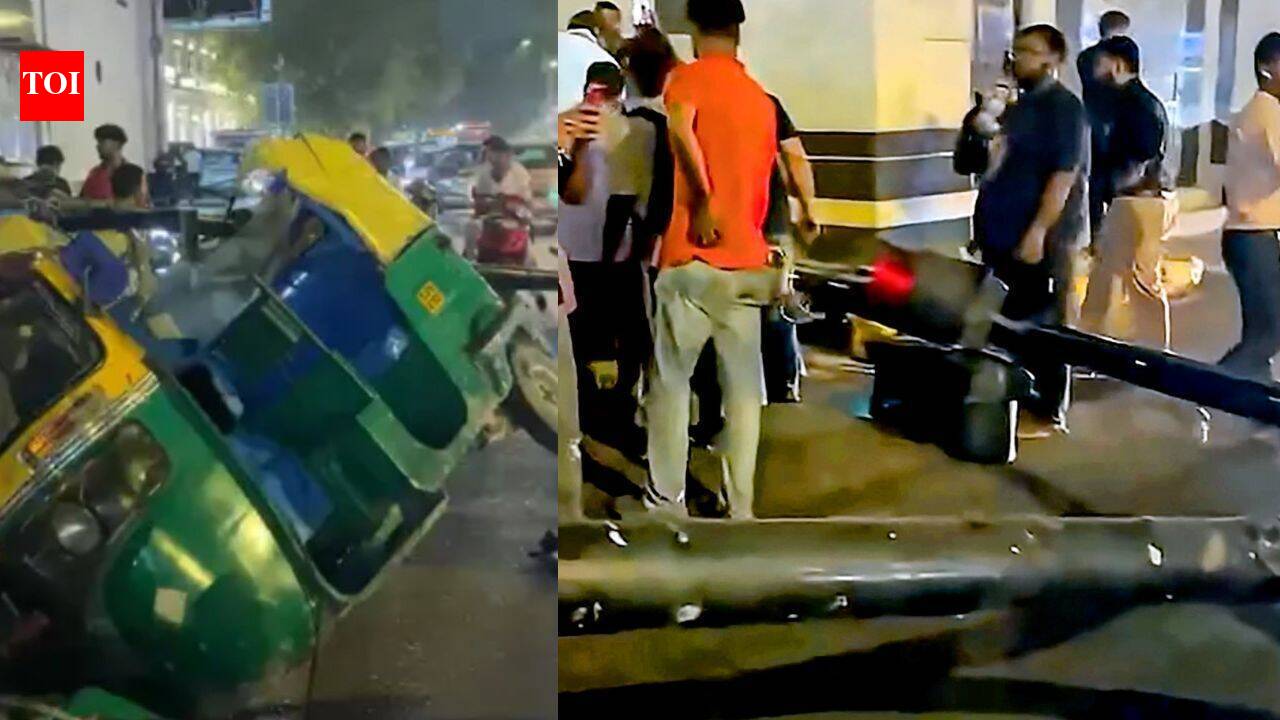
Delhi-NCR faces recurring incidents due to ignored warning signs and system failures.NEW DELHI: Delhi-NCR has been witnessing a spate of incidents in the past few days that do not seem to have much in common on the face of it — a traffic signal pole crashing on vehicles at Delhi's Minto Road, action on unauthorized construction and illegal PGs in Gurgaon, road rage and hit-and-run cases and disruptions to public transport. But look closer, and you start to see a familiar pattern. Sometimes there were warning signs, violations or risks well before the incident itself. The bigger question is whether the region's civic and enforcement systems are doing enough to act on those warning signs before they turn into accidents or public crises.Delhi NCR’s warning signs ignored before incidentsWhen accident is preceded by warningSuch a case is the collapse of a traffic signal pole on vehicles at Minto Road in central Delhi on Tuesday night. Two people were hurt when the pole came down, and police are investigating whether seepage and rust weakened its base. The pole was installed in 2010 and was reportedly showing some visible wear, such as rust around the bottom. More importantly, sources said the agency that maintains it had been alerted to the need for repairs about five days before the collapse. That makes the incident more than a matter of why the pole fell. It poses the more uncomfortable question of what happened in between the warning and the accident.Infrastructure in a city usually does not suddenly break down without some indication that it is deteriorating. Rusts, cracks, water seepages, loose fixtures, damaged pavements and broken street lights can remain visible for weeks or months. The problem is not often identifying the problem, but getting someone to own it, record it, fix it and check that the repair has actually been done. If that chain breaks at any point, what might have been a fairly routine maintenance issue can quickly become a public safety incident.From illegal PGs to illegal floorsThe latest drive of enforcement in Gurgaon is yet another take on the same problem. The Department of Town and Country Planning on Wednesday resumed action in Sushant Lok-1 and South City-1 against unauthorized additional floors, commercial activity in residential buildings, illegal PGs and misuse of stilt parking. More than 17 properties were sealed or faced demolition in the latest operation, after about 27 properties were targeted in two earlier campaigns. In one case, a property with 23 rooms allegedly being used as an illegal PG was sealed by authorities.A call for proactive governance to fix urban warnings before they become disasters.The numbers also show why sealing properties one at a time may not be enough. For years, Gurgaon has been grappling with conversion of residential properties into commercial establishments, unauthorized construction and the growing use of houses as paying-guest accommodation. Once additional floors are constructed, rooms are carved out and a residential property starts behaving like a commercial property, making it far more difficult to reverse the process. Enforcement may be necessary, but the greater challenge is preventing a violation from becoming a fixture in a neighborhood in the first place.It is not simply about individual houses. The recent cases of illegal colonies around the 900-metre restricted zone near the IAF ammunition depot has once again thrown the spotlight on construction in the area, although there are long-standing restrictions. The question for a city like Gurgaon, which is growing so fast, is not just how many buildings can be sealed in an enforcement drive. And it’s also how fast authorities can detect unauthorized activity and prevent it from turning into a whole cluster of infringements.Road safety an event driven businessThe road-rage incident on Gurgaon’s Golf Course Road brings the issue to a more personal setting. Footage shot on her motorbike, as well as CCTV footage, proved to be vital to the investigation into a woman on a motorbike being chased and rammed by a car. The police have constituted a five-member SIT and arrested two accused and taken them into custody for crime-scene reconstruction. The FIR was later enhanced to include charges relating to stalking, outraging the modesty of a woman and attempt to murder.Another incident in Greater Noida demonstrated how quickly a routine road journey can become life-changing injuries. A 32-year-old man met with an accident in wee hours of September 5 when he was hit by a car at Ek Murti Chowk. He suffered multiple fractures in his legs, hand, knees and spine. The 24-year-old driver was later arrested and the vehicle impounded by police. The facts are different from the Gurgaon road-rage incident, but both highlight the same vulnerability: speed, aggression or poor road discipline entering equation can turn a normal journey into a serious safety incident in seconds.A 5-step roadmap to spot, record, act, verify, and prevent urban hazards before disaster strikes.There is also an increasing reliance on cameras and video to reconstruct what happened after an incident. Increasingly, police are using CCTV footage, dashcams and recordings on mobile phones to identify vehicles, establish sequences of events and find suspects. That helps with investigation, but it's ultimately a response mechanism. The tougher job is to build the roads and enforcement regimes that catch and deter reckless behavior before anyone gets hurt.The city’s safety net is strainedThe issue is not only about physical infrastructure or road behavior. Haryana’s H1N1 count rose from 163 on August 26 to 378 on September 16, while in Gurgaon it soared from 12 to 46. Admissions to hospitals across the state more than doubled from 27 to 58 during the same period. These numbers place a different kind of strain on the city’s safety net. It’s not as visible as a fallen pole or a shuttered building, but it can quickly affect hospitals, families and workplaces.Public transit is vulnerable in its own ways. Commuters in several areas in Delhi were left with fewer options and increased demand for the Metro and app-based transport after a strike by contractual DTC drivers over wages and social-security benefits hit bus services. Commuters feel the effect immediately. If there is a problem in one part of the transport network, it can quickly lead to overcrowding and congestion elsewhere, especially during rush hour.These incidents are of very different types, taken one by one. A rusty signal pole is an engineering and maintenance problem. An illegal PG is an enforcement problem. Road rage is a law-and-order and road-safety problem. Rising infections put a strain on public health. A bus strike affects the reliability of public transport. But together they pose a larger question about how Delhi-NCR manages risk.The best safety system is the one that doesn’t have to wait for something to happen to make it work. A damaged structure requires a warning to lead to a repair. Before another floor is added, an unauthorized floor needs to be detected. You need to punish dangerous driving before a crash, not after a crash. Public services need to be robust enough to withstand disruptions and not strand commuters. For a zone developing as fast as Delhi-NCR, the true test of urban safety might therefore be less about how fast authorities respond after something goes wrong and more about how often they manage to prevent it from going wrong in the first place.
Delhi-NCR knew, so why didn't it act?
Full Article
Original Source
Read the full article at Timesofindia →KhanList aggregates and links to publicly available news content. We do not host full articles from third-party sources. Always verify important information with original sources.