
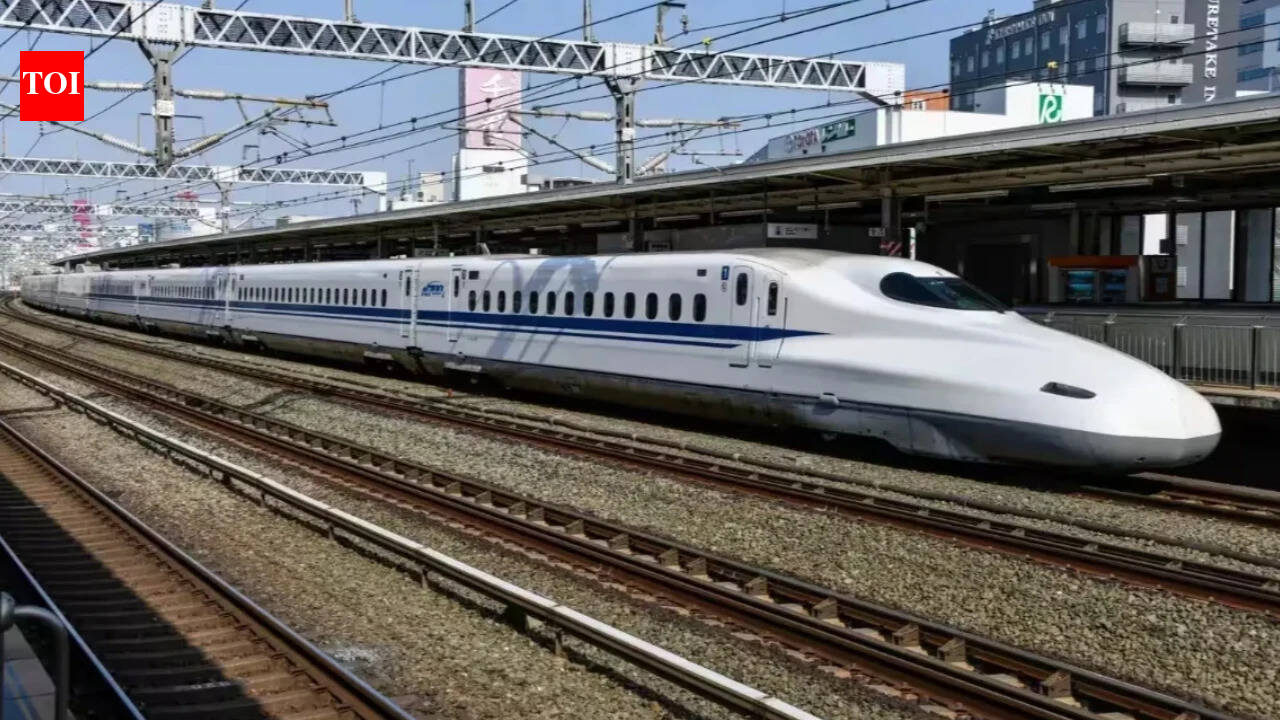
Delhi-Ahmedabad-Mumbai: The missing bullet train link between India’s major economiesImagine covering nearly 1,400km between Delhi and Mumbai in under six hours, instead of the 15 hours 40 minutes taken by the fastest regular train currently connecting the two cities.The prospect remains a long-term possibility, not an announced travel-time target. But it points to a larger question about India's bullet train ambitions: If high-speed rail is intended to connect major economic centres, why does the proposed Delhi-Ahmedabad corridor — a potential extension of the Mumbai-Ahmedabad bullet train line towards the national capital — remain outside the list of new corridors?The proposed Delhi-Ahmedabad corridor and the under-construction Mumbai-Ahmedabad line could eventually form parts of a larger high-speed rail network.The first would connect Delhi and the National Capital Region with Rajasthan and Gujarat, while the second is being built to link Ahmedabad with Mumbai, India's financial capital.Together, they could create a high-speed passenger corridor connecting some of western and northern India's largest urban and commercial centres. But that would require the Delhi-Ahmedabad project to move beyond planning, along with further decisions on network integration and a direct Delhi-Mumbai service.For now, the contrast is stark. The Mumbai-Ahmedabad High-Speed Rail corridor is under construction, while Delhi-Ahmedabad has yet to become a sanctioned project under execution.: A potential high-speed rail connection spanning nearly 1,400km could cut travel time from the 15 hours 40 minutes taken by the fastest regular train currently connecting the two cities.Delhi-Ahmedabad: The missing linkThe proposed Delhi-Ahmedabad high-speed rail corridor is envisaged as an approximately 886km route, with a journey time of less than four hours. The National High Speed Rail Corporation Limited (NHSRCL) has drawn up the detailed project report, and 15 stations have been proposed across Delhi, Haryana, Rajasthan and Gujarat. However, the corridor remains in the planning stage and is likely to take shape only in the latter half of the decade.Manesar and Rewari are the two proposed stations in Haryana. The route will originate at Dwarka Sector 21 in Delhi and enter Gurgaon at Chauma. It will run along the Dwarka Expressway up to Ramprastha City in Sector 37D before turning towards the Delhi-Jaipur railway line. The alignment will cross the KMP Expressway before joining the Delhi-Jaipur highway at Shahjahanpur toll plaza, near the Haryana-Rajasthan border.The 15 proposed stations are Dwarka in Delhi; IMT Manesar and Rewari in Haryana; Behror, Shahpura, Jaipur, Ajmer, Vijaynagar, Bhilwara, Chittorgarh, Udaipur and Dungarpur in Rajasthan; and Himmatnagar, Gandhinagar and Ahmedabad in Gujarat.The entire corridor is proposed to be elevated. At present, a train journey between Delhi and Ahmedabad takes around 14 hours. The proposed bullet train could reduce this to less than four hours.Explaining the choice of alignment, an NHSRCL official told TOI, "We have chosen this alignment (along the rail line and highway) to ensure that land acquisition is minimal. In such mega projects, maximum time gets spent in acquiring privately owned land. While the alignment is final, acquiring land is yet to begin."The official said the preparatory work would itself take considerable time before construction could begin.The corridor was among the early routes considered in India's bullet train plans, after Mumbai-Ahmedabad. However, the two projects are at very different stages. Mumbai-Ahmedabad has moved into construction, while Delhi-Ahmedabad has not received the same implementation push.The omission is significant because Delhi-Ahmedabad could serve a wider purpose than simply reducing travel time between two cities. It could become the missing northern link in a broader high-speed passenger connection between Delhi, Rajasthan, Gujarat and Mumbai.Budget 2026-27 announced seven new high-speed rail corridors, including Delhi-Varanasi, but did not include Delhi-Ahmedabad.That does not mean the route has been formally abandoned or that its revival has been ruled out. But without project sanction, a firm implementation plan and construction, the corridor remains an ambition rather than an imminent transport alternative.Why connecting the economic centres mattersThe economic case for high-speed rail is not limited to faster journeys. Reliable, frequent connections between major cities can make it easier for businesses to operate across regions, improve access to jobs and education, and enable people to travel between commercial centres without spending most of a day in transit.Delhi and the National Capital Region are major centres of government, services, trade and corporate activity. Ahmedabad and Gujarat form part of a significant industrial and commercial belt, while Mumbai remains a major financial centre and gateway for domestic and international business.A connected Delhi-Ahmedabad-Mumbai high-speed rail network could bring these economic regions closer in practical terms. It could make same-day business travel easier, improve access to skilled workers and strengthen links between companies, suppliers and service providers.The benefits would depend on more than speed alone. Station locations, service frequency, ticket prices, local transport connections and the time required to reach stations would all influence whether passengers and businesses actually use the network.Delhi-NCR, Ahmedabad-Gujarat and Mumbai could benefit from faster business travel, improved access to jobs and skilled workers, and stronger links between companies and markets.The corridor could also improve connectivity for cities between the largest metropolitan centres. If stations are well integrated with local transport and economic hubs, places along the route could gain better access to larger markets and employment centres.However, these are potential benefits, not guaranteed outcomes. They would depend on the final alignment, the services offered and the wider development of the cities connected by the line.A passenger network with a wider economic purposeThe comparison with India's freight corridors helps explain the larger infrastructure argument.The Eastern and Western Dedicated Freight Corridors were developed to improve the movement of goods, increase freight capacity and reduce pressure on heavily used conventional railway routes. The Western Dedicated Freight Corridor links the Delhi-NCR region with the Jawaharlal Nehru Port area near Mumbai, strengthening the movement of cargo between industrial and consumption centres and a major port.A Delhi-Ahmedabad-Mumbai bullet train connection would serve a different purpose. Freight corridors move goods; high-speed rail is designed primarily for passengers. But both reflect the importance of dedicated infrastructure that connects economic centres more efficiently.First bullet train service expected in August 2027The road network offers another comparison. The Golden Quadrilateral connected Delhi, Mumbai, Chennai and Kolkata through a major highway network, improving road links between some of India's largest urban and commercial centres.A high-speed rail network would not replace highways or freight routes, but will add another layer of connectivity for passenger movement.The underlying principle is similar: transport infrastructure can support economic integration when it reduces the time, cost and uncertainty involved in moving people or goods between regions.For bullet trains, the challenge is to ensure that major corridors connect into a coherent network rather than remain isolated projects. A Delhi-Ahmedabad line linked operationally with Mumbai-Ahmedabad could be an important step in that direction, provided the government decides to pursue such an extension.India’s first Bullet Train: Inside the Bharat-made train being developed for Mumbai-Ahmedabad corridorMumbai-Ahmedabad is moving; Delhi-Ahmedabad is notThe 508km Mumbai-Ahmedabad High-Speed Rail corridor is India's first dedicated bullet train project. It is being developed with Japanese technical and financial assistance and is planned to have 12 stations across Maharashtra, Dadra and Nagar Haveli, and Gujarat.The line is designed for speeds of up to 350kmph, with an operational speed of 320kmph. The fastest services are expected to cover the route in around two hours. In July 2026, the government said the first service was expected to begin in August 2027 on the Surat-Vapi section. The full corridor is a separate, longer-term undertaking.The project has faced delays, including challenges over land acquisition in Maharashtra, and its costs have risen substantially from the original estimate. Nevertheless, construction is under way, making it the country's only sanctioned high-speed rail project under execution.Delhi-Ahmedabad has not reached that stage. Even if a detailed proposal exists, moving from planning to implementation would require decisions on the project report, financing, alignment, land acquisition, clearances and construction.This is why the two routes cannot yet be treated as one continuous bullet train service. A future Delhi-Mumbai connection would require more than the completion of the existing Mumbai-Ahmedabad line: the Delhi-Ahmedabad project would have to be taken forward, and a through-service and its operating arrangements would need to be established.Could the Gujarat election put the corridor back in focus?The next Gujarat Legislative Assembly election is scheduled for December 2027. The Delhi-Ahmedabad corridor could become a subject of renewed political and infrastructure debate in the run-up to the election, particularly because Gujarat is central to both the proposed Delhi-Ahmedabad link and the under-construction Mumbai-Ahmedabad bullet train project.A project connecting Ahmedabad with Delhi could be presented as a further expansion of Gujarat's links with major economic centres. It could also fit into a broader pitch around investment, industrial development and connectivity.The more immediate question is whether the Centre will move the corridor forward through the required project and financing decisions.Seven new corridors — but Delhi-Ahmedabad is missingBudget 2026-27 announced seven new high-speed rail corridors as “growth connectors”, aimed at improving regional connectivity, supporting tourism and investment, and encouraging a shift from road and air travel to rail. Delhi-Varanasi was included, but Delhi-Ahmedabad was not.The announcement points to a broader ambition to connect major urban and economic centres through high-speed rail. Yet it also raises questions about sequencing: which corridors should be prioritised, how they would connect with one another, and how the government intends to finance a capital-intensive network.The Railway Ministry has cautioned that sanctioning a high-speed rail project depends on the outcome of detailed project reports, technical and economic feasibility and the availability of resources. Therefore, the seven announced corridors should not automatically be treated as projects that are ready for construction.Delhi-Ahmedabad's absence does not prove that it has been permanently shelved.But it does mean the corridor currently lacks the same political and administrative momentum as the newly announced proposals and the Mumbai-Ahmedabad line under construction.If the objective is to build a network that connects major economies, the question is not only how many corridors are announced, but how they fit together and which missing links are necessary to make the wider network useful.The missing link is about more than speedA Delhi-Ahmedabad high-speed rail corridor could eventually connect the national capital with Rajasthan and Gujarat, while the Mumbai-Ahmedabad line would bring Ahmedabad closer to Mumbai.If both are developed and integrated into a wider network, they could form the basis of a faster passenger connection between Delhi and Mumbai.
Delhi-Mumbai bullet train: The missing link between India’s major economy
Full Article
Original Source
Read the full article at Timesofindia →KhanList aggregates and links to publicly available news content. We do not host full articles from third-party sources. Always verify important information with original sources.