
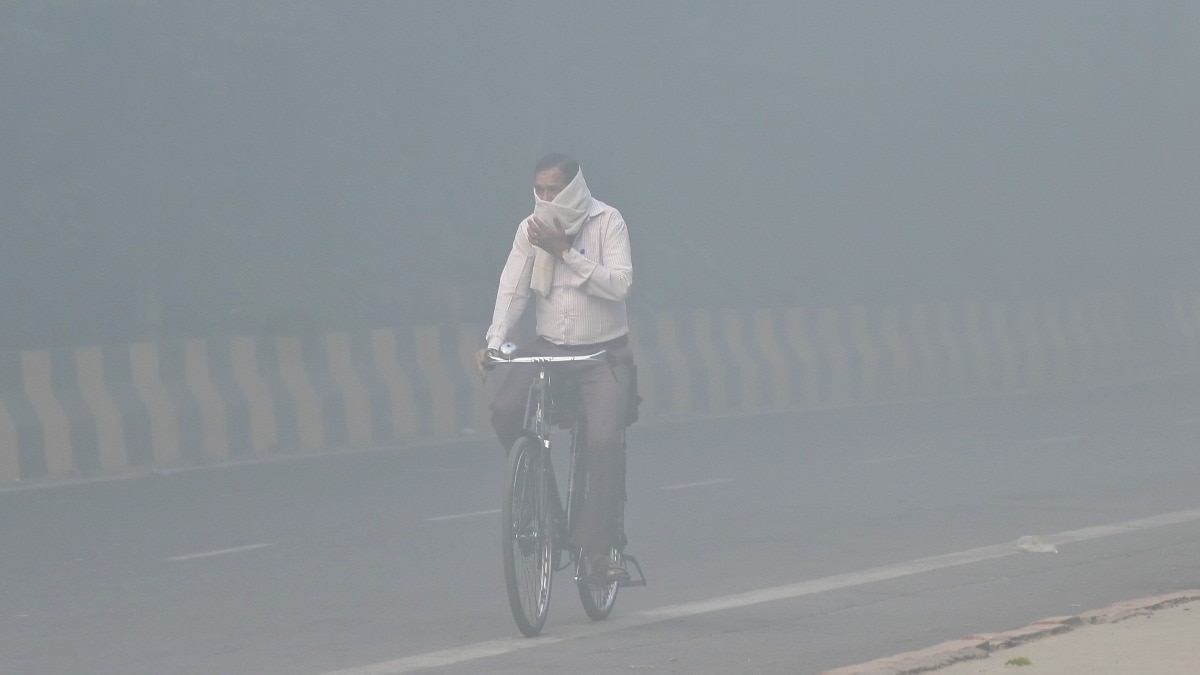
Delhi's air pollution is worsening, with fine particulate matter reaching nearly 20 times the safe limit recommended by the World Health Organisation (WHO).PM2.5 levels stood at 296 micrograms per cubic metre at 9:30 am on Friday, according to AQI.in data, raising concerns over the health risks posed by the toxic air. People stroll amid a thick layer of smog in New Delhi. (Photo: PTI) The AQI, meanwhile, breached the 400 mark and waded into the 'Severe' category as per CPCB, with some places in the capital nearing an AQI of 500.WHAT IS PM2.5?PM2.5 refers to tiny airborne particles that measure 2.5 micrometres or less in diameter. To understand just how small they are, a human hair is roughly 30 times wider than one of these particles. What makes PM2.5 particularly dangerous in that miniscule size. Unlike larger dust particles, which are more likely to get trapped in the nose or throat, PM2.5 can travel deep into the lungs, causing damage over time. A graph illustrating Delhi's PM2.5 levels in the last 24 hours. (Photo: AQI.in) Some of these particles can even enter the bloodstream, allowing them to affect other parts of the body. Breathing in high concentrations can irritate the airways, worsen asthma and other respiratory conditions, and increase the risk of heart and lung diseases, strokes and lung cancer. Long-term exposure has also been linked to premature deaths. An elderly man walks on a road while wearing a face mask after air quality deteriorates. (Photo: PTI) The WHO recommends that the 24-hour average concentration of PM2.5 should not exceed 15 micrograms per cubic metre.Delhi's reading of 296 micrograms per cubic metre at 9:30 am was therefore nearly 20 times that guideline. However, this is a comparison of a live reading with a 24-hour benchmark, rather than two measurements taken over the same period.That, however, doesn't make the rising pollution any less concerning. Dense smoke billows into the sky as a farmer burns paddy stubble. (Photo: PTI) FARM FIRES BRING POLLUTIONSmoke from crop-residue fires in Punjab and Haryana is adding to Delhi's pollution.To make matters worse, northwesterly winds are carrying smoke towards the capital, while weak winds closer to the ground are making it harder for pollutants to disperse.LOCAL EMISSIONS ADDING TO THE HAZEFarm fires are only one part of the problem.Vehicle exhaust, industrial emissions, construction dust, waste burning and other local sources also contribute to the pollution burden. Vehicles move on road amid a thick layer of smog. (Photo: PTI) When these emissions combine with unfavourable weather conditions, pollutants can remain concentrated close to the ground.With no immediate weather system expected to bring rain or significantly improve dispersion, Delhi's air quality remains vulnerable to further deterioration.- Ends
Delhi breathes poison: PM2.5 remains 20 times higher than the safety limit
Full Article
Original Source
Read the full article at Indiatoday →KhanList aggregates and links to publicly available news content. We do not host full articles from third-party sources. Always verify important information with original sources.