
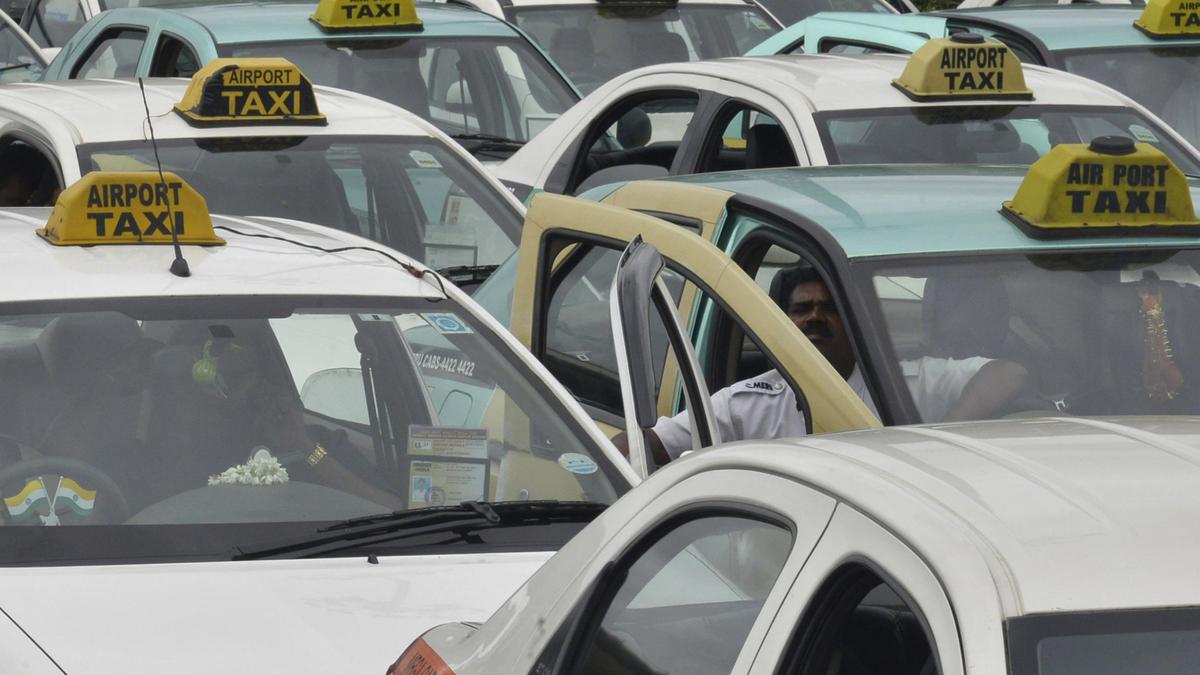
The number of taxis ferrying passengers from neighbouring states to the Indira Gandhi International Airport (IGI) in Delhi has plunged by nearly 80% following restrictions on the entry of vehicles that do not meet BS-VI emission standards. The curbs have left operators struggling with mounting losses and drivers facing the prospect of unemployment.Taxi operators from Punjab, Chandigarh, Uttarakhand, Rajasthan and Uttar Pradesh, with whom The Hindu spoke, said airport trips, which once accounted for a substantial share of their business, had fallen sharply. Several reported losses of 50–70%. With the restrictions expected to remain in place for four months, operators fear the financial strain will worsen as their vehicles remain parked and they struggle to meet loan instalments and contractual commitments.Sanjay Samrat, president of the Delhi Taxi and Tourist Transporter Association (DTTTA), said more than one lakh commercial vehicles from neighbouring states travelled to the Delhi airport every day before the restrictions came into force. The number has now fallen to fewer than 20,000.“Drivers are facing the threat of unemployment, while operators are dealing with losses. Vehicles coming from neighbouring states to ferry passengers to the airport have reduced drastically. Aggregators are benefiting as passengers are forced to switch to other modes of transport, including buses and trains, to reach Delhi, and then book cabs for the airport,” Mr. Samrat said.The impact is particularly evident in Punjab, where airport transfers account for a significant share of the taxi business, driven by passengers travelling abroad for education and work, as well as non-resident Indians visiting the State.Parminder Singh, a transport operator from Delhi, said he earlier had 20–25 cars coming from Punjab to Delhi every day. The number has now dropped to just two or three, as most of the vehicles do not meet BS-VI standards.Varinder Singh, owner of Punjab-based Veerji Taxi, which operates across Punjab, Rajasthan, Jaipur, Delhi and Chandigarh, said at least 10–15 of his 25 vehicles would earlier make trips to the Delhi airport every day. Now, only one or two manage to do so. With much of his clientele comprising passengers catching international flights, the restrictions have wiped out nearly 60% of his business, he said.“The situation is really bad. We don’t have a lot of corporate clientele in Punjab; the business is driven by Delhi-bound travellers. Our cars are parked here, and we are paying their EMIs from our own pockets. We are not coming to Delhi because of the restrictions,” he said.Baldeep Singh Sethi of RS Travels, an Uttarakhand-based cab operator, said his company earlier sent around 30–40 vehicles to Delhi every day, largely to ferry passengers to and from the airport. The number of its own vehicles making the journey has now fallen to 15–20, forcing him to outsource the remaining trips to other operators to avoid turning away customers.“Even when we manage to retain a customer, outsourcing the trip means the payment goes to another operator instead of helping us recover the cost of our own grounded vehicles. Sometimes, we have to pay more than what we are contractually committed to, which adds to our losses,” he said, estimating a business loss of at least 50%.Baljinder Singh, a driver, said the restrictions effectively threatened to phase out commercial taxis before they completed their permitted 10-year lifespan.“BS-VI vehicles were introduced only in 2020. It has been just six years, and BS-IV vehicles are now being stopped from entering Delhi even before their permitted lifespan is over. Four months without work is a serious blow to drivers who depend on these trips for their livelihood,” he said.Some operators and drivers are also finding ways around the restrictions to complete airport transfers.Kulwant Singh said drivers from neighbouring States were bringing passengers in BS-IV vehicles up to the Delhi border, where passengers and their luggage were transferred to another compliant vehicle for the onward journey to the airport.“Some drivers wait at Murthal. The passengers and their luggage are transferred to another car, which takes them to the airport. The two parties then divide the fare according to the distance travelled. But this is not always possible,” he said.Delhi Traffic Police officials said teams had been stationed at multiple points around the airport to ensure compliance with the restrictions. Vehicles found violating the entry curbs are being issued challans of ₹20,000, they said.Passengers feel disruptionArushi Bhatia, a Chandigarh resident who was trying to book a shared cab to her workplace in Delhi on Saturday, said she usually had no difficulty finding an affordable shared taxi travelling from Punjab to the Delhi airport. This time, however, the operators she contacted told her that no vehicles were making the trip, leaving her with little choice but to take a bus.Harsh Ahuja, another commuter whose family had come to drop him at the Delhi airport after the Deepavali break, said his regular taxi operator had to refer him to another operator with a BS-VI-compliant vehicle.“We have a certain trust in our regular taxi operators and prefer travelling with people we know. But they are now unable to take these trips because of the restrictions and are having to refer customers elsewhere,” he said.The DTTTA has announced a march to the Delhi Secretariat on November 17. The association is opposing, among other measures, restrictions on BS-IV diesel taxis and buses, hefty challans and the financial burden of installing panic buttons and vehicle location tracking devices.Mr. Samrat said the protest was aimed at drawing attention to the livelihood concerns of operators and drivers, many of whom depend on interstate airport transfers for their income.
Delhi airport taxi trips from neighbouring states plunge 80% amid BS-VI curbs
Full Article
Original Source
Read the full article at Thehindu →KhanList aggregates and links to publicly available news content. We do not host full articles from third-party sources. Always verify important information with original sources.