
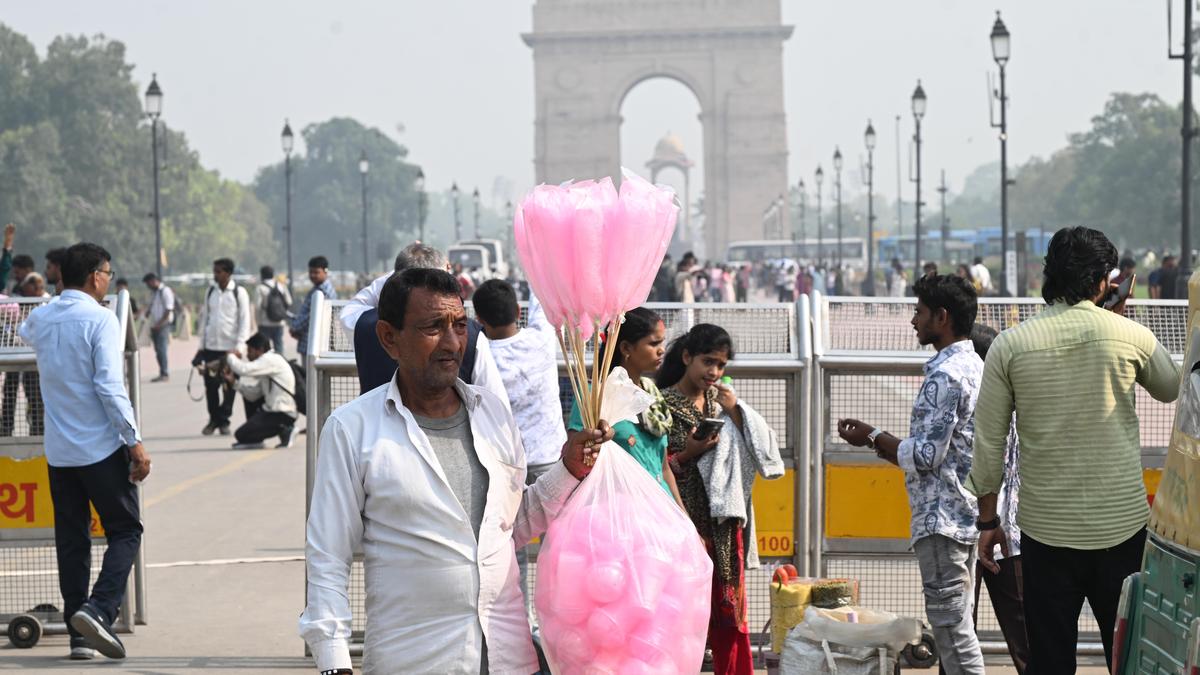
With the Air Quality Index (AQI) crossing 400 at some locations in Delhi, people whose work keeps them outdoors for long hours say they are experiencing breathing difficulties, persistent cough, headaches and burning eyes, often without adequate protection against pollution. For traffic police personnel, domestic workers, roadside vendors, mechanics and gig workers, staying indoors is rarely an option. Yogendra Kumar, a traffic inspector posted in outer north Delhi, said pollution-related health risks for traffic personnel persists throughout the year but increases significantly when air quality deteriorates. “The impact on health is inevitable in the outskirts, as road dust also contributes to pollution alongside emissions. We have no safeguards apart from masks. Prolonged exposure causes breathing problems and a persistent cough,” he said. Reena Chaudhary, a domestic worker in Palam Colony, said she began experiencing breathing difficulties on the night before Deepavali, with her symptoms worsening on the festival day. “I leave home around 7 a.m. and return by 9 p.m. I began having headaches and burning eyes the day before Deepavali, particularly while passing through smoke-filled lanes between houses at night. On Deepavali, my condition worsened. I felt dizzy throughout the day, had a persistent cough and just wanted to lie down. But who would work if I did?” she said. Ms. Chaudhary said she had to walk through smoke on Deepavali night with her dupatta wrapped around her face. Since then, she has been taking her daughter along in case she falls ill and is unable to work. Ravi, a 21-year-old gig worker who attends college during the day, said he works through the night, picking up rides across the city to support his family. “Even at night, I can see that the air is dense and heavy. At times, I have to stop near a green area, such as Vande Mataram Marg, just to be able to breathe,” he said. Mukesh Yadav, an e-rickshaw driver in Palam, said road dust remains a problem throughout the year, apart from smoke from firecrackers and vehicular emissions. “The area remains dusty even on normal days. Since Deepavali, I have been tying a towel around my face,” he said. Mr. Yadav works eight to 10 hours a day, making several trips between Palam metro station and Kailashpuri, a one-kilometre stretch that witnesses heavy traffic. “The only time I am not outdoors is when I am charging my e-rickshaw. I thought my cough was due to the cold, but everyone seems to be coughing, even the passengers. It could be due to pollution,” he said. A study by the Centre for Science and Environment states that time-bound restrictions on vehicles has failed to ease traffic congestion, with nitrogen dioxide, a marker of vehicular pollution, accumulating during the evening and remaining elevated until midnight, even after traffic had eased. | Photo Credit: ANI ‘Pollution higher this year’ An analysis by the Centre for Science and Environment (CSE) found that Delhi’s average PM2.5 concentration in the week preceding Deepavali reached 236 micrograms per cubic metre, the highest in three years. This was 97% higher than the 120 micrograms per cubic metre recorded in 2025 and 32% above the 179 micrograms per cubic metre recorded in 2024. The study also found that time-bound restrictions on vehicles had failed to ease traffic congestion, with nitrogen dioxide, a marker of vehicular pollution, accumulating during the evening and remaining elevated until midnight, even after traffic had eased. “Deepavali pollution is an annual tipping point, but elevated particulate levels before the festival this year show that baseline pollution is higher than in previous years,” said Anumita Roychowdhury, executive director (research and advocacy) at the CSE. She said cleaner air ahead of winter and measures to contain episodic pollution spikes from farm fires and firecrackers could have prevented such severe pollution during seasonal weather changes.
Delhi air pollution: Outdoor workers report breathing difficulties, cough and burning eyes as AQI worsens
Full Article
Original Source
Read the full article at Thehindu →KhanList aggregates and links to publicly available news content. We do not host full articles from third-party sources. Always verify important information with original sources.