
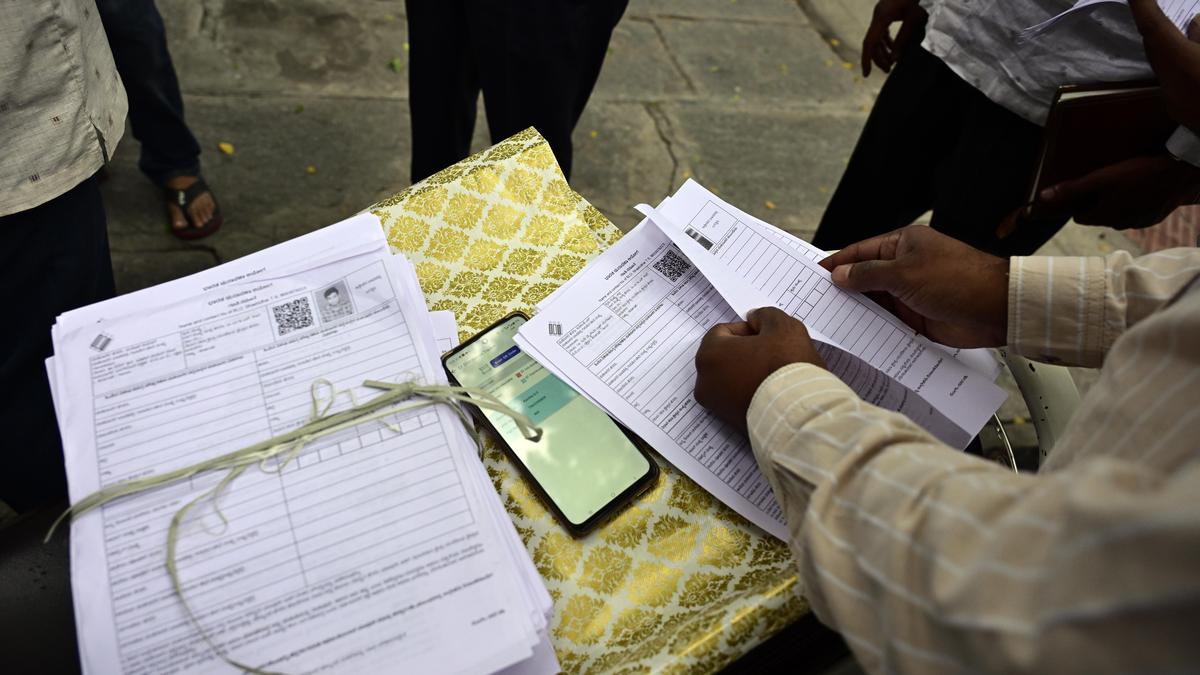
The Booth Level Officers (BLOs) visiting every household and distributing enumeration forms as part of the Special Intensive Revision of the Voters’ List-2026 in Bengaluru on Tuesday 30 June 2026. | Photo Credit: SUDHAKARA JAIN The draft electoral rolls released after the enumeration phase of the Special Intensive Revision (SIR) exercise in Telangana and Karnataka have not only raised concerns of aggressive deletions, but analysis indicates wide variations and arbitrariness in the reasons given for the deletion of names.The two States have seen the highest share of deletions in the draft SIR rolls among the major States. Telangana and Karnataka, which had 3.38 crore and 5.54 crore electors before the SIR respectively, saw roughly one-fifth of their rolls getting culled. The Hindu has reported on the alarming levels of deletions in many of the constituencies in the two States.A reason-wise analysis of the data showed extremes in the application of the four broad reasons cited for deletions — Shifted (or Permanently Shifted), Absent, Deceased, and Duplicate.Before discussing the apparent arbitrariness of the application of these reasons, it is to be noted that the Election Commission (EC) has not offered clarity in any of its SIR-related notifications about when the officials — particularly the Booth-level Officers (BLOs) working on the ground — should mark an elector as ‘Shifted’ and when as ‘Absent’ . The EC’s Manual on Electoral Rolls (2023), which is supposed to be the rule book to follow for all types of electoral roll revision, states that “an absentee voter is that person who is found to be absent for a limited period from place of his ordinary residence where he is enrolled as an elector. An absentee may be with family or without family. But his name cannot be deleted, as in the existing law, a person absenting himself temporarily from his place of ordinarily residence shall not, by reason thereof, cease to be ordinarily resident therein.” This definition raises the question as to whether an elector found to be ‘Absent’ during enumeration should be deleted in the first place.Interestingly, the EC has never officially made public the breakdown of ‘Shifted’ and ‘Absent’ in total deletions. It has combined the two categories and presented only the aggregate numbers for every State where the SIR has happened. The breakdown has been derived by journalists and members of the civil society by processing the thousands of lists containing details of deleted electors.The table below shows a few constituencies from Telangana which stand out as examples of the inexplicable application of reasons for deletions.The table below shows a few such constituencies from Karnataka.For instance, both Jubilee Hills and Nizamabad (Urban) are urban constituencies of comparable size in Telangana. Of the 1,79,510 names deleted in Jubilee Hills, 1,48,859 (83%) were marked as ‘Shifted’, but only 15,000 were found to be ‘Absent’. In Nizamabad (Urban), however, of the 83,282 deletions, officials found 50,307 to be ‘Absent’. The outlier case was the reserved constituency Nakrekal (SC), where 20,169 names were deleted, but not a single person was found to be ‘Absent’.In Karnataka, Hebbal saw 1.3 lakh deletions, of which an astounding 1.14 lakh (87%) were marked as ‘Shifted’, but only 287 were found to be ‘Absent’. The Hubli-Dharwad-East constituency, in contrast recorded, roughly 25,000 of its 47,000 as ‘Absent’. Bommanahalli saw 2.65 lakh deletions, which is 54.8% of its electorate. However, only about 9,700 were found to be deceased.A coherent and uniform application of a well-defined enumeration exercise is unlikely to show such extremities. Published - August 27, 2026 05:00 pm IST
Deletions in recent SIRs suggest arbitrary application of reasons
Full Article
Original Source
Read the full article at Thehindu →KhanList aggregates and links to publicly available news content. We do not host full articles from third-party sources. Always verify important information with original sources.