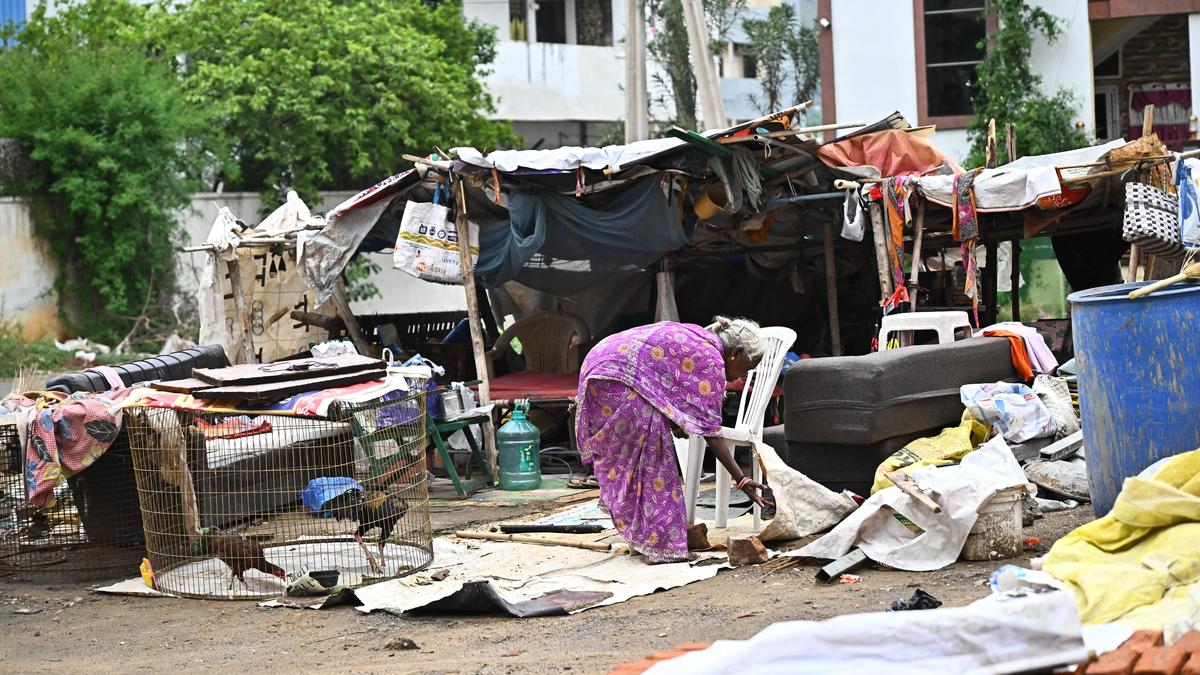
Sandhya, in her 40s, insists she completed every dose of medication prescribed for her tuberculosis (TB) treatment. Yet, as she sits crouched outside her mud house in a remote tribal hamlet near Paderu in Alluri Sitharama Raju district, her frail frame makes her appear decades older than her age.Her struggle extends beyond the disease itself. Like, many other TB patients in the State, Sandhya has been waiting for financial assistance meant to support her through treatment, exposing the consequences of delays in disbursing aid to some of the most vulnerable patients.The disease is just one of the many hardships she carries. Sandhya, who was diagnosed with pulmonary TB in December 2025, is dependent on her elder daughter, the sole breadwinner for their family of four—Sandhya and her three children.Sandhya was placed on a regimen for drug-sensitive TB (DS-TB), which lasts for six months and includes four drugs. Her claim of completing the treatment, however, is denied by her neighbours, who say she stopped her medication in the second month after severe stomach pain made it difficult for her to continue.Even as neighbours urge Sandhya to seek treatment at the Primary Health Centre, nearly 10 km away, she denies. “I cannot make the journey,” she says softly, her voice fading into the breeze before she can finish her sentence.For Sandhya, who belongs to a Particularly Vulnerable Tribal Group (PVTG), getting nutritious food and visiting a doctor are uphill tasks. The hamlet, home to 200 individuals, sits on a hillock, accessible only by a muddy, unpaved road. There is no school or anganwadi within 5 km of the hamlet, and the nearest shop is 2 km away, making eggs or milk a once-a-month indulgence.Distance is only one part of the problem. Sandhya’s family survives on her elder daughter’s income of only ₹100 or ₹150 per day, which she earns when she finds work in an agricultural field. On other days, the family has no income to sustain themselves.“All she can afford is ragi ambali for breakfast and rice with chaaru for lunch and dinner,” says Satya, her neighbour and also the caretaker for those in need of medical assistance in the absence of an Accredited Social Health Activist (ASHA). The villagers say that ASHA worker from a nearby village visits only in times of need.Healthcare workers point out that stomach irritation is considered one of the common side effects of anti-TB drugs. They recommend higher fluid intake and a proper diet to minimise gastrointestinal issues, and a consultation with a doctor is also suggested for further complications.“Nutrition has a direct role to play in determining treatment outcomes for a patient, and undernutrition, as is the case with Sandhya, creates the most favorable condition for the disease to progress, increasing the risk of death by four to five times,” says Dr. Swathi Krishna, a public health physician and TB researcher based in Maharashtra.Now, seven months after the discontinuation of her medications, Sandhya is burning with fever and experiencing body aches. The discontinuation of anti-TB drugs may lead to a relapse of the illness, and the condition may progress into a more serious form of TB, known as multidrug-resistant TB. However, this cannot be confirmed until Sandhya visits a hospital.A medical expert working with an NGO who assessed Sandhya’s condition says she may not live long if she does not immediately resume her medications and eat properly.Dr. Swathi Krishna says that a Body Mass Index of less than 18.5 should be considered a definite criterion for admitting patients to hospitals; Sandhya mostly falls into this category. “But this crucial risk factor is often missed at the time of diagnosis,” she adds. The absence of crucial financial support has left many TB patients in a lurch, with the impact felt among people living in remote and underdeveloped regions | Photo Credit: K.V.S. GIRI Government schemeAccording to the WHO’s Global TB Report 2025, India has the highest number of TB cases in the world and accounted for 28% of the deaths due to TB globally. As of July 3, 2026, Andhra Pradesh had reported 37,130 TB cases. Tuberculosis, caused by the bacillus Mycobacterium tuberculosis, is often referred to as the disease of the poor. As long as there is poverty, data shows, the disease will thrive.In response to such concerns, especially poverty and undernutrition, among people from the economically backward sections of the society, the Union government launched the Nikshay Poshan Yojana in 2018, under which all notified TB patients would receive ₹500 per month during the course of their six-month treatment. In 2024, this amount was increased to ₹1,000 per month, which is funded by the Union and State governments in a ratio of 60:40. However, many patients in Andhra Pradesh have not been receiving this amount for at least six months or more.When asked about the payment delays, A.P. State Nodal Officer T. Ramesh said that updating the payment platforms had been causing delays in depositing the amount since December 2025, but the process would be streamlined soon. He added that payment was made to nearly 29,000 patients in March.The absence of this crucial support has left many TB patients in a lurch, with the impact felt among people living in remote and underdeveloped regions such as Sandhya’s.Sandhya’s ordeal is not an isolated one. This reporter spoke with five TB patients from Alluri Sitharama Raju, NTR, Chittoor, and Eluru districts and identified seven others who said they had not received financial aid. One patient, who began treatment in May 2025, said they did not receive the financial support or the nutritional kit.The experience is no different for Lakshmi, a 37-year-old farmer. A resident of another tribal hamlet in ASR district, she was diagnosed with extra pulmonary TB in June of this year. When asked about her nutritional intake, she says having milk or eggs or even vegetables is a luxury.Her ordeal, however, began long before the diagnosis. Multiple visits to the Government General Hospital in Paderu finally led to the confirmation of TB. A bit hesitant to share her experience at first, she later opens up and shares that she has had cold abscesses on her neck and chest for more than three years. She claims that no one could figure out what was troubling her.“They hurt a lot sometimes,” she says when asked if she is able to do her everyday work. But that does not stop her from going to the agricultural field. The family does not have a regular income but has an acre of land where they grow paddy, carrots, and turmeric. While paddy is for their own consumption, they sell turmeric and carrots in November and December every year. The amount they earn from this sustains them for the rest of the year. “Sometimes, we receive a good amount, like ₹20,000,” says Lakshmi.Nutritional supportAccording to research by medical expert Anurag Bhargava and others, titled “Nutritional Supplementation to Prevent Tuberculosis Incidence in Household Contacts of Patients with Pulmonary Tuberculosis in India (RATIONS): A Field-Based, Open-Label, Cluster-Randomised, Controlled Trial,” supplementation with micro- and macronutrients for six months is effective in substantially reducing the incidence of confirmed tuberculosis in a group at high risk due to close contact with an infectious person and a high prevalence of undernutrition.Based on these studies, the Union government emphasised the nutritional aspect in the treatment of TB. In 2022, with this aim, the government introduced the Ni-kshay Mitra initiative. Under which, the government encouraged the public and corporations to come forward and donate nutritional baskets to TB patients, in an effort to promote public participation in the national efforts to eliminate TB.While many donors had enrolled as ‘Mitras’ in the first year of the programme’s launch, the initiative soon fizzled out as donor fatigue set in. Dr. Ramesh, the State TB Officer, says that more than four lakh food baskets have been distributed between 2022 and July 2026 in A.P.The statistics, however, indicate that each patient requires six baskets—one per month—meaning that four lakh baskets would support more than 66,000 patients. This number is fewer than the cases reported in the State in a single year, specifically 2025.According to a frontline health worker in Annamayya district, securing a donor has become a difficult task, and the government has now shifted the responsibility of motivating the public onto them. “Even health staff at the Primary or Community Health Centre do not come forward to donate food baskets. How can we motivate the public?” the worker asks.Dr. Anand Zachariah, a senior professor in the Department of Medicine at Christian Medical College in Vellore, says that the main problem with ‘Ni-kshay Mitra’ is its complete dependence on donors. “The scheme is structured in such a way that only the chosen ones receive the support. Social welfare programmes cannot be based on donors or voluntary contributions,” he says.Not just in remote areas; donors are not easily secured in cities like Vijayawada either. According to frontline health worker Divya, even if an individual or an NGO donates food baskets, it happens only once or twice a year, and only 10 out of 100 people receive them.She says that in her area, there are five people currently under treatment for TB. None of them have received cash or nutritional baskets, she adds. “Since we are the closest representatives of the government for them, they often look to us for updates on the status of the transactions, and we have no answers,” she says.Chandramma, a 65-year-old street vendor in Vijayawada, recounts her experience after her husband—a rickshaw puller—was put on TB treatment in May 2025. She says she had to make multiple trips to the TB unit at the nearest Community Health Centre and to her bank for updates on the payment. “I was once told that there is no budget with the government,” she says.Chandramma adds, “While he has now recovered, he lost a considerable amount of weight during the treatment and stopped going to work after his diagnosis.” Now, I sell maize and biscuits in front of a school from 8 a.m. to 9 p.m. to make a living. “My earnings per day stay below ₹200,” she adds.“The doctors had told me to take good care of him by providing nutritious food during his treatment, but I could not do much,” she says. With her meagre wages and an old-age pension of ₹4,000, she could only afford to buy him a packet of milk and Horlicks. She also borrowed ₹20,000 to purchase nutritious food for her husband, which she has yet to pay back.While patients and their families recount months of uncertainty and trouble, health officials maintain that digital hurdles are the main cause. When this reporter spoke with ASHAs, Community Health Officers, and TB supervisors from across the State, they stated that digital hurdles, such as the creation of an Ayushman Bharat Health Account (ABHA) ID for TB patients, are the reasons for the delays.“One has to link a patient’s bank details with Aadhaar, then open the Ni-kshay portal and enter the details. Once a QR is generated, we open the ABHA app on another system and scan the QR. Then, the ABHA ID has to be created using the iris of the patient for the face authentication. While in an area with good network, this process takes a maximum of one hour, but in remote areas, it takes up to a week,” says a TB Supervisor from a remote area in Rayalaseema. He mentions that the process is done only for 30% of the patients due to network issues.For TB patients in the State, timely financial support may prove to be as vital for recovery as the medicines and nutrition themselves. While the World Health Organisation’s strategies envision a 90% reduction in TB incidence and a 95% decline in deaths by 2035, Dr. Swathi Krishna says, “The goal can be achieved only if social conditions are improved, including better nutrition and housing, the transmission chain is broken, preventive treatment uptake is increased, and an effective vaccine is found.”(The names of frontline health workers, TB patients, and locations have been withheld/changed to protect them from getting implicated for sharing information)
Delayed aid, prolonged ordeal
Full Article
Original Source
Read the full article at Thehindu →KhanList aggregates and links to publicly available news content. We do not host full articles from third-party sources. Always verify important information with original sources.