
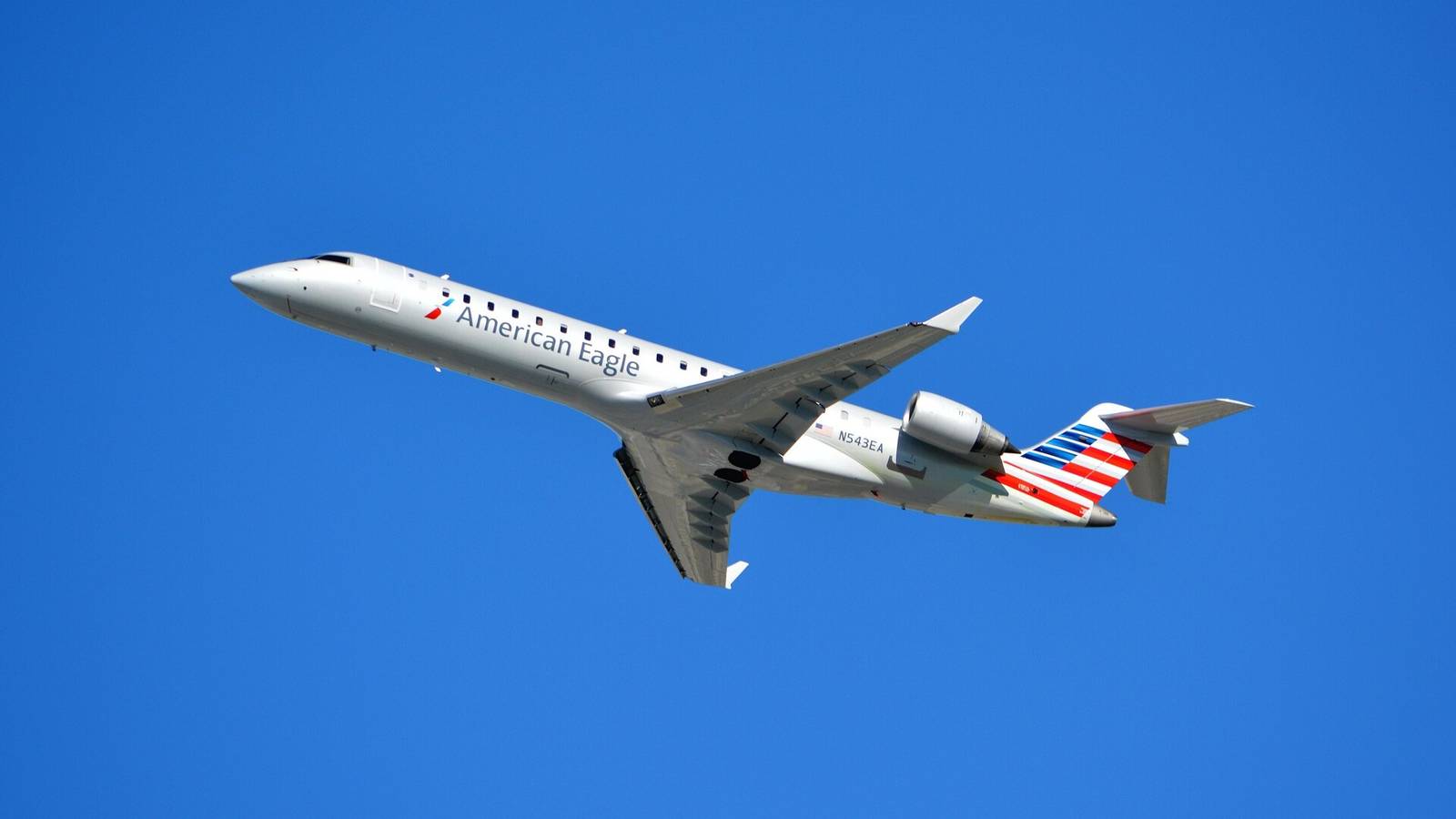
Published Aug 18, 2026, 4:25 PM EDT Paul has had a career of 25+ years focused on the international technology sector, which has taken him to over 100 countries. Along the way, he developed a deep love for aviation, with a travel bucket list measured by aircraft types flown rather than destinations reached. Now he brings that avgeek passion, along with the journalism experience he accumulated early in his career, to write insightful pieces for Simple Flying. Two American Airlines regional jets spent around 26 minutes airborne at the same time with exactly the same flight number and duplicate callsigns, creating a situation in which air traffic controllers had to distinguish between the two aircraft as they approached one another. The August 12 incident involved two Bombardier CRJ-700s from PSA Airlines, operating as American Eagle flight AA5083 between Philadelphia and Providence. If that sounds familiar, there is a good reason. Less than two days later, two American Airlines Boeing 737-800s, both operating as AA2482, encountered essentially the same problem near Phoenix Sky Harbor International Airport (PHX), prompting an FAA investigation. Simple Flying reported how the two 737s ended up on the same frequency as their flight paths converged. Both incidents resulted from a delayed first sector continuing to operate after another aircraft had been substituted for the return flight. Two CRJ-700s Were Both "Bluestreak 5083" Credit: Shutterstock AA5083 is a round-trip American Eagle service between Philadelphia International Airport (PHL) and Providence's Rhode Island T.F. Green International Airport (PVD), which is operated by PSA Airlines, a wholly owned American Airlines Group subsidiary. Although passengers see the AA5083 flight number, PSA's ICAO identifier is JIA and its official ATC telephony designator is "Bluestreak." The aircraft therefore identifies itself to controllers as "Bluestreak 5083" rather than "American 5083." On August 12, the Philadelphia-to-Providence flight, operated by CRJ-700 N527EA, was scheduled to depart at 7:35 PM and arrive at 8:54 PM. Instead, Flightradar24 data shows it was delayed and did not leave Philadelphia until 9:20 PM, ultimately landing in Providence at 10:04 PM. Crucially, American did not wait for N527EA to arrive before operating the return: another CRJ-700, N539EA, departed Providence at 9:38 PM as the same AA5083. AA5083 on August 12 PHL-PVD PVD-PHL Aircraft CRJ-700 N527EA CRJ-700 N539EA Scheduled departure 7:35 PM 9:27 PM Actual departure 9:20 PM 9:38 PM Scheduled arrival 8:54 PM 10:54 PM Actual arrival 10:04 PM 10:39 PM ATC callsign Bluestreak 5083 Bluestreak 5083 Simultaneously airborne 26 minutes That meant the two CRJs were airborne simultaneously from 9:38 PM until 10:04 PM, eventually passing through the same general airspace while using the same callsign on the same frequency. Fortunately, the controller recognized what had happened, warned the crews about the duplicate callsign, and distinguished between "inbound" and "outbound" Bluestreak 5083. This was the textbook response according to the FAA Aeronautical Information Manual: "When aware of similar or identical call signs, ATC specialists must take action to distinguish between the two aircraft and minimize errors." Fortunately, no loss of required separation was reported, and there was no harm to passengers or crew on either aircraft. But remarkably, as One Mile At A Time first reported, the event actually preceded the better-publicized AA2482 incident near Phoenix. The two cases involved different aircraft fleets, but the circumstances that created them were strikingly similar. American 2482 Did Almost The Same Thing Credit: Shutterstock American also uses flight number AA2482 for both round-trip directions from Chicago O'Hare International Airport (ORD) to Phoenix. On August 13, the ORD-PHX flight, operated by 737-800 N946NN, was scheduled to reach Phoenix at 10:43 PM. Weather delays pushed its Chicago departure back by almost two hours, and it ultimately landed in Phoenix at 12:13 AM the following morning. Instead of holding the return service, American assigned another 737-800, N925AN, which departed Phoenix for Chicago at 11:58 PM. That created a 15-minute window in which two Boeing 737s were simultaneously operating as "American 2482." Flightradar24 reported that the arriving aircraft was descending through 11,000 feet as the departing 737 climbed toward 9,000 feet, with both aircraft on the same frequency. The controller began addressing them as "American 2482 on the arrival" and "American 2482 on the departure" while keeping them vertically separated. AA2482 on August 13/14 ORD-PHX PHX-ORD Aircraft 737-800 N946NN 737-800 N925AN Scheduled departure 9:00 PM 11:45 PM Actual departure 10:53 PM 11:58 PM Scheduled arrival 10:43 PM 5:24 AM Actual arrival 12:13 AM 4:56 AM ATC callsign American 2482 American 2482 Simultaneously airborne 15 minutes The FAA subsequently opened an investigation into the incident. American stressed that required separation was maintained throughout, saying the professionalism of the pilots and controllers ensured the issue was identified and addressed safely. Aviation safety expert and former United dispatcher Steve Arroyo told the Associated Press that somebody in the airline's dispatch process likely failed to recognize that both flights would overlap with identical identifiers. The similarity to AA5083 is difficult to miss. In both cases, American intended a single aircraft to fly an outbound-and-return pairing under one flight number. However, the inbound became sufficiently delayed that a second aircraft was brought in to protect the return schedule, but the operational identifier wasn't changed to account for the fact that the original aircraft was still airborne. How Can Two Aircraft Have The Same Callsign? Credit: Shutterstock There is nothing inherently problematic about using the same commercial flight number for successive sectors when they do not overlap. The problem begins when irregular operations change the aircraft sequence. Importantly, the passenger-facing flight number does not have to dictate an identical ATC identifier. FAA rules specifically permit scheduled operators to use a letter as the final character of an aircraft identification — for example, AA5083X — allowing two otherwise identical flights to be distinguished operationally. Controllers also have defenses once a conflict appears. Current FAA procedures require controllers to notify pilots when the same or similar identifications are on the same frequency, avoid abbreviating them, emphasize distinguishing characters and, if necessary, ask an aircraft to use a different callsign temporarily. Controllers must also notify their supervisor when duplicate flight-identification numbers are operating simultaneously in the same sector. Nor is the problem unique to American Airlines. NASA's Aviation Safety Reporting System previously documented two Embraer E170s from an unnamed US airline appearing on the same runway at the same time with the same callsign. The reporting controller said it was the second such occurrence involving that carrier in a week. An older UK Civil Aviation Authority study of 482 callsign-confusion reports found 66% involved aircraft from the same airline, while 27% involved identical callsign suffixes. EUROCONTROL's latest EVAIR analysis says callsign conflicts are a significant enough issue that it provides airlines with a Call Sign Similarity Software Tool, designed to detect and de-conflict risky combinations before they operate. That puts American's unusual week into perspective. Duplicate callsigns are not an American-only phenomenon, but having the same scenario occur twice within days creates the obvious question of whether another safeguard is needed to ensure the third incident is caught before the aircraft ever start moving.
Deja Vu: 2 American Airlines CRJs With Identical Callsigns Nearly Cross Paths
Full Article
Original Source
Read the full article at Simpleflying →KhanList aggregates and links to publicly available news content. We do not host full articles from third-party sources. Always verify important information with original sources.