
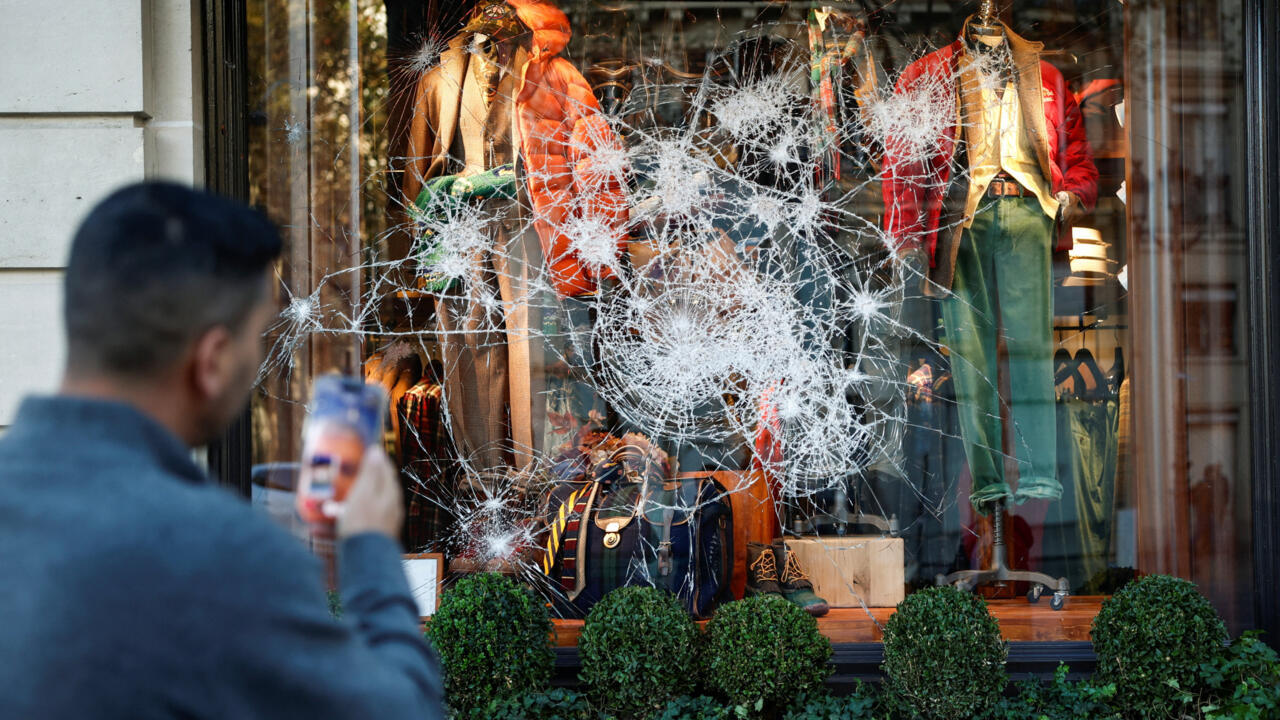
You’ve seen the images by now. The grey husks of cars staining the asphalt with soot. The gutted boutiques spilling their wares onto the street to be snatched up by eager hands. The fires licking the ribs of burning barricades, reaching higher and higher into the skies over Paris. The charred belfry of the Limoges town hall falling into the building’s blazing bowels. Although the overwhelming majority of the public demonstrations against the rising cost of living that swept France on October 17 unfolded peacefully, the riots and looting that broke out on the margins of many of the street marches left the country reeling. While the costs are still being tallied, France’s Chamber of Commerce and Industry has said that almost 2,500 businesses were damaged over the weekend, with more than a thousand of those ransacked, looted or set on fire. The free-market IFRAP Foundation has estimated the nationwide costs at not far short of a billion euros. Hammered on all sides by accusations that it had badly bungled its role in ensuring public order in the face of mass demonstrations, the French government has brought forward a draft bill that would make protesters liable to pay up to €10,000 for damage caused during public demonstrations – even if they were not the people responsible for it. French Senate debates new 'rioters pay' bill To display this content from YouTube, you must enable advertisement tracking and audience measurement. One of your browser extensions seems to be blocking the video player from loading. To watch this content, you may need to disable it on this site. Cover image: BUSINESS © FRANCE 24 03:46 The “make rioters pay” law passed through the right-wing-dominated Senate on Wednesday, and will now be debated in the more divided National Assembly. Although its final form has yet to be determined, the draft law has already raised an outcry from human rights organisations, workers unions and France’s left-wing political parties, who say the bill as it stands today would be an all-out assault on the fundamental right to hold peaceful demonstrations. Other legal experts have also questioned the need for such a law. Laurent Caruso, a criminal defence lawyer and a member of the National Bar Council’s Liberties and Human Rights Commission, said that the French criminal justice system already had ways of making people pay for the damage they’d caused during riots. “If you’ve committed an offence, you may face criminal penalties, or you may have to pay a fine, and the fact that you’ve committed an offence may mean that you may be required to pay for the damage you’ve caused, the destruction and all the resulting consequences,” he said. “So this mechanism already exists – when you’re responsible for something, you pay.” Masked protesters stand next to burning bicycles amid clashes during a demonstration against the cost of living and rising fuel prices in Paris on October 17, 2026. © Jack Taylor, Reuters But putting a name and face to the individuals responsible for the worst property damage after rioters have been driven from the streets is no easy task. To this end, the draft law targets not just individuals found guilty of theft or destruction of property, but people who have “knowingly taken part in” a group formed expressly to carry out acts of vandalism. The law would also apply to people who have remained in public gatherings even after they have been ordered twice by police to disperse. “Under this proposed law, the idea is to broaden out the group of people who could be held liable – people who, although they may not necessarily have taken part in something, are nonetheless liable for it,” Caruso said. “And the aim seems to be that as it is sometimes difficult to identify the people responsible, we’re going to broaden the circle of people who could be held responsible, and we’re going to make someone or other pay. Never mind if you’re not actually responsible – you’ll still pay for what the others did, because you shouldn’t have been there in the first place.” Read more'I didn’t know it was theft': Trials begin in Paris following October 17 violence The draft bill as it stands raises uneasy questions. If the person next to you in a peaceful march starts scrawling slogans on the nearest bus stop, are you now considered part of a group of vandals? How far would you have to walk away from them before you’re no longer financially liable for their actions? Would you have to leave the protest altogether? For that matter, how much time do you have to leave a demonstration once police have given the order to disperse before you’re legally on the hook for everything that follows after? As anyone who has struggled to push their way through a crowd of people kettled in on all sides by armed riot police can tell you, it’s not always as easy as the draft law would suggest. It’s for these reasons that the draft law has come under heavy criticism from rights groups. Amnesty International warned that the law would be “a deeply regressive step” for France. Two of France’s major workers unions, the General Confederation of Labour and the French Democratic Confederation of Labour, on Thursday condemned the draft bill as a profound threat to the fundamental right to non-violent protest. A man rides past a burnt car on a street, a day after clashes during a national day of demonstrations against the cost of living and rising fuel prices, in Paris, France, October 18, 2026. © Stéphanie Lecocq, Reuters Caruso said that the uncertainty engendered by the bill seemed specifically designed to make potential demonstrators think twice before joining a peaceful street march. “The direct consequence is that this is a freedom-destroying law that infringes upon civil liberties, because it is a direct assault on the freedom to demonstrate,” he said. “And the aim is precisely to discourage people so as to avoid having to deal with this sort of situation – given that the state is, after all, a little overwhelmed at the moment.” Read moreFrance faces reckoning with public order policing after violent protest weekend He warned that the law’s broad wording left it open to arbitrary enforcement or even abuse by the police tasked with applying it. “There’s a risk of discrimination too – if you’re a white man in a suit and tie participating in a march, you might not risk much, but if you’re a young person from the housing estates, you might be more easily picked out of the crowd,” he said. “So there’s a risk that this will be arbitrary, and this is what’s murky about the law – and that’s dangerous.” Those who fear the draft law amounts to little less than collective punishment also point to provisions that would see people’s social benefits seized to cover the cost of damages caused during outbursts of street violence. Financial assistance for low-income households, housing assistance and the minimum income that France’s poorest people are entitled too could all partially be taken away to cover the costs of damaged property. Caruso said that social benefits had long been off-limits under French law. “Tomorrow, if we take away a family’s benefits, your whole family could end up paying for something you may not even have done,” he said. “And here, I think we’re taking things too far in the way we approach this issue. Legally, it’s not possible – it’s not fair to begin with, it’s not morally right, but on top of that, it’s completely out of keeping with the law.” The destroyed interior of the restaurant La Barrique, the day after clashes during a national day of demonstrations against the cost of living and rising fuel prices, near the Place de la République in Paris, France, October 18, 2026. © Abdul Saboor, Reuters As the Senate heating grew more heated, French Communist Party senator Fabien Gay pointed out that deducting €57 every month from a family receiving the minimum income as proposed would take 14 years to reach the €10,000 threshold set by the draft law. If the far-right National Rally’s (RN) threshold of €30,000 passed into law, it would take families 44 years to pay the damages. RN senator Edwige Diaz was unperturbed. “To those who tell us that we are taking money from disadvantaged people, I say: don’t worry,” he said. “We’ll give them the chance to pay it back over the rest of their lives.” The once unheard-of suggestion of stripping social benefits from families whose members have been judged responsible for the shop windows that other people have broken also rests on an uncomfortable truth: that many of those found guilty of property destruction during social unrest simply don’t have the means to pay for the damages they’ve caused. “It’s difficult to take money from someone who doesn’t have any – and in that situation, there aren’t many options,” Caruso said. “From a criminal law perspective, there are penalties such as carrying out community service without pay; this benefits the community and is a way of making some sort of social amends for offences, provided they aren’t too serious, of course. But otherwise, with someone who has no money, it’s still difficult to make them pay, apart from pursuing them through the legal system until they have money, they’re in work, and we can take money to compensate for what has happened.” But he stressed that opposition to the draft law was spurred not by a desire to shield looters from legal consequences, but the very opposite: to ensure that those consequences didn’t instead fall on the shoulders of people who had played no part in the kind of riots that erupted on October 17. “As lawyers, we are not in favour of leniency or impunity,” he said. “It’s only right that people are punished for breaking the law, but it has to be done in accordance with the most basic legal principles, without undermining the civil liberties as they stand in our country – and that, from our point of view, is a red line that must not be crossed.”
'Deeply regressive': How the French government plans to make protesters pay for riots and looting
Full Article
Original Source
Read the full article at France24 →KhanList aggregates and links to publicly available news content. We do not host full articles from third-party sources. Always verify important information with original sources.