
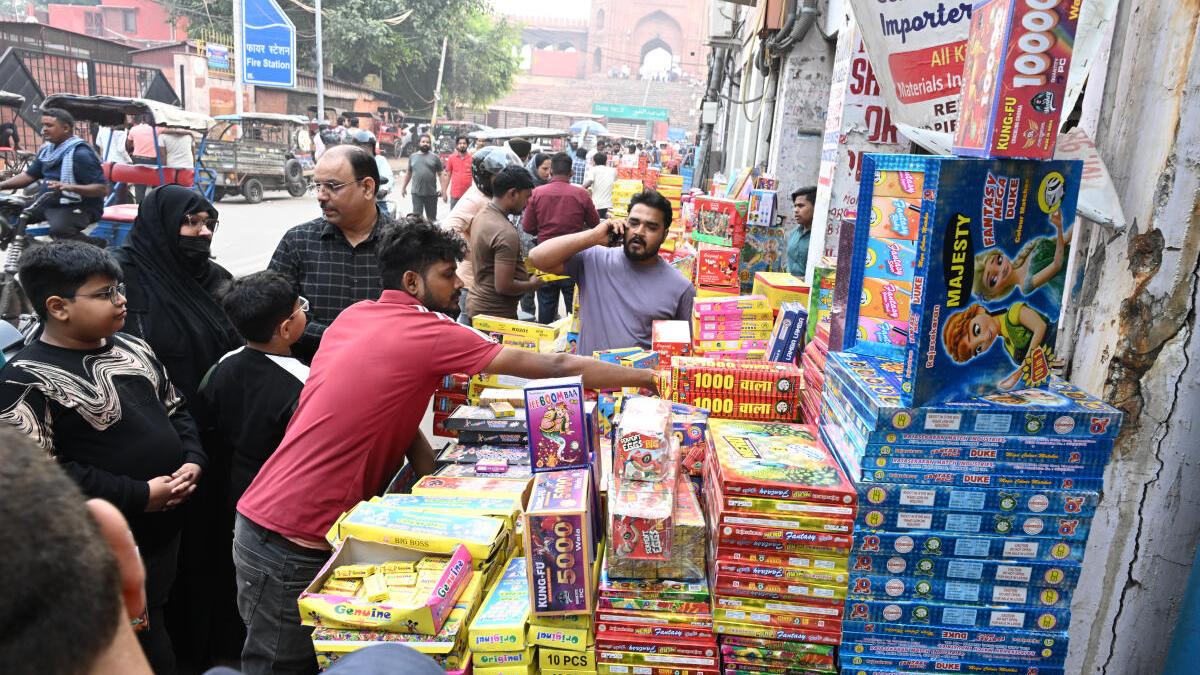
The Supreme Court on November 2, 2026 described bursting of firecrackers during Deepavali as a “religious practice” while permitting the use of green firecrackers for two days, on November 7 and November 8, in Delhi-NCR.The unregulated use of firecrackers during Deepavali has historically led to a sharp rise in the Air Quality Index (AQI) and pollution levels, including the emission of particulate matter, the court observed. “The right of an individual to engage in a particular practice, which may have a religious colour, is only a qualified one and cannot go beyond the Constitutional restrictions,” the Supreme Court held.Failure of the stateThe state had “utterly failed” to comply with the Supreme Court’s orders issued since 2015 to impose restrictions on fireworks, the Bench said. In fact, the situation had not improved even after the reimposition of a complete ban on firecrackers. A significant spike in AQI levels was noticed on Dasara and the following day. The “complete ban” had not only facilitated the illegal sale of firecrackers but had also prevented people from purchasing authorised green crackers, the court said.The court had earlier suggested that the government enlist celebrities such as cricketer Virat Kohli to spread awareness about the harmful effects of firecrackers.In October 2025, the apex court had permitted the sale and bursting of green firecrackers in Delhi-NCR during Deepavali, subject to conditions aimed at balancing tradition with environmental and health concerns. The court had then made it clear that the use of green crackers would be restricted to specified hours on the festival day and its eve.Time slots to burst crackersThe court permitted the bursting of certified green firecrackers between 6 a.m. and 7 a.m. and between 8 p.m. and 10 p.m. on November 7, 2026 and the day after in the Delhi National Capital Region (Delhi-NCR).“There shall not be any bursting of fireworks within a 300-metre radius of hospitals, nursing homes, primary and district health centres, old age homes and any notified silence zones. These areas will be declared as ‘no-cracker zones’, and shall be marked on the ground and published,” the court said in its 23-page order. The same restriction would apply to educational institutions.“We are conscious that the celebration of Deepavali has a religious, social, psychological and emotional connotation amongst people, creating a positive atmosphere of hope, welfare and prosperity. That being said, allowing the environment to degrade, which results in a health hazard to all living beings, defeats the very purpose of the festivities, and the celebrations would be rendered nugatory,” the Bench reasoned.Directions on green firecrackersIn a series of directions, the court ordered that only manufacturers certified by CSIR-NEERI (Council of Scientific and Industrial Research-National Environmental Engineering Research Institute) and PESO (Petroleum and Explosives Safety Organisation) would be permitted to manufacture green crackers between November 2, 2026 and November 6, 2026. The cracker boxes would be sealed and kept separate from unauthorised or conventional firecrackers.There would be no manufacture or sale of firecrackers joined in series (ladis) and garlands. Only firecrackers carrying product-specific QR codes would be allowed to be sold. Cancelled licences of traders would be restored temporarily from November 4, 2026 to November 6, 2026. Manufacturers and traders of firecrackers in Delhi-NCR must furnish a monetary security deposit, the amount of which would be determined by the authorities.What are green firecrackers?Green firecrackers are designed to cause less air pollution. According to the CSIR-National Environmental Engineering Research Institute (NEERI) team that developed them, these firecrackers emit 30% less particulate matter or, alternatively, 20% less particulate matter and 10% fewer gaseous emissions than conventional firecrackers in the same category.The proportions of fuels and oxidisers have been modified to improve combustion efficiency, additives have been introduced to suppress dust formation, and the quantities of certain metals have been reduced.CSIR-NEERI has developed three types of green firecrackers: Safe Water Releaser (SWAS), whose ingredients release water vapour to suppress some of the particulate matter generated during combustion; Safe Thermite Cracker (STAR), which uses a thermite-based composition to achieve higher combustion efficiency and lower emissions; and Safe Minimal Aluminium (SAFAL), which contains less aluminium and consequently generates lower emissions.Restrictions on sale of uncertified crackersEach of SWAS, STAR and SAFAL type of green firecrackers can be used in different types of fireworks, including sparklers and flowerpots.All green firecracker products carry a CSIR-NEERI logo on their packaging and a QR code to verify the product certification. While they produce lower emissions than conventional crackers, they are not pollution-free. Their emissions include fine particulate matter, harmful gases and other combustion by-products that affect respiratory and cardiovascular health. They also generate noise pollution.The sale of green firecrackers will be permitted from November 4 to November 6, while bursting will be allowed only on November 7, 2026 and November 8, 2026 between 6 a.m. and 7 a.m. and between 8 p.m. and 10 p.m., according to the Delhi Police. Firecrackers joined in series (ladis), and crackers containing prohibited chemicals such as barium salts will not be permitted.
Deepavali 2026: All you need to know about Supreme Court-permitted time slots, green crackers and other directives
Full Article
Original Source
Read the full article at Thehindu →KhanList aggregates and links to publicly available news content. We do not host full articles from third-party sources. Always verify important information with original sources.