
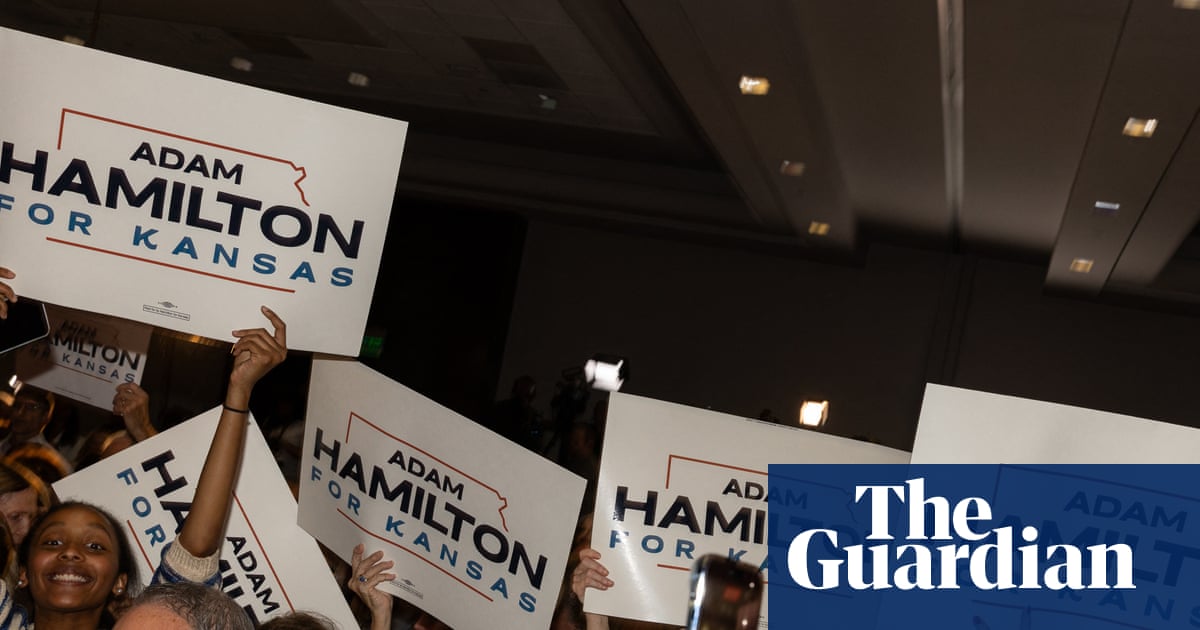
Linda Olson always does her homework before voting – a trait she inherited from a family invested, and interested, in politics. Her father was a photographer who took portraits of political leaders in Washington, while her grandparents were farmers who cared deeply about their industry.In 2024, Olson’s research led her to Donald Trump. She trusted that the then-former president would improve their economic realities in Junction City, Kansas – where she was born and raised – if he returned to the White House.But two years later, life is just more expensive. Last winter, Olson was forced to spend $700 on medication while in between insurance plans, and skipped out on doses to stretch it out longer. Her grocery bills are unrecognizably high. And fuel prices are about a dollar per gallon more expensive than last year.“I thought at the time that he was the better choice of what we had,” Olson said of Trump in 2024. Instead, he’s been acting to “make himself richer instead of really helping the people”.With frustrations like these looming large across the state, Kansans this week elected a Democrat, Adam Hamilton, to the US Senate for the first time in nearly a century. It was a stunning upset in what was, until recently, thought to be a reliably red stronghold.“I’ve seen what Roger Marshall did over the eight years or so that he’s been doing this,” said Olson, of the defeated Republican senator. “And I thought, it’s time we get fresh blood up there.”Hamilton won, in part, by flipping six counties that backed Trump in 2024 and Marshall in 2020 – a sign that, even in more remote, and traditionally conservative, areas, patience with Trump and the Republican party is wearing thin.“Not everybody that voted for Trump is part of this cult of personality that Trump has tried to make the Republican party into,” said Michael Smith, a political science professor at Emporia State University, located in one of those six flipped counties.“There are certainly people in Kansas that are like that: they’re pretty conservative, but they’re not beholden to Trump. And so I think one of the things this election did is peel off those people.”Most of Kansas is made up of farmland, encompassing nearly 45m acres and employing nearly one in five Kansans. Pastures, dotted with grazing cows and their calves, hug the state’s highways. Junction City is surrounded by its famed toffee-colored prairies, so expansive that untouched grassland stretches out to the horizon on both sides of the interstate.Kansans who ranch and farm here, in the most rural corners of the state, remain deeply Republican, according to Smith. But neighboring communities such as Junction City and Emporia, where he teaches, depend heavily on the agricultural economy and have felt the impact of the strains on farmers.Lindsborg resident Tom Holmquist, who said he was voting for Adam Hamilton. Photograph: Nathan Howard/Reuters“The people that live here aren’t actually farmers,” he said. “And they’re more likely to swing over to the other party because the economy is really taking a beating.”David Aguirre, a 25-year-old who was born and raised in Junction City, and works at a Mexican restaurant, El Patron Dos, said that when the rest of the county is suffering, so does his work.“It has, like, a domino effect for families,” he said. “If they’re not doing their best, they’re not gonna come out to eat, and then that affects staff, and cooks, and so on.”While grocery shopping on Wednesday afternoon, Janet Grimm, who considers herself an independent, lamented her rising bills. Everything she picked out from the aisles was tagged with a red and yellow “sale” sticker, a conscious choice she needs to make now.Checking out with just a handful of items – eggs, chicken, some deli meat, two cucumbers and powdered sugar for the banana bread she was planning on making later that day – her total rang up to over $60.Grimm voted for Hamilton, and felt hopefully that he would be able to improve the economy for people like her. “I really have faith that they’re going to do good,” she said.Hamilton – whose campaign slogan was “leading from the middle” – followed an increasingly reliable playbook in Kansas, Smith suggested, in which candidates position themselves as moderate and distant from the national Democratic party. In his victory speech on Tuesday, Hamilton emphasized to a packed room of supporters that he would seek greater collaboration between parties during his tenure, to “solve problems like it used to be”.“I’m going to tell you a little secret. I want to become Jerry Moran’s best friend,” said Hamilton, referring to the state’s second senator – a Republican.“For the rest of the United States, in deeply red Kansas, the heart of America, I want us to model what it looks like when thoughtful people actually work together to solve problems, instead of slinging mud at each other.”Adam on stage in Kansas City after winning his election against Roger Marshall. Photograph: Austin Johnson/AFP/Getty ImagesChanneling his years as the pastor of a megachurch, Hamilton recounted the story of the Good Samaritan – in which a Samaritan stopped to help a man who was beaten on his way to the Holy Land – as a way to illustrate the importance of Democrats and Republicans helping out one another.“If Jesus were telling this parable to a room filled with Democrats, he’d say, ‘And there was a Republican who came along and stopped and helped the man,’” said Hamilton. “If he was talking to a room filled with Republicans, he’d say, ‘And there was a Democrat who came along and stopped.’”Every county in Kansas shifted to vote more Democrat in this year’s Senate race. Still, many areas of the state remain staunchly Republican, and no moderate candidate is likely to change that, said Smith.“It’s still a pretty conservative state,” he said. “Let’s not get too hasty here.”At a grocery store on the outskirts of Junction City, located in Geary county, Dan Duever, 75, said he believed Trump was the reason that Republicans “got hurt so bad” in the midterms, “because of the economy and the war in Iran”.Duever, a semi-retired farmer, said that fuel costs on his farm have tripled – from about $15,000 to closer to $45,000 – because of the record high prices of diesel. He has stopped driving one of his trucks that relies on diesel. His fertilizer prices have roughly doubled.Still, he did not break with his party this year when he voted in the state’s Senate race. “I’m a damn Republican,” he said.
Deep-red Kansas votes for change as patience wears thin with Trump: ‘The economy is really taking a beating’
Full Article
Original Source
Read the full article at Theguardian →KhanList aggregates and links to publicly available news content. We do not host full articles from third-party sources. Always verify important information with original sources.