
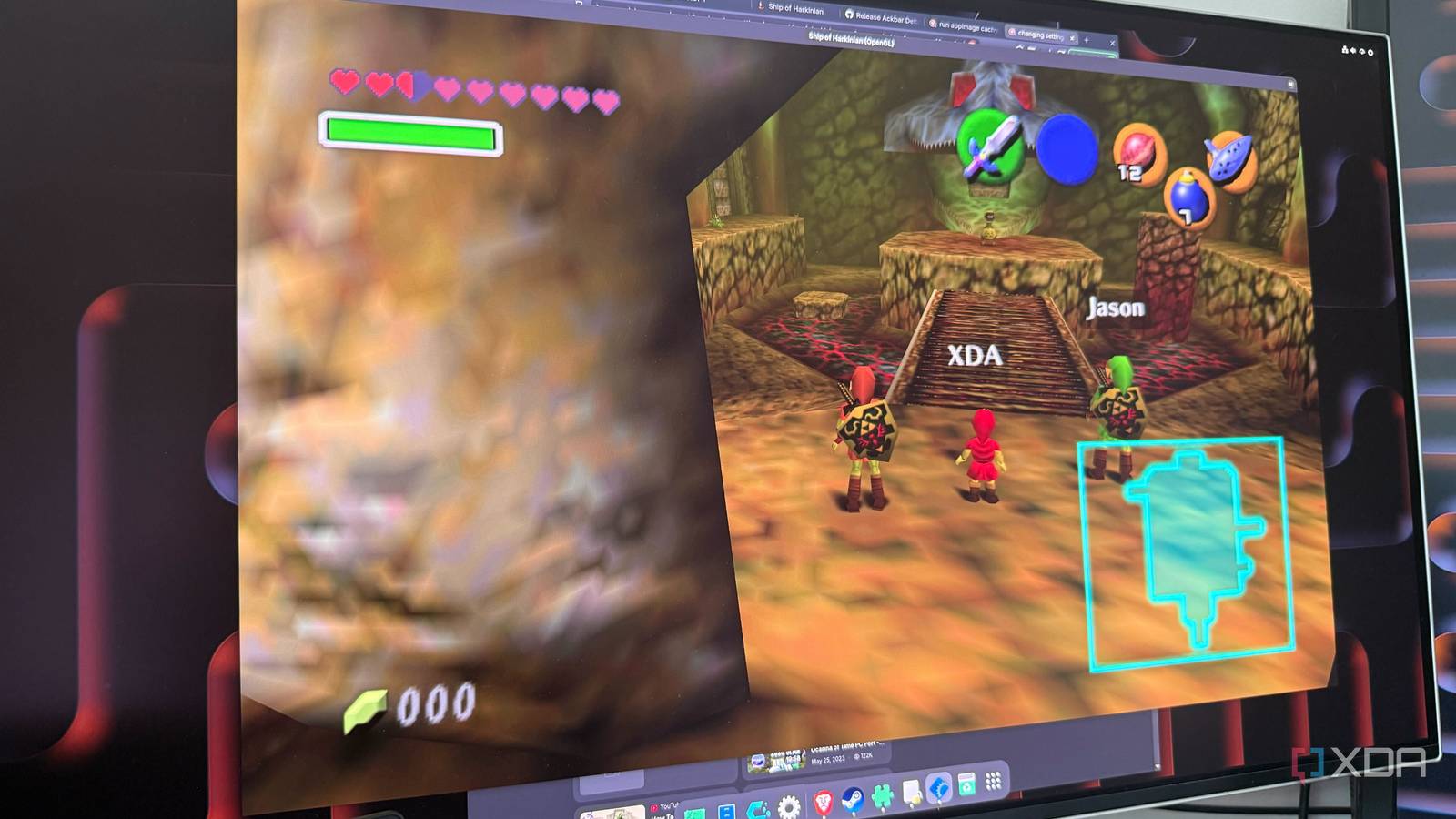
Published Nov 24, 2026, 6:00 PM EST His love of PCs and their components was born out of trying to squeeze every ounce of performance out of the family computer. Tinkering with his own build at age 10 turned into building PCs for friends and family, fostering a passion that would ultimately take shape as a career path. Besides being the first call for tech support for those close to him, Ty is a computer science student, with his focus being cloud computing and networking. He also competed in semi-pro Counter-Strike for 8 years, making him intimately familiar with everything to do with peripherals. When I loaded up Ship of Harkinian for the first time earlier this year, the feeling I got could only be compared to the first time I fired up my Nintendo 64 over 2 decades ago. Emulation is fantastic, but playing a native PC port of one of my favorite games of all time was truly mind-blowing. And the fact that Nintendo wasn't involved anywhere in the development made it even crazier, but decompilation projects like SoH have been spawning in at what seems like an impossible rate. Thanks to the persistence of some very dedicated fans, decompilations for classic Nintendo games like Super Mario 64, Majora's Mask, Banjo-Kazooie, Twilight Princess, and many more have brought remaster-like experiences to the PC, and AI has only accelerated this process for other titles. For console exclusives that were simply never going to make it to the PC, these decompilation efforts have done an incredible amount for game preservation — far more than Nintendo or any other publisher has ever done for their own IPs. Fans have built the library that publishers haven't bothered with PC ports were never in the cards for these games Almost all of these PC ports follow one of two approaches. Decompilation is historically the slowest, and it's where developers take a game's machine code and translate it back into human-readable C code, function by function, until it compiles into a byte-for-byte match with the original. Once that exists, a port to Windows, macOS, or Linux becomes a normal programming project rather than a reverse engineering one. Static recompilation is the other approach, and it uses tools like N64: Recompiled to translate the game's compiled code directly into a PC program your computer can run, without needing a full decompilation. With either approach, a user would have to supply their own copy of the game, and that's the legal loophole these projects are leaning on heavily right now. While Nintendo has re-released Ocarina of Time for the 3DS and remade it for the Switch 2, the other games I mentioned, like Majora's Mask, Banjo Kazooie, and others, haven't received much of an update besides maybe being made available through Nintendo Online or a 3DS remake. It's not just Nintendo either: Konami's original Silent Hill for the PlayStation hasn't got any kind of true remaster, and on the Xbox side of things, games like Sonic Unleashed were ignored for years before it eventually got a full PC port thanks to fans of the game. Even for many Xbox titles, PC ports are usually completely off the table for these console exclusives, but the demand would be much lower if publishers offered more ways to experience the game on modern hardware. It can certainly go badly if neglected after the fact (anyone remember Half-Life: Source?), but it's still better than ignoring the classics that made these IPs so popular in the first place. Static recompilations turned a trickle into a flood The approach a publisher wouldn't take Credit: Nintendo / Dusk A full decompilation is truly painstaking work if done manually — Super Smash Bros. Melee's decompilation efforts took more than six years to complete, and it only gets more complex as the games do. The static recompilation approach was the first big breakthrough behind the flood of PC ports. When Wiseguy released N64: Recompiled in 2024, its first showcase was a Majora's Mask port that came together in a couple of days, aided by earlier reverse-engineering work. The same toolchain has since produced ports of Star Fox 64, Mario Kart 64, and Banjo-Kazooie, and the Majora's Mask port has picked up more than 120 community mods. XenonRecomp did the same for an Xbox 360 game with Sonic Unleashed, and PS2Recomp is attempting it for the PlayStation 2. Each new tool turns an entire console library into potential ports. It does a lot of the hard parts for the developers making these PC ports. Nintendo and other publishers don't take kindly to these recomps They might be on borrowed time Publishers do have a fair argument against fans making these recompilations. The IP belongs to them, and any official release using that IP can include things like licensed music or other copyrights that fan projects skim over. The "bring your own copy" principle has kept them safe from being guilty of redistributing game assets, but the truth is, plenty of players don't own the originals, and will find a way to get the files some other way. Nintendo is infamous for taking legal action against even the smallest of transgressions against their IP. They've pulled down countless videos, websites, and GitHub repos for emulators and recompilation projects, and they're not alone. Other publishers are taking notice, and I think it's only a matter of time before the next shoe drops on these fan projects, even if they have the green light in the eyes of the law right now. The cat is out of the bag AI has super-charged development of these projects AI coding agents have made the arduous task of decompilation into more of a waiting game, and that's the second big reason why serious progress on these projects has been made in such a short span of time. The aforementioned Melee decompilation is one excellent example: it was less than half done in November 2025 and reached 100 percent the following September, and the contributor who announced it credited AI assistance in getting things across the finish line faster. AI isn't a requirement for these projects—Super Mario 64, Ocarina of Time, and Twilight Princess were all decompiled the old-fashioned way—but it has certainly become instrumental because it's so good at this kind of reverse engineering. A lot of repos have popped up in the last few months alone that are clearly haphazard efforts by people with little experience, but those are fairly easy to recognize. I knew AI-assisted development of these projects was an accelerator, but the pace at which the new Ocarina of Time remake hit the PC on an emulator was the moment I took serious notice. It's not a full decompilation, but the fact that someone had it running in an emulator on PC less than 24 hours after its launch was mind-blowing. This toothpaste simply isn't going back in the tube, no matter how badly Nintendo or other publishers want it to. Ship of Harkinian
Decompilation projects have quietly brought more classic games to PC than any official remaster program
Full Article
Original Source
Read the full article at Xda-developers →KhanList aggregates and links to publicly available news content. We do not host full articles from third-party sources. Always verify important information with original sources.