
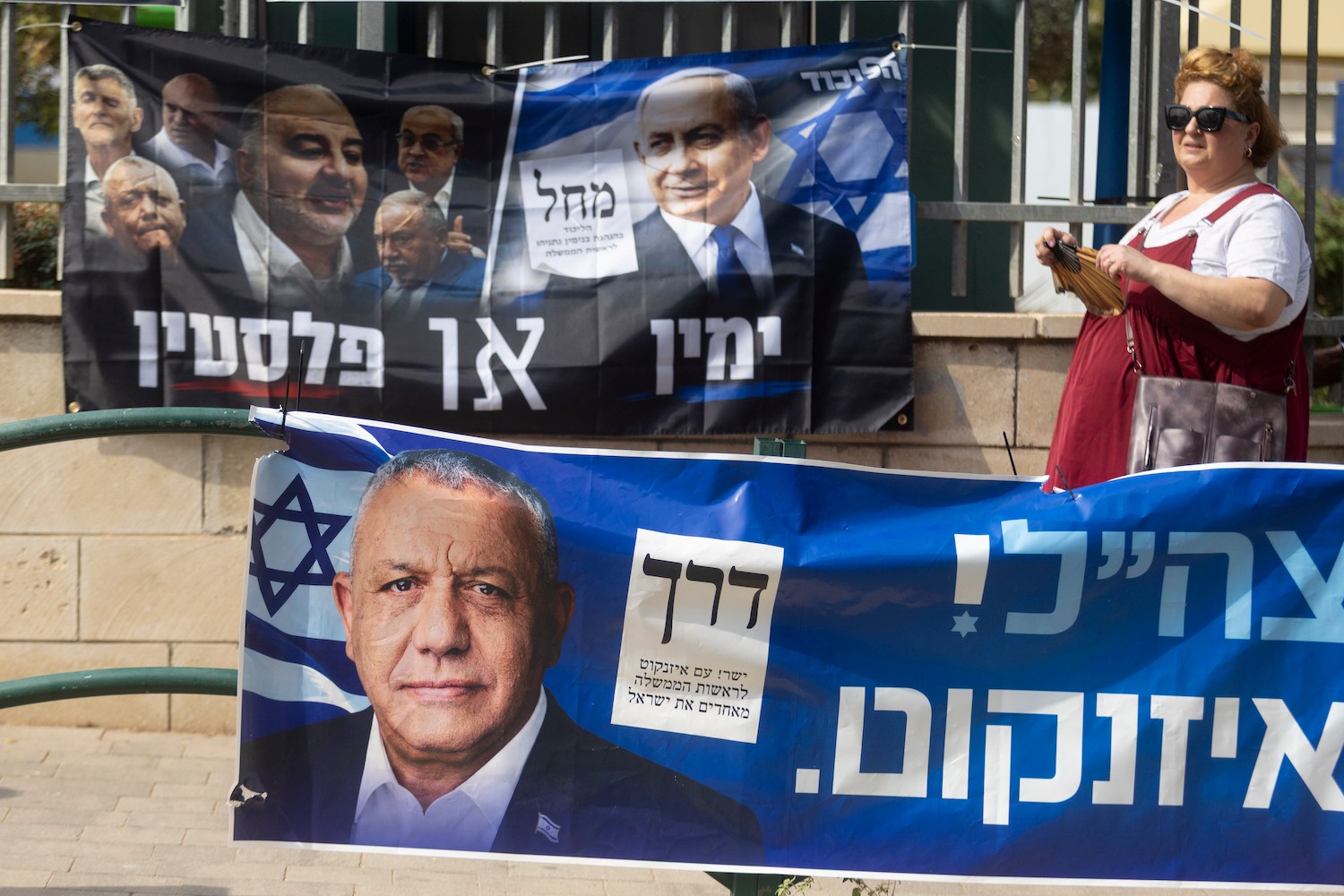
Welcome back to World Brief, where we’re looking at a consequential election in Israel, new European efforts to engage with Russia, and trade opportunities between the European Union and Asia. No Clear Winner Israeli voters flocked to the polls in record numbers on Tuesday in closely watched parliamentary elections seen as a referendum on Prime Minister Benjamin Netanyahu’s leadership. Official results could take days to confirm, but preliminary exit poll results suggest no clear winner. Israel’s Channel 12 shows the bloc led by centrist opposition leader Gadi Eisenkot securing 52 seats in the parliament, compared with 50 seats for Netanyahu’s right-wing bloc and 18 seats for Arab parties. If those results prove accurate, the country could see weeks of political dealmaking before a government is formed. “Eisenkot’s path to power is hardly assured,” FP columnist Steven A. Cook writes. Still, with the Arab-led parties more likely to side with Eisenkot over Netanyahu, the results could mark the end of Israel’s most far-right government in history. Tuesday’s vote comes at a critical time for Israel. It was the first national election since Hamas’s Oct. 7, 2023, attack and Israel’s subsequent wars in Gaza, Lebanon, and Iran. Supporters of Netanyahu have applauded his tough stance on Tehran, including his call last week for the Iranian regime to be removed “once and for all.” However, critics have accused the right-wing leader of failing to prevent the deadliest assault on Israel since its founding and of fostering democratic backsliding. Early results suggest that many voters are unhappy with the status quo. “The initial exit poll results indicate a complete lack of confidence in Netanyahu and the Oct. 7 government among the Zionist majority and the majority of Israeli citizens,” Eisenkot said on Tuesday, vowing to immediately replace the current government. Eisenkot, a former military chief of staff, leads the “change” bloc of opposition parties that all share the common objective of toppling Netanyahu. But that is largely where their like-minded politics end. Among Eisenkot’s strongest allies are the right-wing Yisrael Beiteinu party, led by Avigdor Lieberman, and the left-wing Democrats, led by Yair Golan. Former Prime Minister Naftali Bennett is also considered a key partner of Eisenkot. Yet collaboration among these groups will likely not be easy; a similar coalition tried to govern in 2021 only to collapse after a year of infighting. Until now, Eisenkot has ruled out partnering with the Arab bloc; however, he may be forced to rely on some of these parties to form a coalition. That could include a tenuous truce with Mansour Abbas of the Arab Islamist Raam party as well as with the Joint List, an alliance representing Israel’s Arab citizens. Notably, though, the Joint List has vowed to boycott any coalition that includes Yisrael Beiteinu. Negotiations could take weeks, if not longer, to form a coalition. And even then, Israel’s system allows for rapid turnover if the bloc fails. Between 2019 and 2022, Israel held five national elections. Still, Tuesday’s vote was noteworthy for the sheer amount of public participation that occurred. By 8 p.m. local time, turnout had hit 74.3 percent—Israel’s highest rate since 1988. Today’s Most Read 5 Foreign-Policy Priorities for Democrats After the Midterms by FP Staff America’s Least Bad Option in Iran by Raphael S. Cohen and Howard J. Shatz Why Putin’s Defenders Are Increasingly American by Adrian Karatnycky What We’re Following Call to Moscow. Finnish President Alexander Stubb and Norwegian Prime Minister Jonas Gahr Stoere held a rare call with Russian President Vladimir Putin on Tuesday about the Russia-Ukraine war, where the two Nordic leaders stressed “de-escalation,” Stoere said. European leaders have generally shied away from direct communications with Russia over the war, in part due to the complexity of agreeing on a common position. Danish Prime Minister Mette Frederiksen criticized the Finnish-Norwegian outreach for not including other European nations. “I think Europe should stick together rather than going solo,” Frederiksen said. However, Europe’s lack of engagement risks allowing the United States to set the terms for a Ukraine-Russia peace deal. The White House has recently exerted greater pressure on Kyiv while rewarding Moscow with discussions of possible business deals, including the sale of sanctioned Russian energy company Lukoil. Either way, Russia appears unlikely to bow to either Europe’s stick or the United States’ carrot when it comes to Ukraine. Last week, Russian Foreign Minister Sergey Lavrov discounted the idea of Moscow making concessions in upcoming talks with U.S. negotiators Steve Witkoff and Jared Kushner. “We’ll see what they propose. If they offer something that benefits us economically and financially, then why not?” Lavrov said. Meanwhile, at least one peace process is showing progress: Melania Trump’s. On Tuesday, a local cease-fire brokered by the U.S. first lady with the help of Pope Leo XIV began in the Ukrainian town of Oleshky. Residents of the town, which is under Russian occupation, have suffered starvation due to difficulties getting food in and out along mined roads and under the threat of drone strikes.—Sam Skove An eye on Asia. German Chancellor Friedrich Merz kicked off a five-day Asia tour on Tuesday with a plea for his fellow leaders back home in Europe. “Let us join forces to work toward a big, interregional agreement with the members of the Trans-Pacific Partnership,” Merz said, urging the European Union to prioritize free trade negotiations with Asian middle powers. Specifically, Merz proposed having the EU establish ties with the Comprehensive and Progressive Agreement for Trans-Pacific Partnership (CPTPP), a free trade deal that spans 12 nations, including Australia, Canada, Japan, Singapore, the United Kingdom, and Vietnam. According to Merz, adding the EU would have this bloc account for more than a third of global trade. “We are building a network of partners with whom we share core values and interests,” Merz said. “The new era is bringing us closer together than ever before.” Along with an EU-CPTPP deal, Merz also floated a trade agreement between the EU and the 11-member Association of Southeast Asian Nations. As for the largest economy in the Indo-Pacific, China’s shadow loomed large over Merz’s trip. “Our freedom, our sovereignty, our security, and our prosperity are at stake,” Merz said during his first stop in Singapore. The German chancellor recognized that bolstering collaboration with the CPTPP would reduce dependence on China; however, he rejected calls to completely cut ties with Beijing, arguing that the country also brings opportunities. Bolsonaro caves. Far-right Brazilian Sen. Flávio Bolsonaro left the country for the United States on Tuesday, an ally to the lawmaker told Reuters. His flight abroad further signals his reluctant acceptance of last weekend’s presidential election results, which saw victory go to President Luiz Inácio Lula da Silva. Bolsonaro had initially vowed not to accept the loss, citing the Brazilian Supreme Federal Court’s decision to extend voting by two hours due to alleged transport irregularities. However, he appeared to be one of the only lawmakers hoping to annul the results. On Monday, U.S. President Donald Trump, Bolsonaro’s closest foreign ally, characterized the vote as “another rigged election” (without providing evidence), but he stopped short of vowing to come to Bolsonaro’s aid. Soon after, the leader of Bolsonaro’s Liberal Party announced that the group would accept the vote’s outcome. Still, Bolsonaro may not have abandoned his efforts to undermine Lula. “I wasn’t the one who lost—the system won,” Bolsonaro said on Monday, adding that he planned to “organize the opposition to build a fortress against barbarism.” That could include a lawsuit accusing the left-wing president of abusing his incumbency status to sway the vote. Experts, however, believe that this challenge is unlikely to succeed in court. Odds and Ends Vegemite may be an Australian food staple, but it is not a human right. At least, that is what an Australian state court ruled on Monday, after an inmate tried to sue for access to the savory spread. Last year, 55-year-old Andre McKechnie, who is serving a life sentence for murder, argued that the state of Victoria’s ban on Vegemite for prisoners violated his right to “enjoy his culture as an Australian” under the 2006 Charter of Human Rights and Responsibilities Act. However, Victoria’s Supreme Court found that the ban was justified, as it met the prison’s goals of prohibiting illicit alcohol and drugs; Vegemite is a by-product of brewing beer.
Decoding Israel’s Election Results
Full Article
Original Source
Read the full article at Foreignpolicy →KhanList aggregates and links to publicly available news content. We do not host full articles from third-party sources. Always verify important information with original sources.