
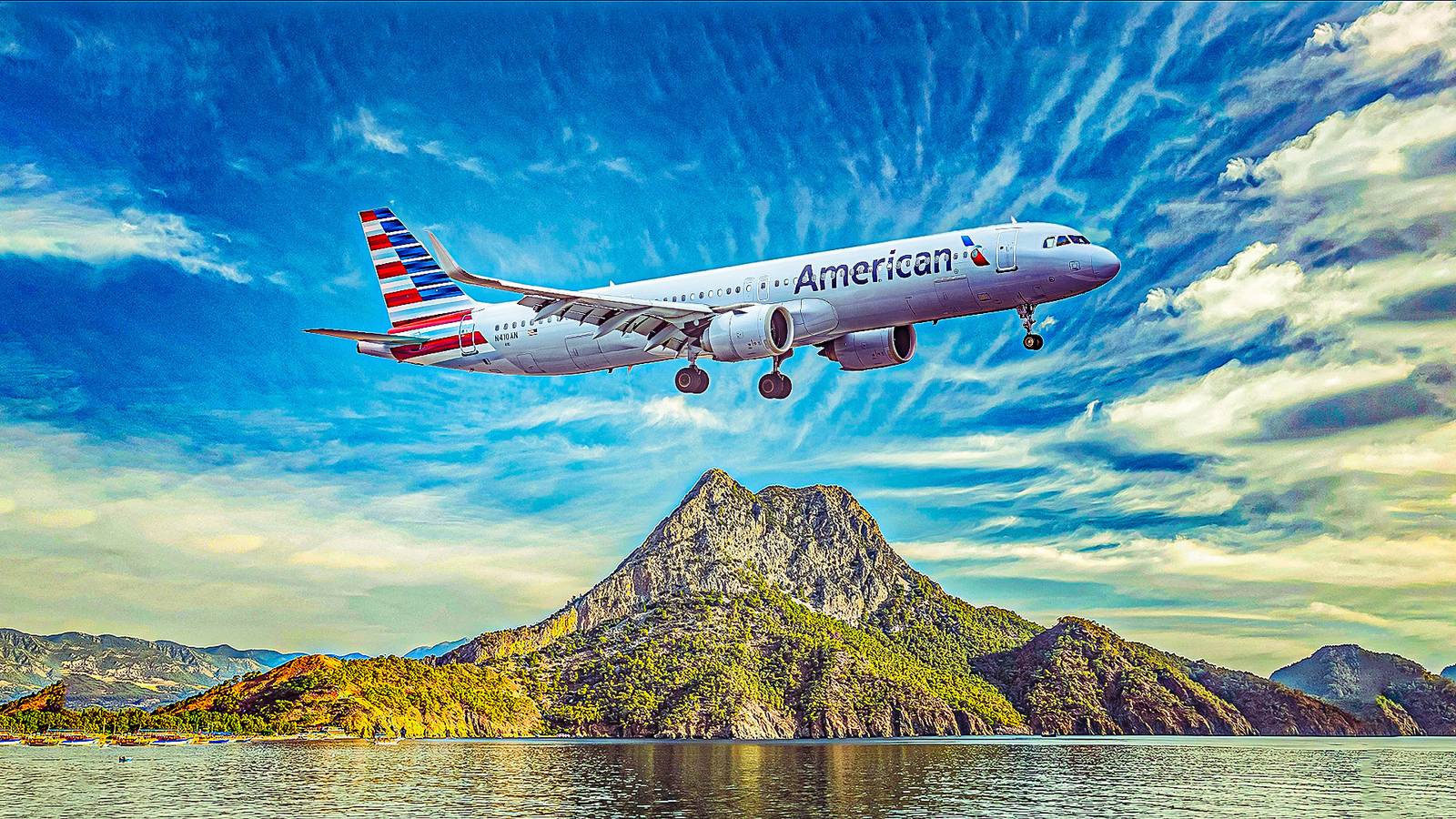
Published Aug 26, 2026, 5:45 PM EDT Paul has had a career of 25+ years focused on the international technology sector, which has taken him to over 100 countries. Along the way, he developed a deep love for aviation, with a travel bucket list measured by aircraft types flown rather than destinations reached. Now he brings that avgeek passion, along with the journalism experience he accumulated early in his career, to write insightful pieces for Simple Flying. American Airlines is preparing to reveal its summer 2027 international routes on Thursday, August 27, but it has given travelers a chance to solve the announcement first. The carrier posted four images of a fictional restaurant menu filled with strange prices, carefully chosen ingredients, airport codes, historical references and what appear to be deliberate red herrings. After working through the clues — and comparing them with speculation elsewhere — five routes stand out: Philadelphia to Vienna, Reykjavik and Porto; Charlotte to Barcelona; and New York JFK to Brussels. There is a second layer to the puzzle, too. Four of those five services could plausibly use American's new Airbus A321XLR, an aircraft specifically intended to make long, thin international routes more viable. That would fit American's increasing emphasis on Philadelphia International Airport (PHL) as a transatlantic gateway. The Clues Appear To Reveal Five Routes Credit: Shutterstock The strongest evidence comes from the page seemingly dedicated to Philadelphia. The "single-patty hamburger" features 321 individual pickled red herring strips, a "UIO bun," and an optional 1,776 sesame seeds for $2.15. Quito and Hamburg initially look like tempting options, while "321" suggests an Airbus A321. However, 1776 is synonymous with Philadelphia and 215 is one of the city's area codes, while the menu itself explicitly calls the other ingredients "red herrings." American appears to be telling us to identify Philadelphia as the origin. while ignoring the obvious UIO and hamburger/Hamburg traps. Once you've side-stepped the red herrings, the destinations of Vienna, Reykjavík and Porto all fall into place remarkably neatly: Vienna International Airport (VIE): The Caesar Salad contains the nonsensical "YLHQQD": shift each character three letters backwards using a Caesar cipher, and it spells VIENNA, while Vienna itself has 23 municipal districts, matching the $23 price. Keflavik International Airport (KEF): The smoked fish soup costs $21.64; reverse those numbers into approximate coordinates of 64°N, 21°W and they point toward Reykjavík, whose name derives from "smoky bay." Francisco de Sá Carneiro Airport (OPO): The initials of Pristine Octopus Ravioli with Truffle Oreganata spell PORTO, a route American has already confirmed for 2027. Then, as final confirmation of these destinations, the three published distances from Philadelphia — 4,333, 2,680 and 3,414 miles — total 10,427 miles, exactly matching the menu's otherwise unexplained $104.27 wine flight. Predicted Route Main Clues Route Confidence Philadelphia – Vienna Caesar cipher + $23 99% Philadelphia – Reykjavík $21.64 coordinates + fish/smoke references 98% Philadelphia – Porto PORTO acrostic + distance 100% Charlotte – Barcelona CLT + 1882 + "sacred family" + 144 years 94% New York JFK – Brussels New York Strip + fries/mayo + 165 92% The two remaining predictions are less certain but still unusually persuasive. Citrus Lime Thyme produces CLT, while the accompanying prawns cost $18.82 and use a "sacred family recipe" passed down for 144 years. It turns out that Barcelona's Sagrada Família began construction in 1882, 144 years ago. American previously flew from Charlotte Douglas International Airport (CLT) to Barcelona-El Prat Airport (BCN) before eliminating it during its 2020 international network reset. Meanwhile, a New York Strip with fries and mayonnaise points strongly toward Belgium, and the $165 price corresponds neatly with Brussels' Atomium, which represents an iron crystal magnified 165 billion times. American previously served New York JFK Airport (JFK) to Brussels Airport (BRU), making this another plausible restoration. This would also be the only route on the list where it had a competitor on the route, in the form of Brussels Airlines, which operates the route daily during summer and up to five times weekly in winter. Importantly, not every dish represents something new. Other clues describe services American already operates, including Miami-Milan and existing links to Nice and London, while its "Magnificent Miso" appears to reference Chicago and Japan — American has already announced the return of Chicago O'Hare International Airport (ORD) to Tokyo Narita Airport (NRT) for 2027. That explains why attempts to turn every menu item into another announcement produce implausibly large lists. American already has its largest-ever European summer schedule in 2026, including new Budapest and Prague flights from Philadelphia. The Airbus A321XLR Is The Real Story Credit: Dallas-Fort Worth International Airport If the route decoding is correct, the aircraft behind the announcement could be almost as interesting as the destinations. Porto is already confirmed for the 155-seat Airbus A321XLR, and Vienna and Brussels look like textbook candidates for the same aircraft. Reykjavík could use either an XLR or American's standard 196-seat Airbus A321neo, while Charlotte-Barcelona appears much more likely to use a 273-seat Boeing 777-200ER. Predicted Route Most Likely Aircraft Aircraft Confidence PHL–VIE Airbus A321XLR 90% PHL– KEF A321XLR / A321neo 90% PHL–OPO Airbus A321XLR 100% CLT–BCN Boeing 777-200ER 90% JFK–BRU Airbus A321XLR 90% Simple Flying has already identified nine scheduled American A321XLR routes and examined just how rapidly the type is spreading into its international network. It is a lower-risk way of opening thinner long-haul routes, while American's winter expansion of XLR flying to Europe illustrates how the aircraft can be used to extend seasonal routes when a widebody may be too large. American has already demonstrated that strategy with JFK-Edinburgh, its first international XLR service, and Brian Znotins, American Airlines SVP of Network Planning, says that Porto will push the concept further: “Porto is exactly the type of new market the Airbus A321XLR enables us to serve... a market that we would be unlikely to fly to with a larger aircraft.” Reykjavik is the one aircraft prediction worth treating cautiously. The mysterious "321" in American's teaser pushes the prediction toward the XLR, but commercially the higher-capacity A321neo remains a very credible alternative. That aircraft carries 196 passengers and has domestic-style first class rather than the XLR's lie-flat Flagship Suites. Iceland is also a heavily leisure-oriented market, and the roughly 2,677-mile sector does not require anything close to the XLR's maximum range. Keen-eyed readers might also recall that American intended to operate Philadelphia-Keflavik before the pandemic, and at one stage loaded the route with the standard A321neo. Charlotte-Barcelona is the outlier. Much of Charlotte's current transatlantic network is operated with 777-200ERs, and the most recent addition of Athens' Eleftherios Venizelos International Airport (ATH) last year also put a 777-200ER on the route. Unless American intends to establish a meaningful XLR operation at Charlotte – and for now, its focus is very much on Philadelphia and New York JFK – then the 777-200ER looks like the much safer prediction for a revived Barcelona flight. American's Expansion Looks Conservative Next To United's Credit: United Airlines Whatever American reveals tomorrow will inevitably be compared with United Airlines' announcement just two days earlier. on these clues, the difference could be dramatic. United unveiled 10 new international cities and three additional new routes, plus a San Francisco-Tel Aviv resumption. Eight of the ten new cities will have no other US airline serving them nonstop, and five — Luxembourg, Toulouse, Ibiza, Valencia and Marseille — will use United's own incoming A321XLRs. Not surprisingly, it is the largest international expansion in United's history. American's apparent list is almost the opposite. Porto is genuinely new to American, but it was announced back in February; Reykjavik would restore a market American previously served; Charlotte-Barcelona would bring back a route cut in 2020; and JFK-Brussels would resurrect a link American operated more than a decade ago. Vienna is therefore the standout completely new reveal if our decoding is correct. That also means that American and United are using essentially the same aircraft to pursue quite different strategies. United is putting the XLR at the heart of an effort to stretch its map, creating demand in less obvious destinations rather than simply following it. American increasingly looks set to use the type to lower the risk of markets it already understands, while selectively filling obvious network gaps that have existed since its 2020 retreat. There is nothing inherently wrong with the safer approach. Philadelphia provides enormous domestic feed, Charlotte has exceptionally strong connecting traffic, and the XLR's economics mean American can rebuild markets previously lost when it retired aircraft such as the Boeing 757 and Airbus A330. But United's contrasting announcement demonstrates just how adventurous a network planner can become when given the same tool. If American's menu really does decode to the five routes above, tomorrow's reveal may therefore say as much about how differently two of America's largest international network builders view risk as it does about where American will fly next summer.
Decoded: American Airlines To Announce 5 New International Routes Days After United’s Reveal
Full Article
Original Source
Read the full article at Simpleflying →KhanList aggregates and links to publicly available news content. We do not host full articles from third-party sources. Always verify important information with original sources.