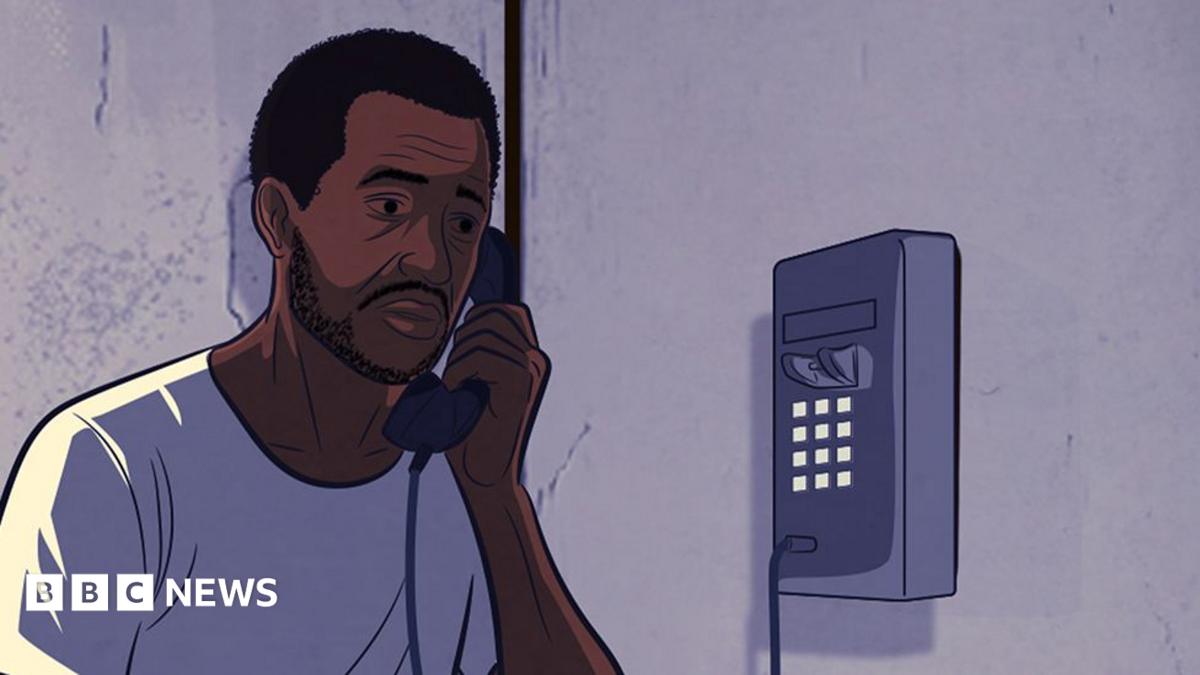
There was desperation in the voice of the young Ethiopian man when he managed to get through to the BBC from a phone in his prison cell on death row in Saudi Arabia.Habtom, whose name - like the other prisoner featured in this article - has been changed to protect his identity, has been held in a jail in the southern city of Khamis Mushait for more than three years.Above the noise of cellmates shouting behind him, he pleaded for help and sounded angry that his government appeared to be doing little to change his fate."One prisoner cannot comfort another. We have no choice but to cry. We are waiting for our turn, even though we do not know when it will happen," said Habtom.He and some of his fellow inmates had fled war and poverty at home in the hope of finding a better life.But that quest, which took him through Djibouti and Yemen, led to his incarceration - joining a growing number of Ethiopians in Saudi prisons who face the prospect of execution for drug-smuggling offences.Anxious to tell their story, some of the prisoners managed to get hold of the mobile phone number for the BBC's Tigrinya language service. In total we have spoken to seven of the dozens - perhaps as many as 200 - Ethiopians inside the prison who are waiting for a death sentence to be carried out.Other foreigners, including Pakistanis, Sudanese and Jordanians, are in a similar position, but in the first seven months of this year 17 Ethiopians have been executed - the highest number among non-Saudis. Five of those executions happened on Monday.Two years ago, according to research by Amnesty International, just two Ethiopians were executed, but 35 were put to death in 2025.It is not clear exactly why there has been an uptick, but it could be linked to more people leaving the northern Ethiopian region of Tigray, where a brutal two-year civil war in Tigray ended in late 2022, leaving devastation in its wake."It may also be linked to Saudi Arabia's expanding use of the death penalty for drug-related offences in recent years," Amnesty International researcher Dana Ahmed tells the BBC.Habtom, who like most of the those the BBC spoke to is from Tigray, was found guilty of smuggling hashish, a type of cannabis. In Saudi Arabia, on the judge's discretion, a guilty verdict can result in a death sentence.But rights groups - including Reprieve, Human Rights Watch (HRW) and Amnesty International - have said that in these kinds of cases due process is rarely followed.Defendants are not given access to a lawyer or the court papers - while translation, when it is offered, can be inadequate, Amnesty's Ahmed says.Although there is the theoretical right to appeal, without a lawyer they cannot submit one "and then the sentence is automatically upheld", she says."There is a near-total lack of transparency throughout the entire judicial process, from sentencing to Supreme Court review and ratification by the King. People on death row and their families are left in the dark about their fate."Habtom alleged that he was not given the chance to speak to a lawyer or defend himself. He also said he was forced to sign a document in Arabic, which said he agreed to the sentence, without understanding what he was putting his name to.Other prisoners that the BBC spoke to had similar stories about the legal system.HRW has also contacted people close to the cases and learned about "mass sentences, mass trials that lacked any kind of due process and people detained then just waiting with no idea when the sentence would happen", Nadia Hardman, the organisation's senior adviser on refugee and migrant rights, said.The Saudi authorities did not respond to a BBC request for comment on allegations that the legal process was not fair, but every execution is accompanied by a statement issued through the official press agency. It outlines a clear process: an investigation, a court case, an appeal, a Supreme Court ruling and then a royal decree.The sentence reflects the commitment to protect citizens "from the scourge of drugs" and the damage they can cause, the statement adds.Habtom said that although he manged to keep in occasional contact with his family via the wall-mounted phone in his prison cell, he refused to tell them he was on death row: "I would rather they be told after I die than now."He had dreamt of finishing high school, graduating from college and getting a job to support his parents - but the Tigray war put paid to that."My goal was destroyed, so I decided to emigrate," he said.After surviving the dangerous journey to Saudi Arabia in 2021, Habtom found low-paid work as a goatherder, but his employers offered him and others a chance to earn more money.They were asked to deliver a package but were stopped by police on the way and were found with the narcotic leaf known as khat - a natural stimulant that is widely used in the Horn of Africa.The official Saudi statements all refer to hashish smuggling but those the BBC spoke to talked about khat."I did not know what we were carrying. But later I was told it was khat. I don't even know what khat is," Habtom said, admitting that he was tempted into the work by the sum of money on offer.Habtom acknowledged he had "made a mistake without knowing it" and hoped that his sentence could be commuted to prison time.Three of his fellow Ethiopian detainees were executed in April - another nine were killed in June. The April killings sparked an outcry from rights groups and some leading Ethiopian figures, including the influential head of the Ethiopian Orthodox Church.Patriarch Abune Mathias urged the government to negotiate with the Saudi authorities and called the inmates "voiceless children" living "under the shadow of death".In its April report, HRW called on the Saudi authorities to immediately halt executions of Ethiopian migrants and ensure all cases were handled in line with international law. It also asked Ethiopia's foreign ministry to intervene urgently and provide consular support.The safety of Ethiopians in general in Saudi Arabia was raised at a meeting in Addis Ababa in May between Ethiopian Foreign Minister Gedion Timothewos and Saudi Deputy Foreign Minister Waleed Al-Khuraiji.This was followed in June by a visit to the prison by Ethiopia's Ambassador Tafa Tulu Dadi, though the prisoners told the BBC that they were not given enough time to explain their situation to him.It also appeared to have limited impact as in the following week more Ethiopians were executed.The African Union's human rights commission has also urged Ethiopia to safeguard the lives of Ethiopians facing execution in Saudi Arabia.The BBC has contacted Ethiopian officials in Saudi Arabia and the government in Addis Ababa for comment but has not received a response.Without referring to the death penalty specifically, Ethiopia's foreign ministry did release a statement on 13 July saying it was in regular contact with the Saudi authorities "pursuing appropriate remedies for Ethiopian citizens facing difficult circumstances".It added that "to date" nearly 2,000 Ethiopians had "benefited from royal amnesties" - without mentioning the crimes or sentences.As they await the outcome of diplomatic manoeuvres, the prisoners who spoke to the BBC said they were enduring hardships in overcrowded facilities.Desta, located in another part of the prison, said there were 200 men in his cell crammed into an area designed for 90 people, with 45 bunk beds arranged around the walls.During the day, the prisoners sat on the floor in stifling conditions squeezed up next to one another; when the temperature dropped at night, they covered themselves with rubbish bags in lieu of bed sheets, he said."The stress of facing execution, combined with the overcrowded conditions, exposes us to illness and anxiety," Desta said."The guard only opens the door to bring food, covering his mouth and nose with a mask - that is the only time the door is opened. After he gives us the food, he quickly locks it and leaves."It is not possible to ask them any questions or speak to them. Even if you ask, there is severe beating."He was arrested while trying to cross the border from Yemen more than three years ago and accused of smuggling drugs."We were four Ethiopians, and there was one Yemeni with us. He told us he could help us cross the border safely because he knew the safest route. In return, he asked us to carry packages containing khat and even promised to pay us some money."Unfortunately, shortly after we crossed, we were captured by police officers. They opened fire on us, and the Yemeni man ran away, but we couldn't. We were shocked and had no idea where to go."Like all those interviewed by the BBC, Desta said he had never expected to be sentenced to death and believed he would eventually return home after serving time in prison.Instead, he alleged that he was also forced to sign a document in Arabic that listed charges carrying capital punishment. Later, when he appeared in court, he said that he was denied the chance to challenge the charges and had no legal representation."When you appear before the judge on the first day, he asks: 'Do you accept the charges?' On the second appearance, he sentences you to death," Desta said.As a brick-maker struggling to support his family, he had left Tigray during the war as the fighting edged closer to his home.Now he worries for his life again - and he, Habtom and dozens of others on death row are begging for outside help."We are living in deep fear and cannot even eat the food we are given," said Habtom.Additional reporting by Damian Zane
Death row inmates desperate to escape execution in Saudi Arabia call the BBC
Full Article
Original Source
Read the full article at Bbc →KhanList aggregates and links to publicly available news content. We do not host full articles from third-party sources. Always verify important information with original sources.