
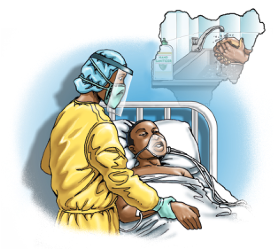
There should be effective mobilisation of trained health workers in addition to widespread public awareness campaigns on containment measures Early last May, the World Health Organisation (WHO) announced that the number of suspected Ebola cases in Democratic Republic of the Congo (DCR) and Uganda had risen to 600, with 139 suspected deaths. Following a WHO Emergency Committee meeting in Geneva at the time, Director-General Tedros Adhanom Ghebreyesus confirmed to reporters that the virus remained a public health emergency of international concern, but not a pandemic emergency. “The WHO assess the risk of the epidemic as high at the national and regional levels and low at the global level,” Tedros said in a report that was meant to put many African countries on the alert. In response, Nigeria announced the establishment of a Presidential Task Force on Ebola Virus Disease Preparedness and Emerging Public Health Threats and ordered the immediate release of N10 billion as emergency intervention funding. Nothing was heard about that committee until Tuesday when the federal government confirmed one case of Ebola disease in the Federal Capital Territory (FCT). The patient, a woman who reportedly arrived in Nigeria on an international flight from Uganda, is currently in isolation and receiving medical care at a private hospital in the FCT, according to a statement by the Coordinating Minister of Health and Social Welfare, Muhammad Pate. Although there have been different claims on the identity of the woman, where she might have contracted the disease and the origin of the virus she carries, what matters is the national response. Thus far, all important stakeholders in Nigeria seem to be on the same page and we hope it stays that way. Calling on health facilities in the country to be on high alert, Pate said 44 close contacts identified so far include healthcare workers, patients, caregivers, and travel contacts, while public health teams identify and monitor people who may have been exposed. It is noteworthy that there is no report that any other person has been infected, but health authorities cannot afford to let down their guard. It is essential that markets, churches, mosques and all public places be made to apply the usual protocols in dealing with crowds. Ebola is a deadly viral disease which kills victims within a week of infection, leaving little or no time for treatment. It takes between two days to three weeks before the complete symptoms manifest. The disease has most of the symptoms of malaria: fever, sore throat, headache, vomiting, etc. And the virus spreads through close contact with blood and bodily fluids of infected persons or animals such as fruit bats. According to DRC health authorities, the current outbreak in the country was fuelled by the Bundibugyo strain, a type of Ebola virus for which no vaccine or treatment currently exists. Nigeria had once experienced the Ebola challenge. The outbreak of the viral disease in 2014 spread panic in the West African sub-region and led to the deaths of some 11,300 people mostly in Liberia, Sierra Leone and Guinea. In Nigeria, Ebola claimed eight lives, including Dr. Ameyo Adadevoh of the First Consultant Hospital, Lagos. The index case in Nigeria at the time was a Liberia-American, Patrick Sawyer who flew into the country with the virus and died in July 2014. The swift and coordinated efforts by health authorities at all levels and other stakeholders were instrumental to containing the virus as the WHO declared the country Ebola-free on 20 October 2014. Since the Ebola viral disease is not indigenous to Nigeria, it could only be imported into the country through the borders – land, sea and airports. In 2014, there were surveillance teams at major points of entry into the country. Passengers were screened amid following up on individuals who had travelled from affected areas. There was also an effective mobilisation of trained health workers in addition to widespread public awareness campaigns on containment measures against the disease. For these efforts, the international community commended the federal government and health authorities in Lagos State for the adequate response in dealing with the deadly disease at the time. Those lessons must serve the country as we deal with the current Ebola virus threat.
DEALING WITH THE EBOLA THREAT
Full Article
Original Source
Read the full article at Thisdaylive →KhanList aggregates and links to publicly available news content. We do not host full articles from third-party sources. Always verify important information with original sources.