
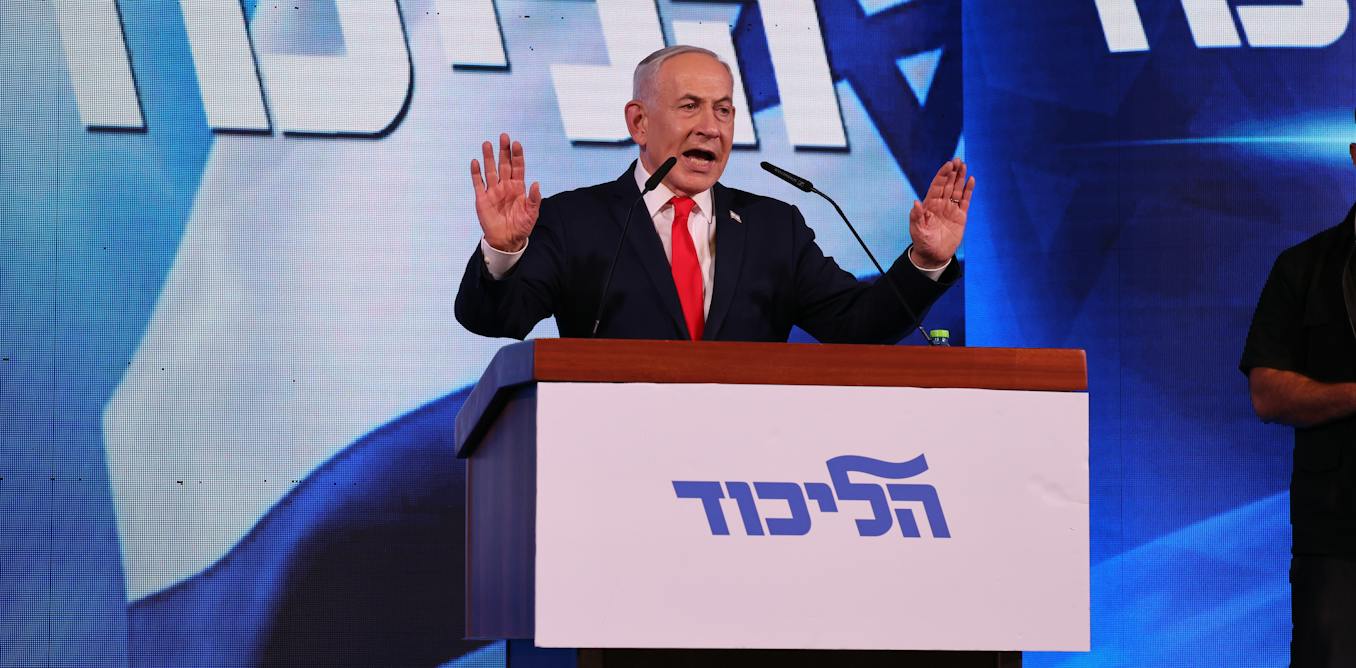
The Israeli political system presently revolves around three blocs jockeying for position after the election failed to provide a decisive outcome. Based on the latest figures – which are likely to change as absentee ballots and army votes are counted – the prime minister, Benjamin Netanyahu, currently leads a coalition based around his own party, Likud, which will have 26 seats in the new parliament, or Knesset. Read more: Israel election by the numbers: who might form the next government? Likud is joined by Shas, United Torah Judaism (UTJ) and Otzma Yehudit (Jewish Power), each of which has seven seats and the Religious Zionist Party, which has six. This gives him control of 53 seats, short of the 61 seats needed to form a majority government. His leading opponent, Gadi Eisenkot, leads a “change” coalition centred on his Yashar! (Truthful) party, which has 21 seats. Yashar! is joined by Together, with 13 seats, the Democrats with eight, and Yisrael Beiteinu (Our Home or IOH) with seven. This adds up to 48 seats. A third bloc includes the two Arab minority parties: the Joint List with 11 seats and Ra'am with eight, making 19 seats in the new Knesset – more than Arab parties have ever won before. Both of the Arab parties oppose Netanyahu, but they have been rejected as possible partners in a coalition by some members of Eisenkot’s change bloc. This was an extraordinary election: it was held under ideal conditions for Israel’s anti-Netanyahu change coalition. Tens of thousands of Israelis flew home to vote, mostly against Netanyahu. Israel’s Arab minority was also motivated, with turnout estimated at nearly 80%. This was largely in response to the hardline anti-Arab policies promoted by the Netanyahu government’s far-right ministers Itamar Ben-Gvir and Bezalel Smotrich. Read more: Two small Arab parties may decide Israel’s election But this was still not enough for a decisive opposition win. So the result of this campaign, which went to the core of Israel’s view of itself, the resilience of its democracy and future trajectory, is still Netanyahu as the leader of the largest party. While the final results will be known early next week, Netanyahu’s bloc is far from a majority. Importantly, the four coalition parties appear to have lost a combined 10-13 seats. Arab parties shunned Yet, despite supporters of Netanyahu holding a minority of seats, an alternative coalition government is still unlikely. This is because Eisenkot and his opposition partners have largely accepted the firewall that Netanyahu and the far-right have raised over collaboration with Arab parties. The view that any collaboration with Arab parties is tantamount to support for terror is a strong one. It binds, to a large extent, the leaders of the change coalition bloc. Only one party in this bloc – which purports to represent the liberal vote – has openly agreed to collaborate with Arabs. Yair Golan, leader of the Democrats party, which is a merger of the far-left Meretz and the centre-left Labour parties, has said: “The bloc opposing Netanyahu holds 67 seats, while Netanyahu has only 53. I believe that right now, we must declare that we are going to form a new government and a new coalition.” But Eisenkot has set conditions for joining any coalition he leads. These include the recognition of Israel as a Jewish state and a commitment to conscription or civil service for all citizens. These are conditions that will not be accepted by the larger party in the Arab bloc, the Joint List. Challenger: Yashar! party leader, Gadi Eisenkot. EPA/Atef Safadi Naftali Bennett, a former prime minister and the leader of the the Together party, declared that after October 7 there is “no mandate” to collaborate with Arab parties. Avigdor Lieberman, leader of Yisrael Beiteinu also rejects the idea. Political stalemate The gap between the change coalition leaders and the Arab parties – already seemingly too deep – will only widen. Netanyahu will use the coming weeks, as he continues in the role of caretaker prime minister pending negotiations over who should form the next government, to continue his long delegitimisation campaign against the Arab parties. The other option facing the change bloc parties is to call on the ultra-orthodox parties (Shas and UTJ) to abandon Netanyahu’s bloc to join the change coalition. This pathway seems blocked by the issue of military conscription. The bloc leaders are committed to a reform which would end the exemption to military service for ultra-orthodox youths. And ultra-orthodox parties have basically become a one-issue pressure group focused on avoiding conscription at all costs. These inner splits within the change coalition leave Netanyahu in a strong position. He can delay, delegitimise and point to what increasingly looks like the most likely path: a grand coalition of the major Jewish parties (mainly Likud, Yashar, Together, and Yisrael Beiteinu) that keeps him as the prime minister. However, during the campaign, all six opposition parties committed not to join a coalition led by Netanyahu. A key question will be who the president, Isaac Herzog, will give the mandate to form a government. The mandate to form a government is given to the person whom the president believes is the most likely to form a government after consulting with all party leaders. Combined with the Arab parties, more legislators are likely to recommend Eisenkot for that role. But given that the paths to cooperation with Arab and ultra-orthodox are probably shut, the most likely outcome is a deadlock. In the meantime, the change bloc can gain control of important legislative positions even without forming a government. The next Knesset will be sworn in on November 10, and the opposition will be able to replace speaker of the Knesset who controls much of the legislative agenda, as well as taking control of important standing committees. At the same time, Netanyahu remains in control of the government as a caretaker. As the conflict with Iran is likely to flare up, a rally-around-the-flag effect could lead to another coalition under Netanyahu – or, at the very least, keep him in power for a longer period. The underlying issue is the growing tribalism in Israel. Netanyahu controls his tribe, mainly conservative and religious Jews. Arab voters are another, and the ultra-orthodox a third. The liberal tribe headed by Eisenkot is split – and its lack of cohesion makes a reversal of Israel’s current trajectory unlikely. The tribalism of Israeli society and parties, the lack of cohesion within the liberal tribe and Netanyahu’s ability to shape the narrative and legislative arithmetic make a significant change improbable. Real change is blocked unless the change bloc leaders accept that another election or joining a government with Netanyahu would only make things worse.
Deadlock ahead for Israel as election fails to deliver an alternative to Netanyahu coalition
Full Article
Original Source
Read the full article at Theconversation →KhanList aggregates and links to publicly available news content. We do not host full articles from third-party sources. Always verify important information with original sources.