
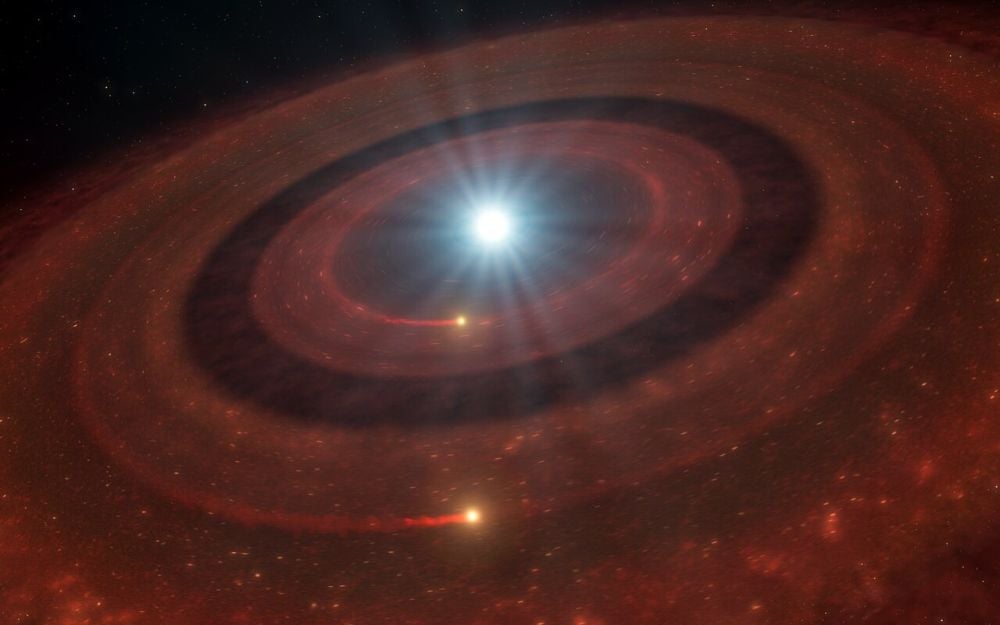
All stars die eventually, but they don't all die the same. A star's death is determined by its mass. Only the most massive stars die in supernovae explosions, and those calamitous explosions announce their death in a burst of pent-up light, an exclamation point marking the end of their lives of fusion. But our Sun, a more moderately-sized star, will experience a much different end. As it burns its fuel and slowly loses mass, it well eventually lose it gravitational hold on its outer layers of gas. It will expand, and the outer layers of gas will be expelled into the space around star, creating a gorgeous planetary nebula, quite possibly Nature's most beautiful creation. The nebula will last tens of thousands of years, and after that, only a cinder-like white dwarf will remain. Fusion will be a distant memory for this stellar corpse, which will radiate only remnant heat. White dwarfs spend an astronomical eternity in this state, until they eventually cool enough to become a black dwarf. But the Universe hasn't existed long enough for any of those to form yet. There's another part of this transition to white dwarf, and it's destructive. When a star like our Sun expands on its way to becoming a white dwarf, it engulfs and destroys its inner planets. In our case, the Sun will definitely destroy Mercury and Venus, and almost certainly destroy Earth. When astronomers gaze out into the heavens, they find many planetary nebulae (a historic name that has nothing to do with planets), lit up by the white dwarfs in their centers. Sometimes, they find something else. Sometimes, they find a debris disk made up of the planets that once orbited the star. For a long time, astronomers have speculated that planets can form out of this debris, a strange, second chance at almost-life. It's highly unlikely that life could once again spawn on one of these resurrected planets orbiting a zombie star. But it's a huge Universe, so you never know. Astronomers recently found a white dwarf surrounded by a debris disk that's split into two components. This could signal the presence of planets. These findings are presented in research titled "A double debris disc around a white dwarf sculpted by two planetary bodies." It's published in Nature Astronomy, and the lead author is Nicola Gentille Fusillo. Gentille Fusillo is an astronomer at the Università degli Studi di Trieste, (Universe of Trieste) in Italy. “The system is a rare glimpse of the violent, chaotic process by which a planetary system meets its end, and it hints that dead stars can have disc structures far more complex than previously realised.” - Nicola Gentille Fusillo, Università degli Studi di Trieste. "Many planetary systems survive the metamorphosis of their host stars into white dwarfs, as demonstrated by the detection of dusty circumstellar discs around these stellar remnants and chemical signatures of planetary debris in atmospheres of these stars," the authors write, though survive might not be exactly the right word. In any case, dust is common in these disks, while gas is less common, having been found in only 21 of them. "All of the 21 known gas discs exhibit double-peaked line profiles characteristic of a rotating flat disc," the researchers write. "The mechanism behind the generation of gas is still debated, but for at least one system it has been linked with the presence of a surviving planetesimal embedded within the dust disc." Astronomers think that planetesimals in disks around white dwarfs generate gas from the dust through collisions. If the planetesimal is moving fast enough through the disk, then when it collides with dust it could vapourize it into gas. This is the most likely mechanism, though others are also proposed. So the presence of gas is one indication that a planetesimal is orbiting the white dwarf. Another indicator is the line profile, which is not double-peaked, but quadruple-peaked. "Here we report the discovery of WD J132800.85–145019.95, a new gas-disc system that exhibits quadruple-peaked instead of double-peaked line profiles," the researchers write. "These emission lines originate from two separate gaseous rings extending from 0.14 R⊙ to 0.34 R⊙ and from 0.54 R⊙ to 1.93 R⊙." The top panel shows the quadruple-peaked line profile for WD J132800.85–145019.95, the subject in this research. The bottom panel shows the double-peaked line profile for SDSS J1228+1040, which is considered the prototypical white dwarf with a gas disk. "The morphology of the emission lines in WD J1328–1450 indicates the presence of two concentric discs around this white dwarf," the authors write. Image Credit: Gentile Fusillo, N.P., Lagos-Vilches, F., Gänsicke, B.T. et al. A double debris disc around a white dwarf sculpted by two planetary bodies. Nat Astron (2026). https://doi.org/10.1038/s41550-026-03004-3 “The structure we see in this system is particularly intriguing because the two gaseous rings are remarkably stable and remain separated by a gap,” study co-author Felipe Lagos-Vilches, an astronomer at the University of Warwick, UK, said in a press release. “The system is a rare glimpse of the violent, chaotic process by which a planetary system meets its end, and it hints that dead stars can have disc structures far more complex than previously realised,” added lead author Gentile Fusillo, who is also affiliated with the INAF-Astronomical Observatory of Trieste. There are probably two small planets, or planet-like bodies, responsible for the disk's structure. Each is on its own orbit. The inner one isn't much more than an asteroid, only a few kilometers in diameter. The other is about the size of Pluto, or maybe as large as the Moon. Astronomers rely on the red-shift and blue-shift of light to detect gaseous disks like the one around WD J1328–1450. Gas moving toward us is blue-shifted, and gas moving away is red-shifted. In a rotating disk, the gas on one side is moving toward us, while the gas on the other is moving away. The shifted light on each side is detected with a spectrograph, which illustrates the shifts as shown in this diagram. In this case, the two disks are rotating at different speeds, creating four peaks. Image Credit: ESO/L. Calçada The disks not only move at different speeds, but they appear to have different compositions. The inner ring seems to be enriched in magnesium, while the outer ring is stripped of magnesium. It's possible, but far from proven, that each disk originated from a destroyed planet with different compositions. Another possibility is that each ring formed from a different part of the same planet, the core and the crust, for example. Adding to the mystery is the nature of the two planet-like bodies. The inner planet must be very dense or have very high internal strength, otherwise it would be torn apart by tidal forces at such a close distance to the white dwarf. If it lacked internal strength, then "it would need to have a density higher than any known material, ranging from ≳3,600 g cm−3 at the inner edge to ≳252 g cm−3 at the outer edge," the authors explain. "In the outer disc, the highest required density is ≳63g cm−3, over three times that of the densest exo-planet." "Therefore, we conclude that any planetesimals surviving within the discs must possess some degree of internal strength," the researchers write. This figure shows the double-disk structure around WD J1328–1450 (inner disc A, outer disc B) and the gap to scale. The colour gradient reflects the brightness profile of the discs. Image Credit: Gentile Fusillo, N.P., Lagos-Vilches, F., Gänsicke, B.T. et al. A double debris disc around a white dwarf sculpted by two planetary bodies. Nat Astron (2026). https://doi.org/10.1038/s41550-026-03004-3 "The detection of this stable double-disc presents a new challenge for the current models of debris disc formation and evolution," the authors write. Astronomers have known about these gaseous debris disks around white dwarfs for two decades, but how they form, the architectures they develop into, and how they evolve over the long-term is not well understood. "The discovery of a stable double debris disc around WD J1328–1450 provides additional observational constraints for the development of physically more detailed models for these discs." This system could offer a glimpse into our Solar System's future, where the Sun expands and vapourizes Earth and the other inner planets. It's possible that some time in the future, billions of years from now and long after humanity has gone extinct, this is all that remains of our home. “The system therefore offers a remarkable glimpse of what the future of planetary systems, including systems like our own, might look like,” said Lagos-Vilches.
Dead Planets Orbiting a Dead Star
Full Article
Original Source
Read the full article at Universetoday →KhanList aggregates and links to publicly available news content. We do not host full articles from third-party sources. Always verify important information with original sources.