
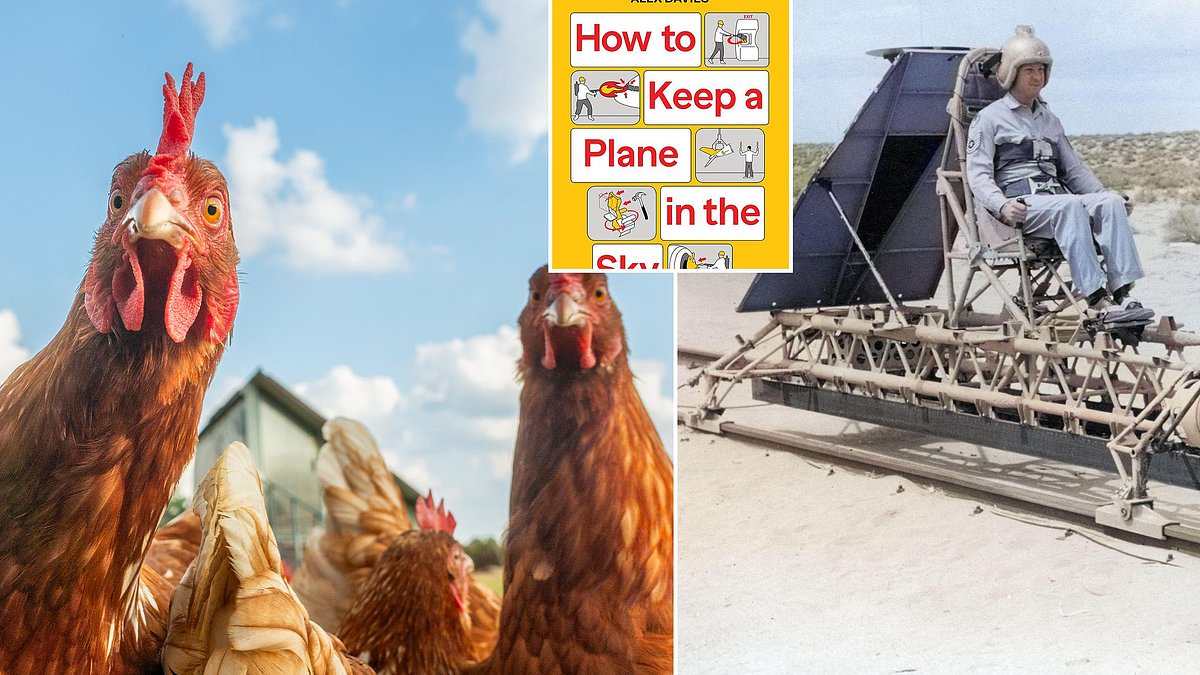
My children are convinced that I deliberately take them to the most boring attractions I can find. How else to explain our recent outings to the John Lewis Heritage Centre, for instance, or the Museum of Berkshire Aviation? But the truth is, I am now deeply embedded in what the Danish philosopher Soren Kierkegaard calls the ethical stage of life. That means I am less interested in Byron than in Brunel. Art has made room for engineering. Which is one reason why I reached for this quirky book about the unsung heroes of that world.It was all very well for the Wright brothers to invent aeroplanes, but someone had to check that they were safe. This is the job of the test engineers. Because when you take a soft-bodied human into the clouds encased in a thin shell of metal, there are lots of things that can go wrong. Birds, for instance. Remember the scene in Indiana Jones And The Last Crusade when Sean Connery shoos up a flock of seagulls to foul the propellers of a hostile fighter pilot? Unfortunately, this kind of thing also happens by accident, with devastating results.That partly explains why, to quote the subtitle of this offering from American journalist Alex Davies, the ‘wild’ world of test engineering is often ‘unseen’. It isn’t for the fainthearted. In 1960, 62 people died after their plane was brought down by errant starlings. This prompted the Federal Aviation Administration to invent tests that involve firing volleys of dead chickens out of a cannon at rotating aeroplane propellers. The aim, amid the explosions of blood and feathers, is to develop propeller designs that can withstand avian impact.Descending from the sky to terrestrial bird-related problems, consider that, in America, more than a billion birds perish each year after flying into panes of glass. Which explains the bird-safe glass testing tunnels of the American Bird Conservancy. A bird flies at the exit, half of which is open, half screened by glass specially marked to be seen by birds but not humans. Bird-lovers will be relieved to learn that no birds are hurt in these experiments. Whichever way they fly, they first blunder into invisible netting, which protects them from harm. Like the remit of test engineers, this book divides roughly into two. There are operational risks, which are what can happen, owing to rogue external factors, even when a device is performing its proper function. Then there are non-operational risks, which are what can happen when a device malfunctions or disintegrates, owing to ordinary wear and tear. Colonel John Stapp demonstrates the efficacy of seat belts A classic example of an operational risk relates to the use of circular table saws. It’s not the table saw’s fault that ten fingers are lopped off every day in America by careless carpenters – ‘two hands’ worth’, as Davies wryly points out. The solution is the SawStop device. With the SawStop, when a finger touches the whirring blade, it completes an electric circuit. This triggers a spoke that jams the wheel. Result: light bleeding but no loss of digits. Trouble is, the SawStop is expensive, so isn’t widely used. Those fingers keep falling.When it comes to non-operational risks, Air Force officer John Stapp is a hero. In the late 1940s, he volunteered to test at what speed a pilot could safely eject from a damaged plane. The question was what level of deceleration (measured in g’s) a human could withstand. In a series of tests, Stapp strapped into a sled on a short, sharp railroad known as a linear decelerator. This shot him out at vast speed, before braking violently. During testing, Stapp broke both his wrists and lost several fillings. Finally he survived an ordeal of 40g’s: more than twice the perceived limit of 18g’s. Afterwards, for eight minutes, he found that he was unable to see. In a lovely understatement, this was referred to as ‘reversible incapacitation’.Book reviewers, of course, are the test engineers of literature. To measure the operational risks of any new publication, we strap ourselves in and give a thumbs-up, before exploding out along the verbal railroad. In the case of How To Keep A Plane In The Sky, I can confirm that the ride is completely safe – a little too safe, perhaps. I didn’t black out or lose fillings. The treatment felt conscientious rather than compelling. Davies doesn’t bring his human heroes to life, which is a key test of any work of non-fiction. How to Keep a Plane in the Sky is available now from the Mail Bookshop I was left wanting to know more about John Stapp, and about Elisha Otis, who in 1854 was so confident of his device for jamming a falling elevator that he publicly demonstrated it with himself as the guinea pig.On the plus side, Davies explains things about the world that we would be unlikely to learn elsewhere. The reason fridges close magnetically is because, back when they had external latches, children used to hide in them, get locked in and suffocate. Another example? My three-year-old recently helped himself to a bottle of Nurofen. I was outraged, since the lid was supposed to be child-safe, but now feel obscurely consoled to learn that such lids are deliberately only 85 per cent child-safe. If you make them 100 per cent child-safe, too many adults also can’t open them.Test engineering isn’t perfect, but it’s heartening to read the success stories. Since the invention of those push-and-turn safety lids, the number of accidental child poisonings has fallen by 80 per cent.One thing Davies makes clear is that each new piece of technology brings with it a wave of new challenges for test engineers. The development of widely available electricity in the 19th century, for example, brought new dangers needing new solutions. The rise of AI is only the latest chapter in this story. It’s nice to know that out there somewhere, those white knights of Kierkegaard’s ethical stage are at work, shredding dead chickens and generally ensuring that life is that little bit safer for all of us.
Dead chickens and human crash test dummies...the bizarre world of test engineering
Full Article
Original Source
Read the full article at Dailymail →KhanList aggregates and links to publicly available news content. We do not host full articles from third-party sources. Always verify important information with original sources.