
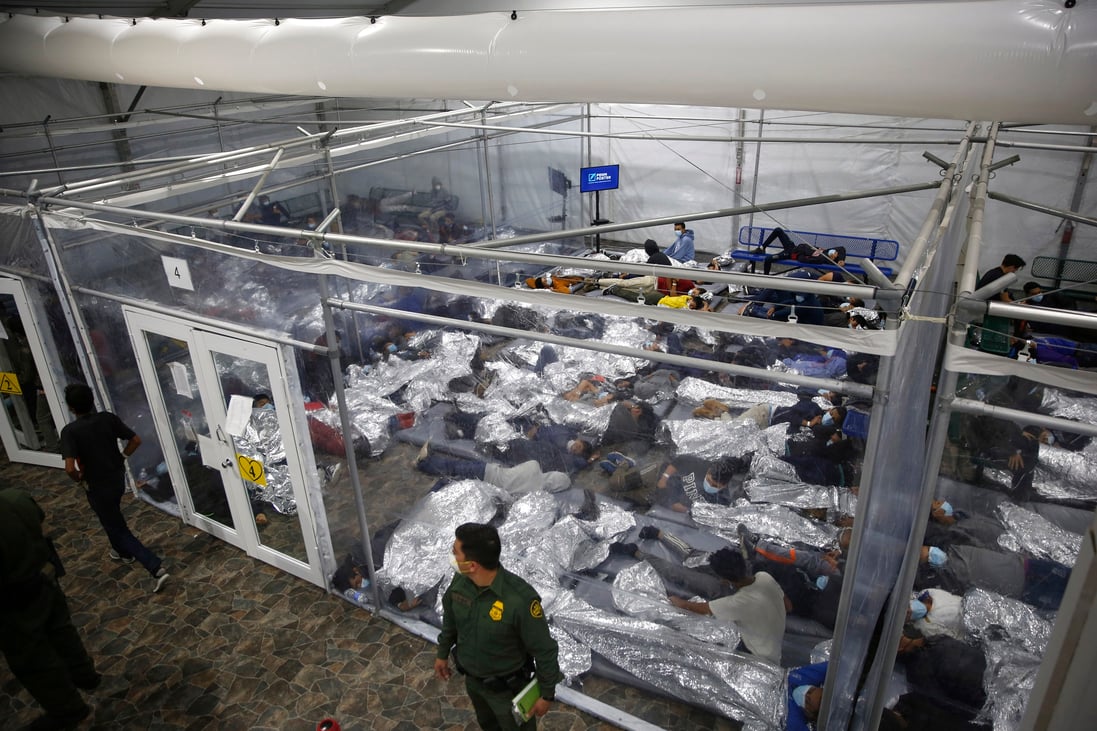
U.S. Circuit Judge Robert Wilkins said the policy could hypothetically be compared to government officials barring lawmakers from the Senate chambers, as oversight and voting are part of lawmakers' official duties.WASHINGTON (CN) — A D.C. Circuit panel appeared likely Tuesday to side with a group of Democratic House members in their lawsuit challenging a Department of Homeland Security policy blocking surprise oversight visits at immigration detention centers.The three-judge panel made up of U.S. Circuit Judges Robert Wilkins, Gregory Katsas and Bradley Garcia — a Barack Obama, Donald Trump and Joe Biden appointee, respectively — heard the Justice Department’s challenge to a federal judge’s Feb. 2 order freezing the requirement that lawmakers provide a week’s notice to conduct a visit.A group of 13 Democratic lawmakers, led by Colorado Representative Joe Neguse, filed the lawsuit in July 2025 and argued a recurring provision in each congressional appropriations bill since 2020 specifically bars the department from using its appropriated funds to prevent lawmakers from conducting oversight visits.The specific provision in the latest congressional appropriation bill in 2024, Section 527, also prohibits DHS from using the funds to make any temporary modification that in “any way alters what is observed by a visiting Member of Congress.”According to the Justice Department, the funds appropriated in 2024 to U.S. Immigration and Customs Enforcement expired in February 2026, thus rendering U.S. District Judge Jia Cobb’s order to comply with Section 527 effectively moot.Justice Department attorney Steven Myers urged the panel to restore the U.S. Immigration and Customs Enforcement policy, arguing the lawmakers lack standing to claim an injury to their official powers, and the policy impacts all members equally.He pointed to the 1997 Supreme Court case Raines v. Byrd, which he argued set the precedent that lawmakers lack standing to assert injuries to their powers that arise “solely because they are members of Congress.”“On the one hand, legislators might have standing to assert that they’ve been deprived of something to which they are personally entitled, what Raines describes as the loss of a private right,” Myers said. “Those are things like the loss of salary or a loss of your own personal seat in the legislature. But in contrast, Raines says a claimed injury to official authority or power that arises solely because they are members of Congress does not state an Article III controversy.”Wilkins, at the tail end of the hearing, directly challenged the government’s position with a series of hypotheticals in which the Department of Homeland Security closes streets surrounding the U.S. Capitol, blocks entrances to the Capitol and surrounding office buildings, or even the Senate chamber doors, all to pass a Trump-sponsored bill.Myers said any example would be a hard case for the government to win, but the question would center on whether “entering your place of work” amounts to an injury to an official power.“You don’t know that there’s a clear yes or no answer to that?” Wilkins responded, noting the point of such extreme hypotheticals is to test the government’s principles.Christine Coogle of the Democracy Forward Foundation, representing the lawmakers, argued the case centered on whether lawmakers have the same entitlement to sue over the deprivation of information as private citizens when denied documents in a Freedom of Information case.“There’s no principle or case law that would suggest that Congress has less authority to provide that kind of entitlement when conferring it on its own members,” Coogle said, noting depriving members of information directly harms their oversight abilities.Cobb ruled in December that an initial version of the policy violated a recurring provision in each congressional appropriations bill since 2020 that bars the department from using its appropriated funds to prevent lawmakers from conducting oversight visits or make any modifications that would hide conditions from lawmakers.DHS then enacted a nearly identical policy on Jan. 8, which the government defended during a Jan. 14 hearing as drawing funds exclusively from the One Big Beautiful Bill Act, not the department’s annual appropriations. The Big Beautiful Bill appropriated $191 billion to DHS, as well as Congress’ short-term continuing resolution, which maintains 2025 appropriation levels through Jan. 30, 2026.In her February ruling, Cobb rejected that representation after finding significant evidence the Jan. 8 policy was also “promulgated, implemented and is presently being enforced with the use of Section 527 funds.”Before the Jan. 14 hearing, Neguse informed Cobb that DHS blocked three members of Congress from conducting an oversight visit at an ICE facility in Minneapolis on Jan. 9, despite the Biden appointee’s ruling.Congress’ oversight power is a longstanding and central part of the legislative body’s purpose, and the Supreme Court has repeatedly upheld it as necessary for effective lawmaking. The representatives noted in their July lawsuit that the power is as “penetrating and far-reaching” as Congress’ appropriations powers, citing the 1959 case Barenblatt v. United States.Subscribe to our free newslettersOur weekly newsletter Closing Arguments offers the latest about ongoing trials, major litigation and rulings in courthouses around the U.S. and the world, while the monthly Under the Lights dishes the legal dirt from Hollywood, sports, Big Tech and the arts.Additional Reads
DC Circuit signals ICE ban on surprise lawmaker oversight visits unlawful
Full Article
Original Source
Read the full article at Courthousenews →KhanList aggregates and links to publicly available news content. We do not host full articles from third-party sources. Always verify important information with original sources.