
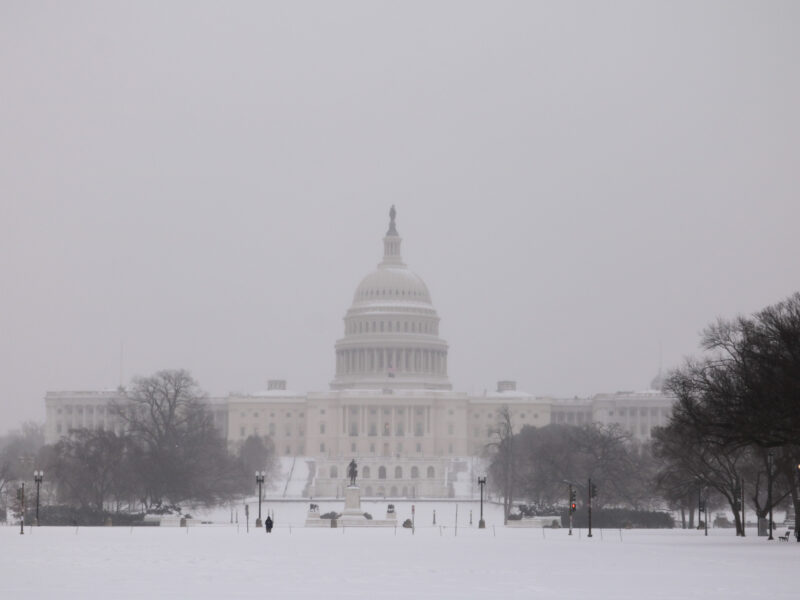
In a split decision, Trump appointee Neomi Rao ruled the Eastern Steps of the U.S. Capitol are a nonpublic forum and a “demonstration ban” was too restrictive under the First Amendment.WASHINGTON (CN) — A split D.C. Circuit panel ruled Tuesday that U.S. Capitol Police cannot ban demonstrations on the steps of the Capitol due to lack of sponsorship from a member of Congress, finding it a First Amendment violation that wrongfully bars demonstrations for less popular issues.In a 2-1 decision, the appellate panel sided with Reverend Patrick J. Mahoney, a Presbyterian minister who had planned to pray on the Eastern Steps of the U.S. Capitol on Sept. 11, 2021, and sued in advance to challenge the ban.U.S. Circuit Judge Neomi Rao, a Donald Trump appointee, wrote the majority opinion, joined by U.S. Circuit Judge Karen Henderson, a George H.W. Bush appointee.“Although the Eastern Steps are a nonpublic forum, the regulations are not reasonable because an individual’s right to demonstrate outside the Capitol cannot turn on the discretion of a member of Congress,” Rao wrote. “The universal injunction, however, exceeded the district court’s equitable authority. We therefore affirm the grant of summary judgment for Mahoney on his First Amendment claim but vacate the injunction and remand for the district court to determine the appropriate scope of relief.”The majority found that, under the Supreme Court’s decision in Trump v. CASA to ban universal injunctions, Chief U.S. District Judge James Boasberg’s injunction must be vacated and replaced with an injunction tailored to Mahoney’s case.The Capitol Police Board promulgated its Traffic Regulations for the U.S. Capitol Grounds in February 2025, which permit the public free use for recreational activities like sightseeing, exercising and dog walking. However, “demonstration activity” is permitted only in certain areas throughout the grounds, with three stairways leading into the Capitol’s East Front largely closed for any such activity.Prior to the Sept. 11 terrorist attacks, the steps were open to the public, including for demonstration activity. Now the steps are cordoned off in all but the lower section.The board carved out an exception allowing members of Congress and their staff to use the steps to enter and exit the Capitol, as well as granting members the ability to sponsor or organize their own demonstrations. To do so, they must sponsor the protest in their “official capacity” and attend the demonstration in full.Rao highlighted examples of demonstrations, such as when Democratic Representative Cori Bush organized an overnight demonstration protesting the end of the Covid-19 eviction moratorium and when Senator Cory Booker and Representative Hakeem Jeffries hosted a 12-hour sit-in to protest a proposed budget.Boasberg granted Mahoney summary judgment, but only after extensive litigation resulted in the minister agreeing to limit his claims to his First and Fifth Amendment challenges to the demonstration ban. Boasberg, a Barack Obama appointee, ruled the Eastern Steps a traditional public forum as they had historically been open to expression and prohibited substantially more speech than necessary for security.Rao partially disagreed, finding the steps are a nonpublic forum because they are integrated with the Capitol Building and are distinct from the surrounding Capitol Grounds.“The board justifies the demonstration restrictions as necessary to allow the safe passage of members and staff into and out of the Capitol,” Rao wrote. “Despite this safety rationale, however, the board permits even large public demonstrations when sponsored by a member of Congress. If a particular cause garners the support of a member, demonstrations are allowed. Individuals and groups that lack the political power to secure a member’s support are out of luck.”Senior U.S. Circuit Judge Judith Rogers, a Bill Clinton appointee, agreed with her colleagues that Boasberg should reshape his injunction for Mahoney, but dissented to note her view that the Eastern Steps are a traditional public forum and the demonstration restriction should be thrown out in full.Rogers wrote that the majority wrongly ignored the D.C. Circuit’s Vietnam War-era decision *Dellums v. Powell,*which determined the Eastern Steps are a traditional public forum.Rogers further pointed to the extensive history of protests on the Eastern Steps — such as a pro-suffrage march by thousands of women in May 1914, the 1932 demonstration by World War I veterans demanding payment for their services and the 1990 demonstration by 60 disability rights activists for the passage of the Americans with Disabilities Act.“Yet despite the long line of precedent and tradition of expressive activity on the Eastern Steps, the majority concludes that the Eastern Steps are a nonpublic forum, largely because the steps are ‘physically integrated with the Capitol,’ and their ‘specialized purpose’ is to ‘provide a secondary entrance and exit to the Capitol for members of Congress and their staff,’” Rogers wrote. “This conclusion too rests on faulty premises.”Subscribe to our free newslettersOur weekly newsletter Closing Arguments offers the latest about ongoing trials, major litigation and rulings in courthouses around the U.S. and the world, while the monthly Under the Lights dishes the legal dirt from Hollywood, sports, Big Tech and the arts.Additional Reads
DC Circuit sides with minister in battle over Capitol steps protests
Full Article
Original Source
Read the full article at Courthousenews →KhanList aggregates and links to publicly available news content. We do not host full articles from third-party sources. Always verify important information with original sources.