
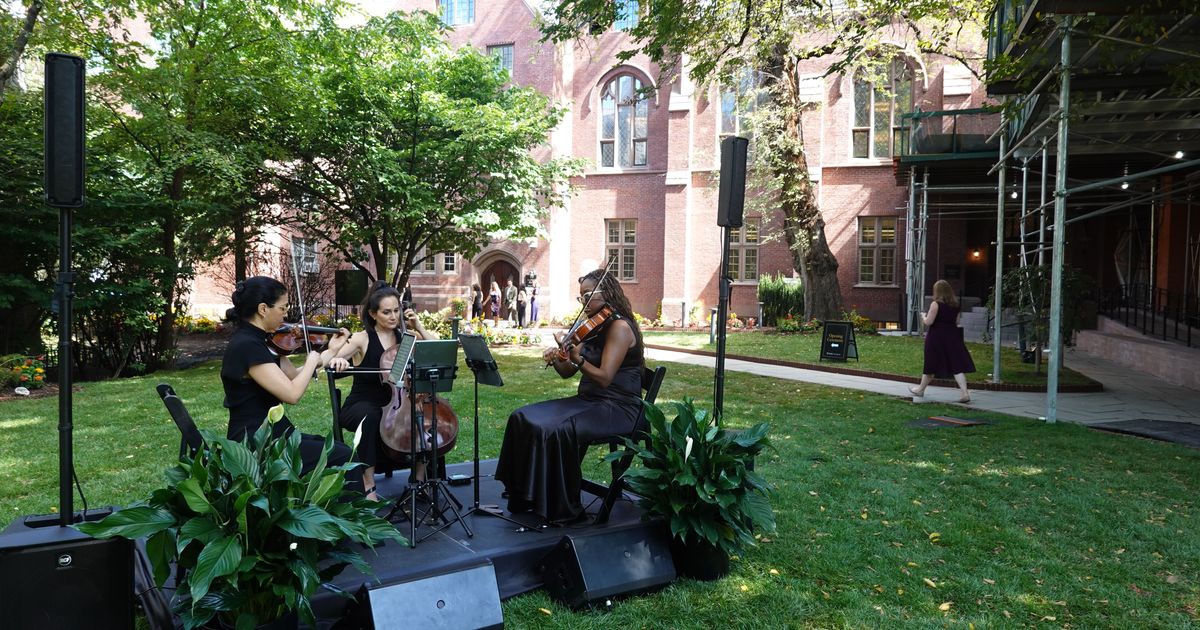
Day One at Vanderbilt’s New York Campus By , an Emmy Award–winning Curbed writer who has reported on New York City for four years A string trio plays at the opening of Vanderbilt’s new campus in Chelsea. Photo: Adriane Quinlan When a 20-year-old from Tennessee arrived in New York City for the first time this week and stepped onto Vanderbilt University’s new satellite campus in Chelsea, she looked around and saw more of the same: the same red 19th-century Gothic buildings she might find on the quad in Nashville, the same dense canopy of trees. Her classmates didn’t seem too different either. “It’s a lot of finance kids who came here to network,” she said. “I’m also going to network — but in a different way.” Ella, which isn’t her real name, plans to spend the semester chasing a career in the arts — not exactly what administrators had in mind when they first envisioned the work-study program they would establish at the seminary. “When you think about coming to New York City and you think about internships, folks think Goldman Sachs, Bank of America, Google, Related,” said James Kellerhouse, the vice-chancellor hired to steer the project. Instead, Kellerhouse was surprised by the number of applicants dreaming about internships in social work, urban design, and art. “What they were looking for was something that was a little bit different,” he said. “We have one art museum in Nashville,” said senior Sophie Azar with theatrical emphasis. She signed up for a class in museum studies that promised field trips to the Frick and the Met, not exactly a requisite for her economics degree. Brianna Lai, a psychology and computer-science major who’s in the same class, said she’s particularly looking forward to a field trip for the entire cohort to see A Few Good Men at Lincoln Center. Sure, Nashville has symphony orchestras, live bands, bluegrass — but not a lot of Broadway shows. 87 students form the campus’ first cohort. They have internships at Tishman Speyer and Merrill Lynch, but also at the High Line and the American Museum of Natural History. Photo: Courtesy of Vanderbilt University It’s not surprising that a stream of young transplants is once again arriving in Chelsea, ready to throw itself on the art world and gaze up at the footlights. What is sort of funny is imagining how immersion in the city’s cultural scene fits into Vanderbilt’s broader ambitions. The Chelsea campus is the first satellite opening as part of an expansion helmed by business-savvy chancellor, Daniel Diermeier, who raised $3 billion in donations, made the school’s motto to “Dare to Grow,” and hired the first chancellor focused on real estate, a strategist who built Harvard an “innovation district” to rival MITs. This is how colleges compete for the last families able to pay full tuition and survive, an era that education professor Ryan Allen calls the “Age of Conquest”: Following the model set by Northeastern, they buy up the campuses of struggling schools and rebrand, like high-end retailers opening new shops closer to a new base of customers. More locations means more paying students, wider brand recognition, and perhaps a chance to launch the high-paying careers of alumni who might someday fund another satellite. Or at least that’s the theory. And Vanderbilt’s new locations map onto where the money is. A new $520 million business school in West Palm Beach (partly funded by developer Stephen Ross, who’s building a mini-empire of his own there) is a 15-minute drive from Mar-a-Lago and will offer degrees in “finance, management, engineering, space technology and innovation, defense technology and manufacturing, and business innovation.” In San Francisco, a hub for 1,000 students who might graduate into Silicon Valley jobs is backed by a $75 million investment from the founder of Nvidia. The West Palm Beach site takes over a campus already zoned for a college that wasn’t built, San Francisco’s first class will step into the rooms left behind by the last cohort of the California College for the Arts, and in Chelsea, Vanderbilt undergrads are moving onto a gated green that was built to educate Episcopalian priests, the General Theological Seminary. It had been struggling to stay afloat, selling off buildings and air rights. It began offering low-residency options and was considering a deal with a right-wing, Catholic institution before a Vanderbilt alum living nearby heard the news and called in Diermeier. The bulk of the Gothic buildings was designed by Charles C. Haight, who also designed much of Yale University. Photo: Courtesy of Vanderbilt University Vanderbilt added to the landscape, planting 1,500 flowers and thicker hedges to buffer the space from neighbors. Photo: Barry Williams This week, Diermeier arrived at the launch party for the campus in Chelsea after ringing the opening bell on NASDAQ. He darted among servers offering cucumber waters as he accepted congratulations from politicians and professors on his way to Hoffman Hall. The 1900 building, in the campus’ northwestern corner, is one of its jewels — a vaulted room hung with candelabras lit for the campus opening in gold and blue, the school colors. Vanderbilt has been renting this impressive room for weddings to help fund its restoration, but the space was built for a humbler purpose: to serve as the dining hall for student priests. They will still be able to use the grounds: The university’s 99-year-lease allows seminarians to return for six-week stretches to meet in person after months of remote learning. The university’s deal also keeps the seminary afloat through its payment of $44.3 million and by paying for the restoration of its buildings — work last estimated to cost around $30 million. As he made clear from his opening remarks, Diermeier sees an obvious value in making the investment in New York. “There are few places in the world where so many forces shaping our future converge,” he said. As for whether he intended to create a pipeline for students to become artists and social workers, Deiermeier seems thrilled by the idea. “Being more prevalent in the arts is always important for us,” he says. “There’s no or. It’s always and.” Vanderbilt’s mascot poses for a social photo in the 19th-century Chapel of the Good Shepherd. Photo: Adriane Quinlan Vanderbilt’s foothold in the city is well-established. Eleven percent of the school’s incoming students already come from New York, and it’s the biggest alumni network outside of Nashville. So it makes some sense that Diermeier’s team moved quickly to snap up a location here, especially when the seminary campus is one of the city’s nicest. As Ella noted, it bears a striking resemblance to the look of the grounds in Nashville, and offers the same sense of insulation from the world at large, an unlikely extension of the “Vandy bubble” in a place like New York. “Nashville students should come to New York and feel at home,” said Kellerhouse. Cosmetic upgrades extend Vanderbilt’s brand: furniture comes from the college’s in-house provider; classrooms were upgraded with tech that matches what’s in Nashville; and the palette of white, navy, and gray fits the school’s branding, as do the marigold-colored banquettes in a new student center. New wayfinding signs are in Vanderbilt’s preferred font (Libre Calson), and the school’s name is shown in gold lettering above a new iron gate on 21st Street. Nathaniel Rogers of Beyer Blinder Belle, the architecture firm commissioned to update the campus, also spiffed up the dorms. But the units are monastic, at least by the standards of Nashville upperclassmen, who usually live in singles or in apartments off campus. There are shared bathrooms, no kitchens in the units, and little wasted space. “Frankly, there will be more double occupancy just because it’s New York and everyone’s very lucky to be in New York,” Rogers said. “We want people to be outside their rooms as much as possible. You’re in Chelsea in Manhattan. What an extraordinary place to be.” Daniel Diermeier ahead of a ribbon cutting in the refectory. The Chronicle of Higher Education called him the country’s “most divisive” chancellor. Photo: Courtesy of Vanderbilt University In a way, the emphasis on the porous boundary between the campus and the city mirrors what the seminary itself intended for its future priests. “The setting in the heart of New York City meant we saw and felt the degradation of blacks, Puerto Ricans, Jews, and immigrants who hurled by us as we left the seminary and went out into the city and world,” recalled a student who arrived in 1953. The campus leaned progressive — graduating civil-rights leaders and accepting women before the church allowed them to be priests — and the seminarians did volunteer work that put them in daily contact with the poor and with the victims of the AIDS epidemic that exploded just outside the gates. The location pushed the seminary’s politics to the left, but poverty and activist flags are harder to find in Chelsea these days. What’s here: hundreds of the world’s most loaded art galleries and a corridor of starchitect-designed towers along the High Line. “They’re landing in a world-class center for art,” said Scott Rothkopf, the director of the Whitney, who agreed to host students for a field trip this semester, and showed up at the opening party — an easy ask, since he lives across the street. “There’s a business impact from arts and culture that I think is very important,” said Jeffrey Le Francois, the head of the Meatpacking District’s BID, who showed up for the party in a double-breasted white linen suit “And it’s nice for business and real-estate people to recognize that.” Students had a catered lunch on opening day this week before classes began. Some are taking courses in the city’s history and museum studies, in addition to more practical requirements. Photo: Adriane Quinlan On the lawn, juniors and seniors in branded beige T-shirts gathered at tables shaded by patio umbrellas, munching on peppery mac ’n’ cheese and sipping mocktails. Sophie Azar, the economics major trying out a course in museum studies, said she was looking forward to her fall internship, which isn’t at a bank, as one might expect. Instead, she’ll use what she’s learned in econ to help crunch numbers and think strategy for a nonprofit focused on people with disabilities. “Not everyone is here for lucrative careers,” she said. Day One at Vanderbilt’s New York Campus Your product is saved! You’ll receive emails when your saved products go on sale. Manage preferences.
Day One at Vanderbilt’s New York Campus
Full Article
Original Source
Read the full article at Curbed →KhanList aggregates and links to publicly available news content. We do not host full articles from third-party sources. Always verify important information with original sources.