
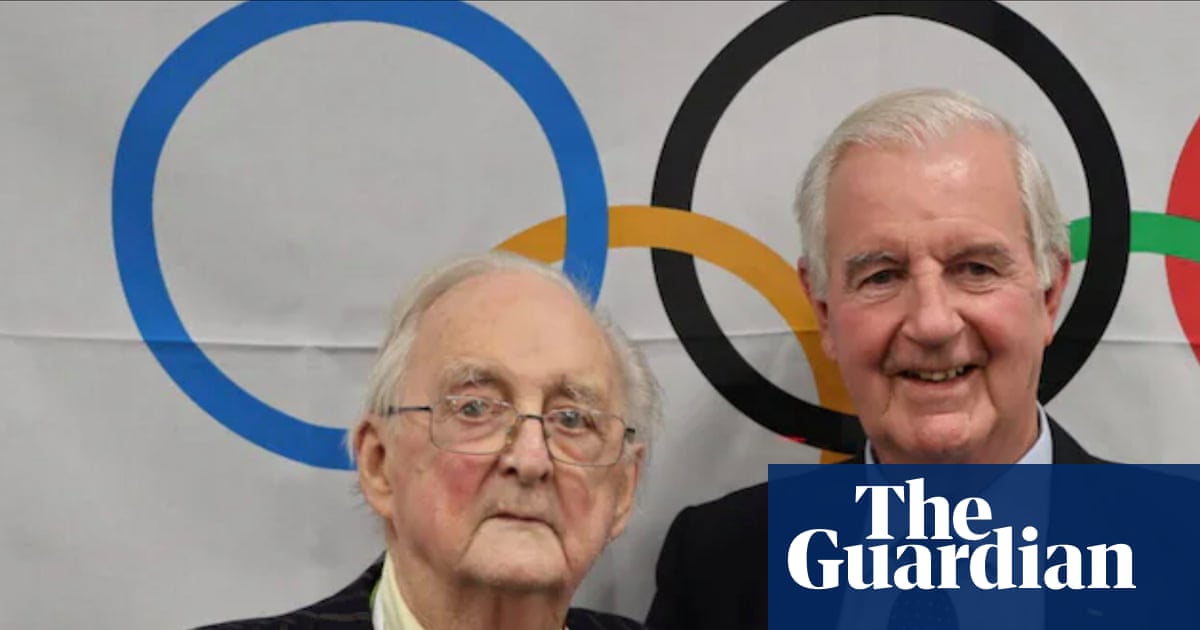
In 1956 a young science graduate fresh out of Cambridge was given a junior job on the sports desk at the Times. Two years later he made his own way on starvation rations to the football World Cup in Sweden. He reported some of the less enticing matches for his paper for six guineas a game.By 2012, when David Miller’s career in regular sports journalism finally drew to a close, he had watched 25 Summer and Winter Olympic Games, 14 Fifa World Cups, 62 FA Cup finals, 450 England football internationals and 53 Wimbledon championships. In at least two of those fields – football and the Olympics – he was acknowledged as one of the world’s leading experts.Miller, who has died aged 91, was an unlikely sports reporter. He looked and sounded more like a Conservative MP of the Macmillan era. Yet, unlike most of his neighbours in the press box, he had genuine athleticism: he won a football blue as a Cambridge winger in 1954 and 1955 and was not far from a place in the javelin at the 1956 Olympics.He also brought great qualities to the job. “He took football more seriously than anyone else,” said the columnist Pat Collins. Miller’s judgment of the sports he knew best was excellent. And he was a workaholic, much of his time being spent nurturing high-powered contacts over many years – from Stanley Matthews to Sebastian Coe. He also wrote more than 30 sport-related books, the last when was 87.And on the big stories he could be stunning. On the night of the 1985 European Cup final between Liverpool and Juventus at Heysel Stadium in Brussels, when 39 spectators died in riots, he turned in a tour de force: front page, back page, sports page, thousands of words placing the whole story, including the match – which was played despite the carnage – in context in time for Times readers’ breakfasts. That was journalism of the highest class.David was the son of Wilfred Miller, an actor, and Everilda (nee Milne-Redhead), and was educated at Charterhouse before going to Peterhouse, Cambridge. He did not last long on his relatively menial early job on the Times, but he met EW Swanton of the Telegraph, the leading cricket writer of the era, and even though cricket was far from Miller’s No 1 sport, Swanton recommended him to his sports editor. In his first year at the Telegraph, 1960, he clocked up 227 bylines – football in winter, tennis in summer – as opposed to zero on the Times whose writers were still anonymous.He was clearly a rising star and he may have been influenced by Swanton. Miller developed a justifiable Swantonesque confidence in what he saw from the press box rather than seeking confirmation from others. Both liked to hobnob with the top people and had a writing style that was solid rather than scintillating. And they both had a de-haut-en-bas personality that did not always endear themselves to lesser mortals.In 1973 Miller left to join the Daily Express as chief sports writer; he had a free rein to write what he liked and presumably good money. But the once mighty Express was in freefall and a very unhappy ship. Miller lasted a decade before taking a pay cut to go back to the Times where he might be more appreciated. His longtime sports editor there, Tom Clarke, was a great enthusiast: “He understood how big-time sports people operated because he spent time with people like Coe. I know some people thought him pompous. But he wasn’t pompous to work with.”However his urge to rub shoulders with the greats could be a two-edged sword. John Rodda, the Guardian’s counterpart as Olympic expert, was pally with Lord Killanin, the low-key leader of the International Olympic Committee in the 1970s, who gave Rodda occasional tip-offs.This understandably riled Miller, who was keen to get in with Killanin’s successor, Juan Antonio Samaranch. He succeeded so well that at one Games he wangled a go-almost-anywhere officials’ pass, which irritated the rest of the Olympic press corps. In return, one of his books, Olympic Revolution (1992), veered towards a Samaranch hagiography, which was, as the Guardian said at the time, “ludicrous”. This misjudgment was the old story of flying too close to the sun.Given that the Samaranch regime, despite many achievements, had a murky underside, this may have hastened his departure from the Times in 2007. He retired to Norfolk and kept on writing as a freelance.Miller was a man full of paradoxes. He was capable of being both infuriating and very generous, especially to waiters. He had family holidays with the Guardian’s Frank Keating, a totally different character.And then there was his driving. Colleagues remember terrifyingly fast lifts in his Mercedes. In an Italian city, he did stop at a red light. The neighbouring driver wound down his window and said, admiringly: “You drive like an Italian.” “Grazie,” Miller replied. Then the moment the lights changed he veered, cut up the real Italian, and roared off.Once he took Keating on his yacht in the Solent in what his guest insisted was Force 10: “I swear we didn’t so much go past the Needles as through them.”Miller married Marita Malyon in 1957. She died in 2018, and their daughter, Michelle, died in 2024. Miller is survived by their son, Gavin.
David Miller obituary
Full Article
Original Source
Read the full article at Theguardian →KhanList aggregates and links to publicly available news content. We do not host full articles from third-party sources. Always verify important information with original sources.