
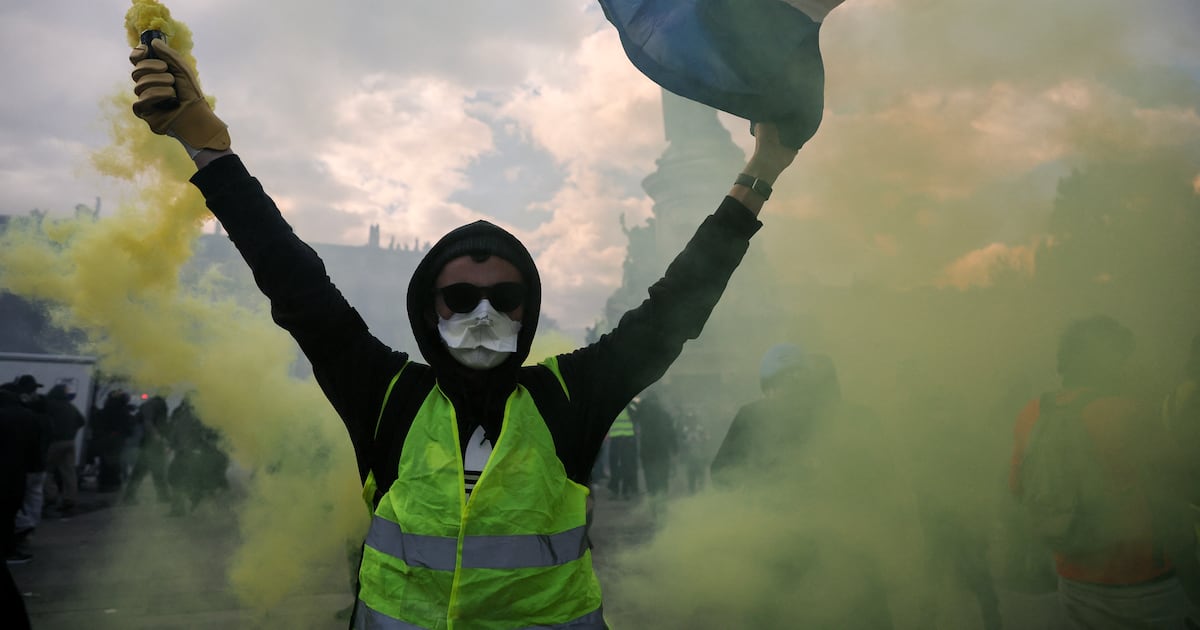
France is in flames. Is this a precursor of things to come all over Europe or a display of French exceptionalism? France is facing a polycrisis, a once-in-a-generation moment where various separate crises - political, demographic, economic and cultural - converge at the same time. Any one of these would be difficult to solve on their own, coming together they threaten to overwhelm the Macron government. Looking on, Marine Le Pen eyes up the Élysée. France is a peculiar case. For many, it is a paradise: Europe’s earliest retirement age, generous pensions, reasonably cheap housing for the majority, brilliant transport infrastructure and a health service that works for the most part. It also has beautiful landscapes and historical towns, evidenced by the fact that France is the world’s most visited country. Despite this, enough French people have convinced themselvesthey live in a hellhole and the only solution is to tear it down. Protesting is in the French DNA. These people gave the world the French Revolution- not the French Negotiation or the French Re-evaluation – which was the most consequential political upheaval of the past 300 years and it started in Paris. France is also a country on its fifth republic, the previous four having been swept away by events. What price a sixth republic under a President Le Pen? For the past two decades, French economic growth has been stagnant, yet persistent inflation has driven up the cost of living, leaving many citizens just getting by and highly sensitive to price changes. A few years back, the widespread “Gilets Jaunes” (Yellow Vests) national protest movement was triggered by the threat of a small carbon tax on motor fuel. Such is the economic precariousness of the people, particularly outside Paris, which is a city blessed with an impressive public transport system, that the prospects of a small increase in petrol prices prompted revolt. These protesters occupied roundabouts, signalling that these country people drive everywhere and are not protected by the urban Metro. The Gilets Jaunes look tame, almost quaint, when contrasted with this week’s urban rioters. READ MOREOn top of rising inflation in recent weeks, the financial markets have begun to question whether France can pay back its national debt, which stands at 120 per cent of GDP. Interest rates of French debt have recently risen from 3.1 to 4.8 per cent. This might not seem like much but it is about a 50 per cent increase in the cost of paying back debt. As the interest on French government debt rises, this drags up the interest rates that French borrowers must pay on their car loans, mortgages and overdrafts. Youth unemployment is above 20 per cent, which is twice the overall rate. Since the second World War, France has been governed either by the centre left in the guise of the French Socialist party or the right, normally the Gaullist party – the Republicans. Over time, both interventionist left and expansionist right came to a truce in the centre, so much so that Emmanuel Macron, a minister in an ostensibly left-leaning cabinet, saw his chance and set up his own centrist party called En Marche! (Forward!). He has dominated French politics for the past decade. Without a local political power base, Macron has governed from on high, leading to criticism that he is removed from the masses, and is seen as the creation of big business rather than the people. Some even refer to his style as Jupiterian, sitting on top of his Olympus, directing the lesser mortals below. Now the people are revolting, but against what is hard to pin down. Behind all the sloganeering is the essential fact that France is experiencing a generational conflict pitting the late middle-aged and the retirees against the young. France’s last major street rebellion took place in 1968, when radical students took against Charles de Gaulle. These idealistic kids, born in the boom years after the end of the war, promised to change France, making it more dynamic, democratic and modern. In truth, this one-time revolutionary generation, the soixante-huitards or the 68ers, would end up pilfering the place, lining their pockets with well-endowed pensions, higher property prices and a bourgeois lifestyle, unmatched elsewhere in western Europe. In the process, they gave the bill to the generations coming behind them and, as France’s fertility rates plummeted in the 1980s and 1990s, the country finds itself in the position that there are not enough young people to pay for all these well-heeled retirees. The centre’s solution to too few French young people is not to reduce their own expectations of their retirement entitlement, but to call for more immigrants to pay the bill. Thus, an economic or commercial problem has morphed into a cultural and racial one, playing directly into Le Pen’s hands.[ ‘A bombshell’: French teachers spot something on payslips that reveals scale of funding crisisOpens in new window ]The promise of the centre has been betrayed and this feeling of abandonment is exacerbated by the sight of rich French people getting richer over the past two decades while the average worker treads water. Since the advent of the euro, French interest rates have dropped below where they had been for many years, driving up asset prices. But the wages of workers were anchored to the floor by competition from China. Workers’ incomes barely budged, while the wealth of asset owners – property, companies, shareholders – rose, leaving millions feeling on the outside, without a stake. But they have a vote and they are seeking revenge in the presidential election of 2027. [ ‘I have never felt anything so painful in my life’: Irish caught in French riotsOpens in new window ]Supposed to bring prosperity and security, the Macron centre has failed. The electorate is ready for a real alternative. This internal pressure is being made more acute by capital flight as investors who have lent money to the French government are selling French bonds, implying that the political/demographic crisis is driving the financial crisis, pushing France closer towards the once-unthinkable possibility of bankruptcy. The most likely way this pans out is that over the next few months the European Central Bank steps in and buys French bonds on the basis that France is too big to fail, Le Pen wins in April and, within her first term, a new, sixth French republic is declared. And they’ll still win the Six Nations.
David McWilliams: France is likely heading towards ECB support and a Marine Le Pen presidency
Full Article
Original Source
Read the full article at Irishtimes →KhanList aggregates and links to publicly available news content. We do not host full articles from third-party sources. Always verify important information with original sources.