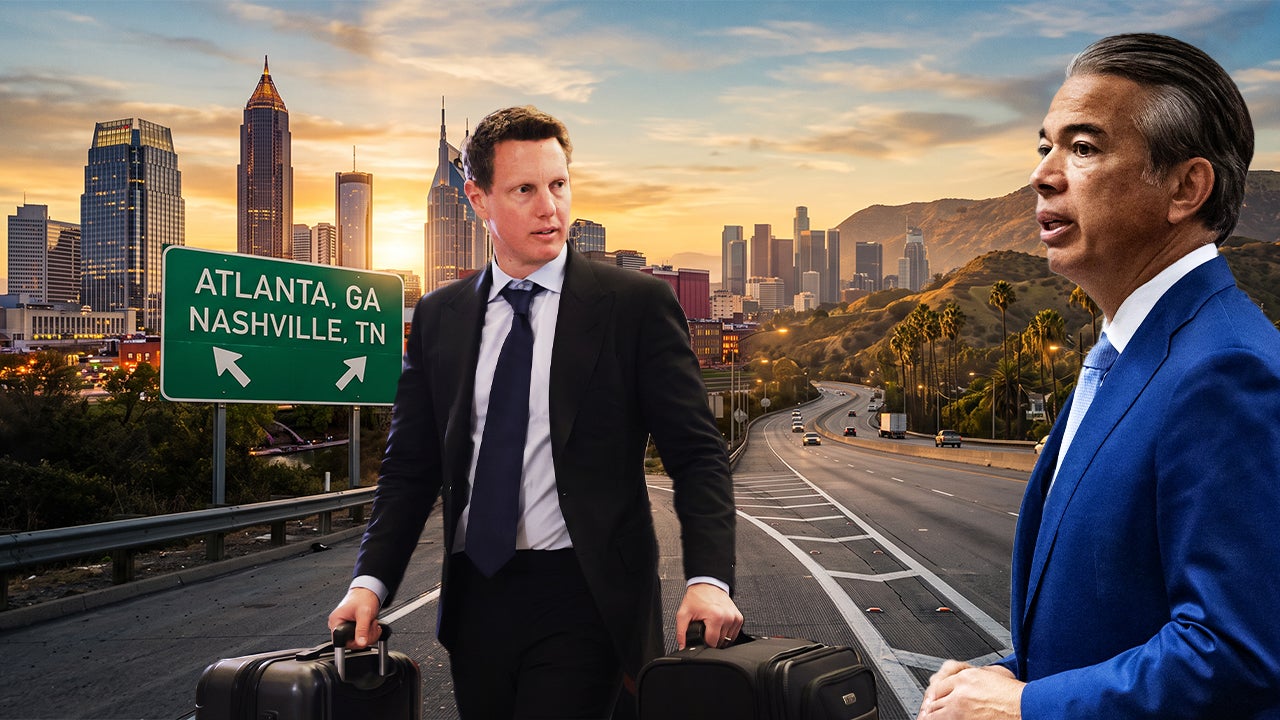
Can a major Hollywood film and television studio operate out of Middle America? If David Ellison’s threat to move out of California is for real, we may find out. Under increasing pressure as his $110 billion deal to merge Paramount Skydance with Warner Bros. Discovery faces an antitrust trial, Ellison told his 12-person leadership team last week – including the heads of his film and TV divisions – that if California Attorney General Rob Bonta continues to ignore his efforts to negotiate a settlement, he will begin the process of moving the entire company out of the Golden State starting in October. A lot of people were upset when the meeting ended, which included film studio chiefs Dana Goldberg and Josh Greenstein, streaming chief Cindy Holland and CBS leader George Cheeks, according to multiple insiders who spoke to TheWrap. But Ellison is increasingly frustrated that Bonta has declined to negotiate with him as an Oct. 1 date when a $7 million/day ticking fee begins draws closer. His team has told TheWrap that “resolutions” have been offered to Bonta since May 19. And while many reactions on Tuesday dismissed Ellison’s gambit as grandstanding or worse — a “hissy fit” as one wrote on X, “shameful” as a rival studio leader said — one Paramount executive insisted Ellison is “dead serious.” He would prefer to stay in California, the insider said, but he feels his hand is being forced by the state AGs and their lawsuit. If Bonta won’t engage, Ellison would potentially sell both the Paramount and Warner Bros. lots for $4 billion to $5 billion each, leave a “creative hub” behind and set up shop likely in Nashville or Atlanta, both red states with lower taxes, another Paramount insider told TheWrap. Ellison justified the move by saying it would save hundreds of millions of dollars in taxes, but it poses practical challenges for Paramount in an industry where so much business is conducted at industry watering holes, on the golf course and during spontaneous on-the-lot meetings, much of Paramount would be absent. The remote nature would seem to put the studio at a major disadvantage in dealmaking. And what about keeping all the talent Paramount worked to curate over the last year? Who’s to say the Duffer Brothers or Jon M. Chu, who struck first-look deals last year, wouldn’t be wooed by another suitor who’s in closer proximity? Several industry insiders also pointed out that it contradicts Ellison’s core argument that the merger will support the entertainment industry and demonstrates his deep commitment to Hollywood. Is this a tantrum or a fist slamming on the table with the force of “ENOUGH”? What is the viability of moving Paramount and Warner Bros. out of Hollywood? Some Paramount staffers who spoke to TheWrap feel like Ellison is merely posturing to get Bonta to the negotiating table. Others said confusion abounds as they wonder how much production would be forced to move and where those left behind would set up shop. Is it really cheaper to sell the lots and pay to lease soundstages, they ask? And with layoffs looming should the merger go through, Paramount could face a wave of resignations from those who would rather enter the job market now than move thousands of miles away only to be laid off anyway. Ellison’s threat is a shot aimed squarely at Bonta, who thus far is unwilling to bend. “(Ellison) is negotiating against himself. It’s embarrassing,” a top media mogul told TheWrap of Ellison’s threat. “They’re f–king pissed off.” During an appearance at a conference hosted by Politico on Tuesday, Bonta claimed that Paramount was trying to blackmail the state and regulators into allowing an illegal deal to go through. He also said he doesn’t see AMC Theatres and Regal’s support of the merger undercutting the states’ legal case and that, like a sale of CNN, Ellison’s theatrical release pledge is a behavioral remedy, not structural. “I think they’re eager to enter those talks and we are very happy with where we are,” Bonta added when asked about a possibility of a settlement. “We’re confident in our case. We will prepare and be ready to go to trial. And if they, in good faith and sincerely, want to talk about settlement with us, of course we will be open to any proposals they want to propose to us. But right now, we’re focused on litigation and going to trial.” At the same conference, Paramount’s Chief Legal Officer Makan Delrahim characterized Ellison’s potential move as a financial necessity. “His intent is to be committed to California. There’s a point at which you have a fiduciary duty to your shareholders, and those are all the factors you consider. But our goal is to be here. I heard the attorney general say that this was some kind of blackmail attempt before the lawsuit. It is not,” he said. “You have to take a look at the business environment and look to see what’s best for not only the community, but the business ultimately, and go to a place where you’re wanted.” Delrahim added, “We’ll go through the trial. We’re confident we will win, but it’s unnecessary.” Is Ellison’s threat a winning legal strategy? When looking at the threat from the legal strategy angle, experts are mixed on whether this puts Paramount in a better position. “I don’t see this threat as an effective negotiating strategy to get the California AG to back down,” Morningstar Research analyst Matthew Dolgin told TheWrap. “In my view, the optics and political angle are the reason for the lawsuit as much as anything, and this would make it more likely for Bonta to dig in. A middle ground that is palatable for each will be difficult, in my view, and a threat doesn’t make finding one more likely.” Paul Nary, an M&A strategy professor at University of Pennsylvania’s Wharton School of Management argued Ellison’s threat is “only somewhat objectively credible” without real costs or barriers to reversing it. “Whether sincere or strategic, knowing how strong and savvy the Paramount team are as dealmakers, it’s something that may both move the needle, even if slightly, tomorrow, as well as something that can be reversed or used as a bargaining chip in the future,” Nary added. Los Angeles-based trial lawyer and former federal prosecutor Neama Rahmani said Paramount leaving California could be a real blow to the state, but at the same time, he didn’t rule out it simply being a negotiating tactic to settle. “The vast majority of cases do settle, so I would expect this case to settle as well. But you never know,” Rahmani said. Chairman & CEO Paramount David Ellison attends the UFC 324 in Las Vegas, Nevada. (Photo by Jeff Bottari/Zuffa LLC) Ellison and Delrahim have sent a list of possible concessions to Bonta, the specifics of which have not been made public, to no avail. If Ellison’s latest chess move is designed to finally get Bonta to blink, so far it’s not working. Hours after the news broke, he slammed Ellison’s plan to leave as an attempt to “blackmail” regulators. “If you have a business model that relies on acting unlawfully, I don’t know that that’s a particularly good business model,” he said. “They attempted to blackmail the regulators on the eve of our filing of our complaint. Maybe they thought that we wouldn’t file the complaint if we heard this blackmail threat. We did file the complaint. It didn’t work. It won’t work. It will never work.” Ellison’s options Ellison has already received an invite from Tennessee to set down roots in the Volunteer State. Nashville is notably home to Oracle, the software giant co-founded by David’s father Larry Ellison, which is building a new headquarters in the state. Tennessee is openly wooing Paramount with its low taxes and “a steadfast belief that government should be a partner in private-sector growth.” The other location under consideration is Atlanta. A Georgia Film Office spokesperson declined to comment on private correspondence, but said it “welcomes any such conversations” with Paramount as a major film production hub with long-term relationships with industry partners. Andrew Mahaleris, Texas Gov. Greg Abbott’s press secretary, has also thrown the Lone Star State’s hat in the ring, arguing it offers “the best business climate in America” with no corporate or personal income taxes. It is also, of course, the production hub of Paramount’s popular Taylor Sheridan suite of shows. “Companies that leave high-tax, high-regulation states like California will find opportunity and success here,” Mahaleris told TheWrap. A man walks by the main entrance of the Paramount Pictures Studio on July 25, 2025 in Los Angeles, California. (Photo by Apu Gomes/Getty Images) If Paramount ultimately decides not to move, the March trial doesn’t go its way and Bonta won’t come to the table on settlement talks, Ellison & Co.’s other option is to fight all the way to the Supreme Court. While the Paramount legal team has telegraphed as much, Rahmani warned that such an endeavor would be both time-consuming and expensive and would likely require an extension past the merger’s final deadline of June 4, 2027. “You’re not going to get to the Supreme Court probably until 2028,” Rahmani said. “I think it is more likely than not that the Supreme Court takes this case, but the timing matters a lot. In 2028, there may be a Democratic president and Democratic Department of Justice, they may have a very different view of this merger. So, time is not your friend.” What does a move mean for California, Paramount and Hollywood as a whole? The entertainment industry contributes over $115 billion annually to California’s regional economy. In addition to Paramount’s contribution to local spending, the majority of its studio and streaming workforces call the state home, per an economic analysis ordered by the Los Angeles County Board of Supervisors. Milken Institute senior fellow and Melcene Advisory principal and managing director Kevin Klowden told TheWrap that completely moving Paramount’s production would be “devastating” for the LA entertainment community at a time when it has already faced cutbacks from the strikes and the end of the peak-TV era post-pandemic. He added that it would take years to execute and is “extremely dangerous” for Paramount from both an optics and financial standpoint. “If Paramount does that, then they’re no longer connected to the studio apparatus, the talent agencies, all the different things that they draw benefits from being in LA. [Outsourcing productions] could be thousands of jobs just on its own. It reduces the number of productions and it puts more pressure to essentially attract productions from everybody else just to make up for the gap,” Klowden warned. “That could just tip things even further and cause more people to basically leave the industry.” Klowden said that Paramount would face a “massive credibility loss” because most of the decision-makers in Hollywood are based in Los Angeles and New York, adding that historically, corporate relocations can lead to “major talent bleed.” Klowden continued: “The bigger threat, as far as Hollywood is concerned, is that more back office jobs will be lost from the merger than they would be from a move. If that is [state AGs’] calculation, then the threat of a move from Ellison isn’t really enough to overcome that bigger consideration.” But on the Paramount side, it sounds like they’re still willing to do whatever it takes to get this deal done. “Everything is on the table,” Delrahim said Tuesday. “We would be delighted to engage and discuss any resolution to get to this closing after all this time, in order to repair the industry, create more jobs, bring more jobs and production back.” Sharon Waxman and Jose Bastidas contributed to this report
David Ellison Goes Nuclear With Threat to Move Paramount Out of California — Is It a Stunt?
Full Article
Original Source
Read the full article at Thewrap →KhanList aggregates and links to publicly available news content. We do not host full articles from third-party sources. Always verify important information with original sources.