
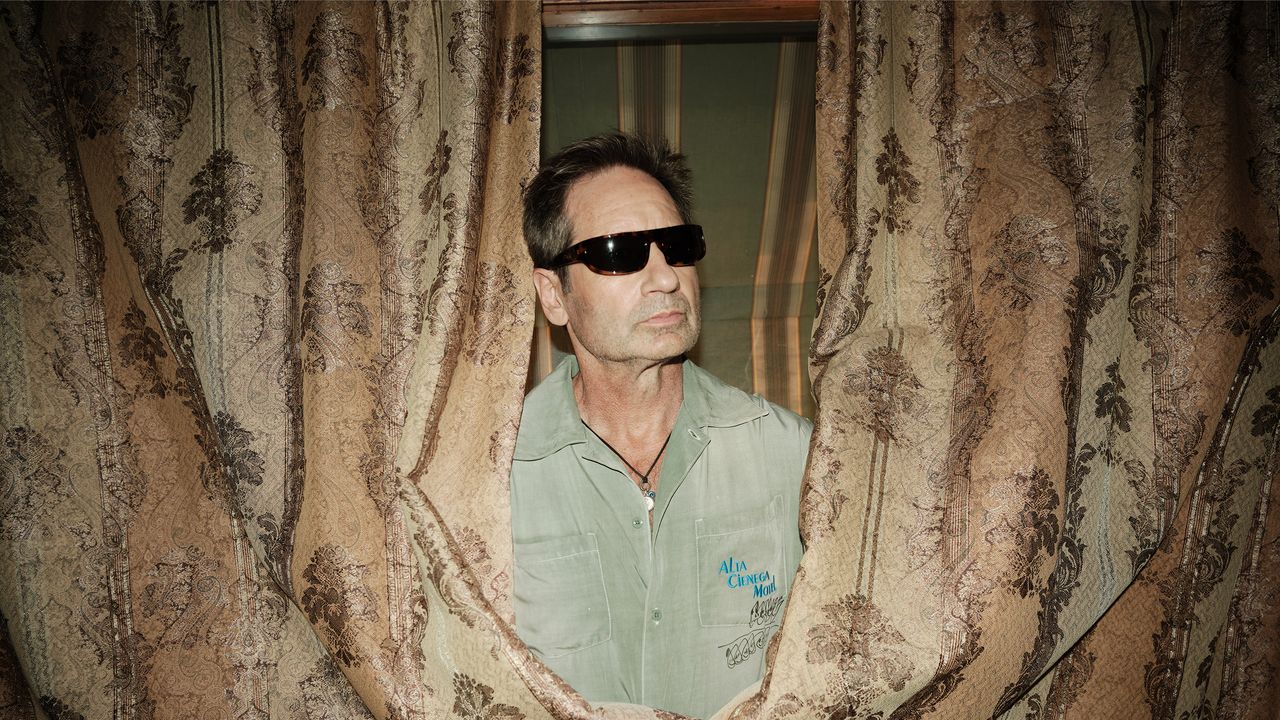
Everyone's a Sellout Now—Except for David DuchovnyFor the last decade, The X-Files star has been quietly churning out excellent novels, poetry, and rock albums. Too bad he can’t stand to promote them.David Duchovny has been famous for as long as I have been alive. From 1993 to 2002, The X-Files made government conspiracies a staple of primetime television. Duchovny’s FBI special agent Fox Mulder, with his skeptical counterpart, Gillian Anderson’s agent Dana Scully, personified the imminent breakdown of consensus reality in the coming century, delivering the paranoid fringe into 20 million American living rooms. The show belongs to a world of monoculture that no longer exists, and it launched Duchovny into a realm of visibility that’s hard to imagine now, when famous people are produced and consumed at an industrial rate. A few weeks ago, as my boyfriend shopped for a suit jacket at Crowley Vintage in Brooklyn and I edited this story on my phone, I watched a college-age boy put on a long, gray trench coat and announce to his girlfriend: “Mulder mode.”Duchovny went on to star in Californication, a raunchy dramedy about a divorced novelist navigating the sexually and professionally parasitic Hollywood studio system of the 2000s. Many viewers interpreted Californication as a kind of autofiction, although Duchovny did not write for the show. The actor has written a number of novels, but it’s apparent to anyone who has spent 30 seconds with him that this soft-spoken, reluctant celebrity has nothing to do with the character Hank Moody. Still, Californication did anticipate something about art, celebrity, and self-commodification: Anybody who writes today must contend with marketing an artistic persona for a public that does not, as a rule, read.In addition to his six books, Duchovny has released four records, and written and directed a number of feature films. He greets the degraded state of American arts with a charming blend of rigor and self-deprecation. “I’m not Jonathan Franzen,” he says of his fiction-writing process. “But if I work on something every day, it deepens. And eventually, hopefully, I can achieve one tenth of what Jonathan Franzen achieves.” But he has an aversion to the sort of publicity that might make his various artistic ventures more lucrative. He tells me he finds it “spiritually impoverishing.”I meet Duchovny with his band—millennial slackers half his age—at their practice space in Carroll Gardens, where they’re preparing to tour their fourth LP, Prince of Pieces. He wears a white Hanes T-shirt, tight underneath his athletic arms, and he has a tattoo on his ankle—a compass pointing west, something he got when his daughter, West, was hospitalized as an infant. (She’s 27 now, an accomplished actor. “She wanted to be a doctor,” he says. “I was so happy when she told me she was going to pursue acting. Thank God.”)The albums are composed of subdued, easy-to-listen-to folk-rock tracks, not dissimilar from early Kurt Vile. It’s the band’s first rehearsal in ages, and one of their only chances to prepare in advance of a European tour. In person, they play the songs harder and heavier, sprinkling in crowd-pleasing covers: “Godzilla” by Blue Öyster Cult, “The One I Love” by REM, and—“sadly only one time,” Duchovny says—“Hotline Bling.” The energy in the room is high. These men like one another. Duchovny’s manager offers me a beer from the cooler I’m perched on. I gesture to the tallboy in my purse. He looks disappointed. “You didn’t trust us,” he says. Duchovny steps aside to take a sip of water and picks up the microphone.“You can sing along,” his keyboardist, Colin Lee, says.“I can sing along?” Duchovny asks.Duchovny at rehearsal with his band. At 66, David Duchovny remains a sex symbol. He’s in better shape than he was on The X-Files. He’s in better shape than the boys in the band. The night after practice, during a Q&A for a screening of his 2023 film Reverse the Curse, he mentions that the wardrobe department had to fashion a “BDSM harness” for him to wear under his clothes to remind him to hunch like an old man. He plays a Red Sox fan who bonds with his estranged son over baseball, marijuana, and their shared lust for a beautiful, young death doula. Duchovny’s character has terminal cancer. “I’m in my dying era,” he tells the crowd. “I die in every film. ”For the most part, the audience at Westchester County’s Irvington Theater is old enough to have watched The X-Files as it aired. At least two esoteric-looking old men carry David’s poetry collection like a prayer book. There are a handful of young people. A college-aged girl in a KN95 mask raises her hand to ask about Bucking Fucking Dent, the novel adaptation of the Reverse the Curse screenplay, which Duchovny wrote while the movie was in production purgatory. “In the book, Ted and Marty’s last name is Fullilove. In the movie you change it to Fullaker. Why did you do that?”“Good question,” Duchovny says, stalling. “Full of love. Full of shit. It’s all the same.”Inevitably, someone asks about the new X-Files. Ryan Coogler is rebooting the show for Hulu. Duchovny will later suggest to me that Chris Carter, the show’s original writer, has designs on a reboot of his own—“He has plans, and wants to end with the original show.” As for Coogler’s version, he says, “I know he said he wants me to come do something, but we haven’t figured out what yet.” During the audience Q&A, Duchovny seems to have misheard the question, and spoils the ending for The Exiles, his forthcoming Taiwanese crime film: “I die in that one too.”PALY/Ryan Thomas MurrayDuchovny’s latest book, About Time, a collection of poems published last year by Akashic, is also largely about dying: the death of his father, the death of his first marriage, the ambient death that hung in the air at the beginning of the decade. He started writing the poems when his therapist encouraged him to talk to dead people. “He was talking about Rudolph Steiner’s belief that you can talk to the dead. And he said: You can talk to your father and you should. My dad and I didn’t connect like we might have,” Duchovny says. “When you’re younger, you think you have all the time in the world to get the relationship you want. But the relationship doesn’t end.” In conversation, he is cerebral without being annoying. “There’s a power struggle when you read a really good novel,” he says. “Somebody’s mind is taking over your mind. I think about language a lot and how we take it for granted as being an accurate signifier. When I was younger I thought communication was possible. I’m not so sure now. But it’s fun to try.”Duchovny’s humility complicates the sexual charisma that still lives at the center of his public persona. His introduction to About Time begins, “I know what you’re thinking: Just what the world needs now—a bunch of poems from an actor.” There’s a sense that he wants to get ahead of the reader’s skepticism. But there’s also plenty of perceptive lines in the poems themselves: “You dreamt you wrote something so good, / so ambivalent and destructive, so creative, / so lacking in morals, decency, or instruction, / so sad and so funny, / so useless and old, / so familiar and new, / so full of theft and power / that they had to name a god after it.” I ask him if good writing is necessarily amoral. He says, “Probably. Which is why any politically correct work of art is usually super successful and really bad. Usually artists are difficult people, and I have no problem separating the art from the artist. But people do now.”In college, Duchovny wanted to be a poet. “I thought it was an actual occupation you could have,” he says. When an underclassman turned up in his workshop who was better than him, he quit writing poems on the spot. “It was actually Walter Kirn,” he says. “He showed up at 16-years-old. He was a genius. I was like okay—I’m not a poet.”The two men have become close in the last decade. Kirn, who wrote Up in the Air and founded the newspaper County Highway, tells me what Duchovny was like at Princeton: “He was golden. He had an aura. I was a little starstruck by him.” Duchovny has agreed to play paranormal radio host Art Bell in American Nights, a biopic that Kirn is developing alongside director Alex Lee Moyer. Bell’s Coast to Coast, a cult AM show during the ’80s and ’90s, was beloved by long-haul truckers and compound preppers alike, who called in to report UFO sightings, cattle mutilations, and crop circles. “I, like the rest of my generation, grew up on The X-Files,” Moyer tells me. “It made a massive impression on me, and I’ve been a fan of David ever since. The synchronicity of him being a part of this is not lost on me.”I ask Duchovny if he always needed to be the best. “I at least needed to be the best in my class,” he says.PALY/Ryan Thomas MurrayIn LA, I meet Duchovny in a quiet restaurant to talk about his books. He describes his first novel as “an act of cowardice.” Holy Cow is narrated by an anthropomorphized barnyard animal who uncovers the conspiracy theory that is factory farming. “I thought: Well, they’re not gonna cut me off at the knees on this. Because I’m clearly not that serious. It was calculated. I didn’t want to try for the great American novel the first time as an actor.” The books that followed are more ambitious, each one better than the last. By the time he was promoting his fourth book, 2021’s Truly Like Lightning, he made his ambition plain. “I want to be taken seriously,” he said on Marc Maron’s podcast. “That’s my weakness. I want that book to be taken seriously.”“You don’t want people to be like the guy from The X-Files wrote a book,” Maron said.“That’s what they’re gonna say,” Duchovny said, “but I hope and I believe that eventually people will see that I mean business.”Truly Like Lightning centers on a Mormon polygamist family forced to enter the godless world of Los Angeles when their homestead is upended. “When I started to read about Mormonism, it struck me as super optimistic. Everyone’s gonna get their own planet and everyone’s gonna be able to propagate souls. As opposed to a European perspective, which was always about the end of something, being 2,000 years removed from this thing. The Mormons said no, this is still happening.” The novel takes cues from the literary critic Harold Bloom, who wrote that Mormonism was an “American original” and called its founder a “religious genius.” Duchovny studied under Bloom at Yale, where he earned some of an English PhD. “Everything goes back to Bloom,” he says. “And you never really leave grad school. I’m not sure I’ve left grad school. They might still be waiting for my dissertation.”But Duchovny did leave grad school. He signed with a talent agent one summer to try to earn some money acting in commercials. His agent told him that if he wanted to go out for theater or film roles, he’d have to get into an acting class. “I said: I’m not doing anything. When I stepped into acting class, something happened. I wasn’t a demonstrative person—I was an intellectual person. So it was like: Yeah, be unreasonable. Be irrational. It opened up a different world, a world of fiction, a world without consequences. I’m doing a scene, and I’m yelling at this person and I’m going to murder them, but I don’t have to go to jail.”For someone with half a dozen good books and an enormous public profile, it’s surprising there haven’t been more reviews. Johnny Temple, who published Duchovny’s two most recent books on Akashic, tells me, “It’s certainly frustrating that there hasn't been more review coverage of David’s books. For any well-known actor, musician, or other type of public figure, there’s always going to be obstacles to being taken seriously in a different medium.” Kirn tells me, “That makes writing fiction a much purer achievement in my mind. You’re doing this because you love it, and you know that two thirds of your fans will only remember you as a TV character. It’s a brilliant, Sisyphean task. Also, he’s a superb writer.”I ask Duchovny whether he still thinks about being the best. “I think now I can acknowledge that it’s a hollow designation,” he says. “Especially in the arts. Even though we give awards, which is silly. Holy Cow made the Times bestseller list. Ever since, everything I write sells less and less.”“It’s hard for someone to champion it,” he adds. “If I wrote a memoir, I’m sure it would get reviewed in the Times.”Talking to Duchovny, one is reminded that wanting to be taken seriously and being in on the joke aren’t mutually exclusive. As band practice winds down in Brooklyn, the guys are excited to cover Lou Reed’s “Perfect Day.” Duchovny crosses his arms in front of his lap like a schoolboy as he sings. To my ear it sounds just fine, but Lee, the keyboardist, asks the mixer to lower the reverb on David’s voice.“Maybe lower David’s mic in general?” the bassist, Mitchell Stewart asks.“Thanks, guys,” Duchovny says.“Lower it to zero,” Lee says.“Lower than zero,” Duchovny says. “Less than zero.”A few days later, he texts me. He just screened an early cut of Soapbox, a Hollywood satire he wrote and stars in opposite Laverne Cox. At first, he’s bummed that the test audience has decided that his character shouldn’t get killed in the final moments of the movie. But a couple hours later, he writes me again: “People don’t want me to die. I guess I should be flattered.”PALY/Ryan Thomas MurraySign up for Manual to receive useful advice on style, health, and more, six days a week.
David Duchovny on Books, Band and ‘The X-Files’
Full Article
Original Source
Read the full article at Gq →KhanList aggregates and links to publicly available news content. We do not host full articles from third-party sources. Always verify important information with original sources.