
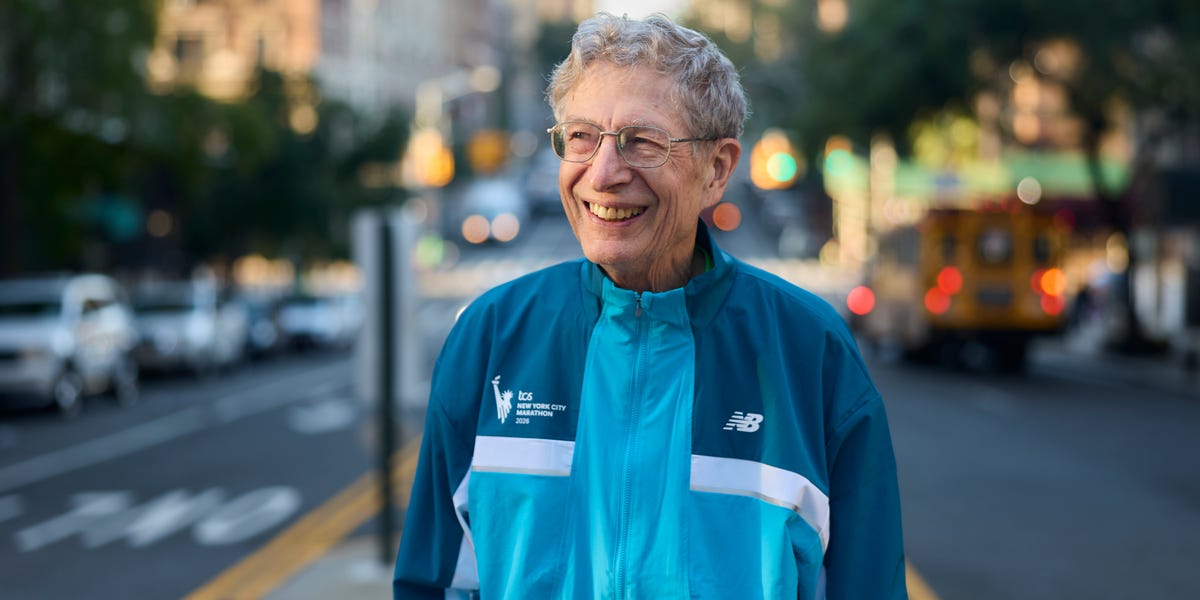
Dave Obelkevich’s first experience with the New York City Marathon was in 1973, when it had fewer than 400 entrants and took place entirely in Central Park. He was on the west side of Manhattan near 100th Street when a pack of runners in bibs flew by. He asked a few onlookers what was going on. “It’s the marathon,” they said.A recreational runner himself, he was both impressed and intimidated by the lead runners’ speed. He knew he couldn’t keep up with them for 26.2 miles, but he figured he could probably finish one of the four loops of the park at a respectable pace. So, on their final lap, he jumped in and finished in 43 minutes. After that, he immediately signed up for the following year.Obelkevich admits that it took a couple of years for his training to gel. In the months leading up to the 1974 race, he did just one six-mile training run a week. “I took six days off,” he says, laughing. He still managed to finish in 4:20:27, but the experience itself was “tough,” he says.The now 83-year-old registered again in 1975, but didn’t finish the race. He’d started strong but suffered a series of dizzy spells. With five miles to go, he’d stopped to take a break when the late Fred Lebow, race director and cofounder of the New York City Marathon, drove by. Discouraged by the time he’d lost, Obelkevich asked Lebow for a ride to the finish line. “He should have said, ‘Hell no, you finish by walking!’ But instead, he said, ‘Yeah, get in the back.’ So it’s his fault I didn’t finish,” Obelkevich says, jokingly.In 1976, the marathon course changed to include all five boroughs of New York City. “It ran through much of the city I’d never seen,” Obelkevich says. He grew up in a suburb of Binghamton, New York, and moved to Manhattan in 1961 to attend Columbia University, but he’d always lived on the Upper West Side. “I don’t think I’d ever been to Staten Island. It was an eye-opener,” he says.By the time he reached the start line of that first five-borough marathon, Obelkevich was, thankfully, running more than six miles a week. He’d joined the Millrose Athletic Association, where he’d picked up some solid training habits and gained a whole new social circle.He’d discovered that, in a group of runners who shared similar goals and challenges, he was more extroverted than usual. “I opened my mouth and spoke to a complete stranger. It’s not that hard to do. It’s just a matter of getting started. So that changed my whole personality,” he says. That year, he finished the marathon in 3:22:44.From that point on, Obelkevich has never missed a New York City Marathon, making him the runner with the longest streak on record: 49 races. This November, he’ll share a 50th anniversary with the course as it’s known today.Over the past five decades, both Obelkevich and the marathon have evolved. The race, which included just over 2,000 participants in 1976, now hosts nearly 60,000 runners from all over the world. “When I was running the first few years, you look around, and everyone is from the Northeast. Now a quarter of the people are from another country,” he says. The whole experience feels more inclusive and interesting, he adds.Obelkevich’s approach to the marathon has changed, too. Several years ago, he dealt with a life-threatening aneurysm in his left leg. He has since recovered, but he’s never felt quite the same; he gets winded after a couple of minutes of running. So now he walks the course with Athletes with Disabilities (AWD), and his daughter, whom he’s raced with before, will be his guide.He trains by doing physical therapy exercises and walking almost every day, with his longest walk this training cycle totaling 15 miles. “People say you should do several 20s, but I didn’t have time for them. If you’re going three miles an hour, it takes a long time,” he says.He also gives himself permission to skip a day when the weather is bad or something hurts. “One of my techniques of avoiding injury is, if I have a pain somewhere, I’ll try for five minutes. If it hurts, I walk home. If it hurts the next day, I’ll stay home,” he says.In the late 1970s, Obelkevich’s goal was to break three hours, which he did in 1979 with a time of 2:50:18. This year, his goal is twofold: to finish the race—he estimates it will take him a little over eight hours—and have fun. “That’s more important than anything else for me,” he says.What Dave Obelkevich Has Learned About the New York City Marathon Over the Last 50 Years If you’re running the marathon this year, look for Obelkevich in Staten Island. He’ll be repping New York Road Runners as part of the 2026 Team Inspire, starting at 8:22 a.m. Until the gun goes off, he makes a point to chat with other runners. In fact, it’s one of his tips for passing the time and growing your network.“Don’t be shy about introducing yourself. Everyone has different stories,” he says. “It’s a great way to meet people and pass the time. Have some business cards with you. So, if you want to keep in touch with someone, you can say, ‘Here’s my card.’”Here are a few more of Obelkevich’s tips, insights, and observations, based on 50 years of running the New York City Marathon.Be Careful on Shakeout RunsThere’s no shortage of organized prerace shakeout runs in the city, and you can always loosen up with a couple of easy miles on your own. But be careful running on the city’s streets and sidewalks, which can be uneven and full of unexpected obstacles, Obelkevich says.He recounts one year when, the day before the race, he tripped over a misplaced barricade near the finish line and fell. Luckily, he was fine, but it could have been catastrophic.Enjoy the Ferry to the Start LineThe early morning ferry ride to Staten Island is one of those experiences that’s unique to the New York City Marathon. (How many other races start with a boat ride?) So, if that’s your assigned mode of transportation, take it all in, from the views of the New York City skyline and the Statue of Liberty to the energy of your fellow passengers.Before Dave began running with AWD, which provides a bus to the start, he’d typically take the ferry and use the opportunity to chat up runners from all over the world. “That was always a lot of fun,” he says.Pack Some Disposable Reading MaterialRather than draining your phone’s battery with nervous scrolling, take along some reading material you can toss once it’s time to line up. “It helps to bring, say, The New York Times. It’s something you can read, and then you can leave it there,” Obelkevich says. (One time he had the idea to write a letter while he waited, but he couldn’t find a mailbox. So, maybe skip the postcards.)Don’t Bring Only Disposable LayersLots of runners stay warm with a “throwaway layer,” sweatpants, sweatshirts, ponchos, hats, and gloves they plan to discard right before their wave. (Volunteers then collect the pieces to donate or recycle.) But be careful about tossing all your extra clothes, Obelkevich says.“I suggest that people, if they’re going to have a jacket or something, once they warm up, don’t throw it away because it’s going to take a while after you finish to get to your clothes. You have to walk a distance,” he says. There’s about a mile-long walk from the finish line to the street, and it’s even longer if you need to walk to the subway or your hotel. If you’re sweaty, depleted, and cold, that walk can be especially miserable.If you tend to get chilly after a race, consider keeping something lightweight that you can ball up and shove in a fanny pack or tie around your waist or shoulders.Lean Into the CrowdsOn a difficulty scale of one to 10, Obelkevich, who has run marathons and ultramarathons all over the world, rates the New York City Marathon at six, but with a caveat.“The crowd is so supportive in New York. Often you can hear two bands playing at once—one ahead and one behind you. So, all that makes the pain go away faster,” he says. If it weren’t for the two million or so cheering spectators, he’d rank the difficulty level a lot higher.Use the Talk Test to Keep Your Speed in CheckThe only downside to all that positive energy is that it’s easy to get carried away and start out too fast. Obelkevich has always used the “talk test” to keep his effort in check. “If you can’t talk, you’re going too fast,” he says.Stay Focused on the Queensboro BridgeOut of the five bridges you’ll cross, the Queensboro Bridge is the most grueling, according to Obelkevich. It begins around mile 15, when some runners may start feeling fatigued. The bridge itself is 3,725 feet long, but because it’s eerily quiet (there are no spectators on the bridge) it can feel like it lasts for miles. If you get energy from the crowd, he says, this part of the course can be really tough.But rest assured: On the Manhattan side of the bridge, there are thousands of cheering spectators lining First Avenue. That section of the race is often referred to as “the wall of sound,” and once you come off the bridge, you’ll know why.Prepare for the Potential Wall at Around Mile 20Obelkevich has noticed that a lot of runners tend to struggle around mile 20 in the Bronx. That said, he’s never had an experience with hitting the wall.“That’s partly because I’m planning to finish with some gas in the tank,” he says. He recently read an article about a celebrity runner who was planning to finish the marathon with “no gas in the tank,” a goal he finds questionable.“Once you finish, you still have to walk a bit. You can’t be exhausted at the finish line and fall down,” he says. Knowing that he has to preserve a little energy to get himself out of the park and home keeps him from pushing too hard during the race.Embrace the Best Part of the Course: Mile 24No matter how much pain you’re in, turning into Central Park at 90th Street, at mile 24, feels like a homecoming. The park is a recognizable landmark, the crowds are electric, and you know you’re going to finish.“Central Park is something that I’ve been in almost every day, and people know it backward and forward and upside down, so it’s very reassuring to come into Central Park,” Obelkevich says. “I would say that, except for the finish line, which is most impressive, that’s what boosts my spirits the most—coming into Central Park.”Take the Subway Stairs BackwardOnce you’ve crossed the finish line, collected your medal, and found your way out of the park, your journey home or back to your hotel begins. Even a technically walkable distance may feel insurmountable, so plan to take public transportation.“Don’t expect to find a cab,” Obelkevich warns. Even if you can get an Uber, road closures make traffic impossible to navigate. “One nice thing about mass transit is that you have to either walk up or down stairs, and that’s great for recovery,” he says. “And trust me on this: If you’re going downstairs, turn around, hold on to the railing, and go down backward. It’s 50 percent less painful.”Sure, it feels a little awkward, but New York City straphangers have seen far weirder things.Go for a Walk the Next DayAfter the race, “I would suggest people forget about running for maybe a week,” Obelkevich says. Instead, he recommends going for a walk, which can help with circulation and recovery, without adding more stress.But don’t forget to celebrate your accomplishment. After a hot shower, Obelkevich plans to have dinner with his wife, Lyn, and their family at home. There’s no particular ceremony or menu, but there is one non-negotiable: “Beer is very important,” he says, noting that his go-to brew is Miller Lite. “Just one. But one beer is very important.”
Dave Obelkevich, 83, Will Run His 50th NYC Marathon on Sunday. He Shares the Tips You Need for Your Best Race.
Full Article
Original Source
Read the full article at Runnersworld →KhanList aggregates and links to publicly available news content. We do not host full articles from third-party sources. Always verify important information with original sources.