
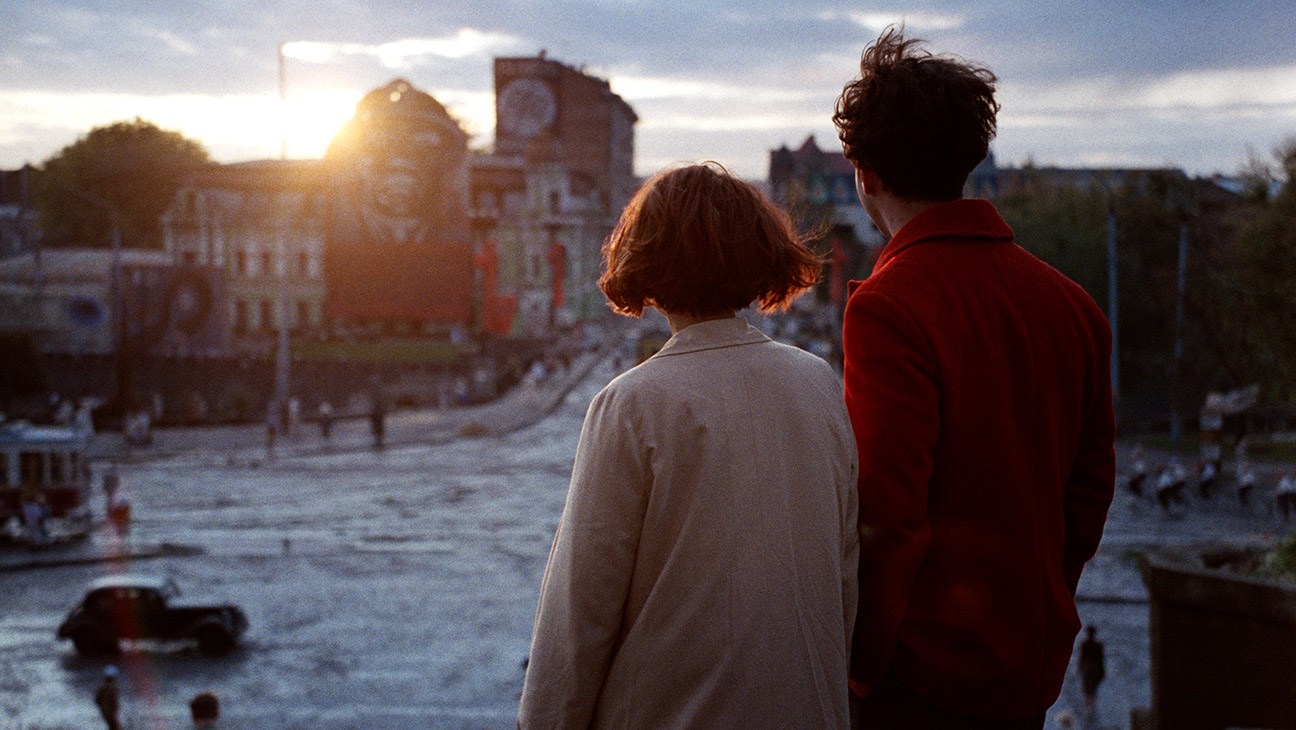
Can a movie be so long-awaited that at some point, people stop waiting for it? For those entrenched in the international arthouse and film festival world, this is what seemed to happen with Russian director Ilya Khrzhanovsky’s DAU, a biopic about the Nobel Prize-winning quantum physicist Lev Landau that was so monumentally ambitious and cinematically excessive, it began pre-production all the way back in 2006 and is finally premiering, well, now. DAU The Bottom Line Worth the long wait. Venue: Venice Film Festival (Competition)Cast: Teodor Currentzis, Radmila Shchogolieva, Anatoly Vasiliev, Maria Nafpliotou, Vladimir Azhippo, Dmitri Tcherniakov, Dmitry CheglakovDirector: Ilya KhrzhanovskyScreenwriters: Ilya Khrzhanovsky, Susanne Marian, Vladimir Sorokin, Ilia Permyakov 3 hours 15 minutes (plus a 15-minute intermission) Plenty of articles (see the recent one in THR) have been written about the making of what seemed, at least at first, to be a single feature film, then ballooned into the “DAU (project),” encompassing a total of 14 planned features and six TV series culled together from 700 hours of rushes shot on 35mm film. There was also a website called “Dau.Digital” and a month-long installation in 2019 that transformed two public theaters in Paris into securitized DAU zones requiring a special visa for entry. For the people who lived through or witnessed DAU‘s production — including writer Michael Idov, who visited DAU’s massive city-set and wrote a memorable exposé about it for GQ back in 2011 — it was as if Charlie Kaufman’s Synecdoche, New York had been remade in Ukraine (where most of the film was shot), but for real this time. Initially budgeted at $3.5 million (funded in part by the Kremlin-linked oligarch Sergey Adonyev), the final cost would be ten times that for a staggering shoot that relocated hundreds of actors and thousands of extras inside a giant simulacrum of the Soviet era, their daily interactions captured by a roving team of camera and sound technicians. As if this wasn’t enough, DAU was then mired in controversy once it became ready for release, with allegations (some of them since refuted) of on-set violence and sexual assault, as well as numerous ethical breaches, committed during its three-year-long production. The first festival screenings finally took place at the Berlinale in 2020, where a spinoff feature and six-hour TV series provoked outrage at the height of the #MeToo movement. (The catalogue described the series, entitled DAU. Degeneration, as one in which “vodka and sperm are flowing freely.”) It’s been a long and strange trip — clearly the only one of its kind in movie history. (The closest projects of this scale that come to mind are Erich von Stroheim’s Greed and Sergey Bondarchuk’s War and Peace, both of which were finished much more quickly than this.) All of which makes the official premiere of what’s simply known as DAU, the movie, something of a milestone in and of itself. Although once again, it comes with another major scandal, this time involving backlash from Ukraine and its many supporters against the Russian-made feature (which, technically speaking, is actually a German-French-Swedish co-production). So, was it worth the long wait — along with all that money, labor, controversy, vodka and sperm? No movie is surely worth all that, and yet judging by the 195-minute version that unspooled in Venice’s main competition, DAU is a considerable artistic achievement that demands our attention from the very first frame. At once immense and intimate, political, historical and personal, it’s the kind of shoot-for-the-moon feature that rarely happens anymore, and certainly not like this. Comparisons will surely be made to Oppenheimer (for the epic nuclear scientist side) or The Brutalist (for the thwarted genius side — as well as for the fact that cinematographer Lol Crawley worked on both movies), but DAU is very much its own, highly original and cinematic labor of love, telling the tale of a brilliant man crushed by the weight of a totalitarian regime. The last time Khrzhanovsky got behind the camera prior to this was for his 2004 debut, 4, a mesmerizing Moscow-set feature that put him on the map as a 24-year-old auteur inspired by greats like Tarkovsky or Sokurov. That talent is evident throughout DAU, which reveals a director with a capital D who can tackle monumental set-pieces but also smaller scenes of disarming intimacy — and sexual intercourse — between characters seeking out pleasures of the flesh when all other pleasures were denied to them. If Khrzhanovsky’s Truman Show-style approach seemed like insanity on paper, when you watch the film you can see how there was a method to his madness: Obliging his cast, whether leads, supporting roles or background talent, to live as if they were under the reign of Stalin seemed to rub off on everyone’s behavior, helping them play characters who are constantly making compromises to survive. The autocratic nature of the shoot is felt in every grainy frame of a movie that depicts people striving for personal freedom and happiness in a place where none of that was easily achievable — or only achievable through the betrayal of one’s convictions. Set in three cities over three time periods — Leningrad in 1928, Kharkiv between 1933 and 1937, and Moscow stretching from 1938 all the way to 1968 — the script (credited to Khrzhanovsky and a trio of writers) follows the trajectory of Lendau or Dau (Greek-Russian classical conductor Teodor Currentzis) from his early days as one of the U.S.S.R.’s most gifted, rebellious scientists to his gradual co-optation by a regime that would leave him hollowed out by decades of disillusion. Not that Dau doesn’t have a good time along the way: When we first meet him in his student days, he’s something of a perennial punk (Currentzis looks strikingly like Robert Smith in the early years of The Cure) among his brainy peers. But as a budding mastermind in the new field of quantum physics, he manages at first to thrive within the tyrannical Soviet regime, carving out his own comfy place (a nice apartment, hearty meals) at a time of mass starvation, poverty and war. He also gets what he wants in the bedroom, especially after he convinces his wife, Nora (Radmila Shchogolieva), to accept an open marriage that only seems to be open on his end, allowing Dau to bring in a parade of lovers while Nora stands rather helplessly by. Given all the footage Khrzhanovsky shot over the years, it’s impressive how editors Ilya Permyakov and Rob Myers managed to carve out a sturdy narrative throughline, oscillating between Dau’s lives at work and home to show how the two were forever intermingled. The physicist was housed and fed by the various Soviet institutions he worked for, beginning with his debut as a post-graduate lecturer in Leningrad — a city depicted as a sprawling and chaotic shithole — and continuing through his tenure as the head of Department of Theoretical Physics at a prestigious institute in Ukraine. (In one squeamish sequence in Kharkiv, Dau and other young scientists are awarded the rare delicacy of sheep’s heads, which they start tossing around like they’re playing dodgeball.) It’s during the latter period that Dau is pressured by Party apparatchiks to help build radar systems and other weapons for the military, which he categorically refuses until he’s physically and psychologically bludgeoned into acceptance. Everyone else around him, including mentor Krupitsa (Anatoly Vasiliev), who brings him to the Institute for Physical Problems in Moscow where Dau will spend the remainder of his career, as well as fellow physicists Shubnikov (Dmitri Tcherniakov) and Kortez (Dmitry Cheglakov), suffers under the same Kremlin-dictated coercion to either obey or face personal ruin. Things are no better out in the streets, where we see scenes of the proletariat scrounging around for food, including one eye-popping sequence of people picking desperately through huge piles of rotting cabbage. In the colossal yet claustrophobic world that Khrzhanovsky has created (or recreated), Russians are stuck between a rock and a hard place, between the hammer and the sickle. Even Nora’s marriage to Dau, which allows her to escape the hardships of factory labor — albeit totally surreal factory labor involving clay bunnies getting smashed on a long assembly line — means that she’ll wind up becoming the lifelong prisoner of a man with a raging ego and libido. We see the tempestuous couple fall in and out of love several times, until they eventually wind up having a son, Denis. Toward the end of the film, that kid is grown up and stuck in an incestuous relationship with his mother, while a nearly incapacitated Dau sits drooling nearby. This is all revealed during a long epilogue that involves, among other things, the training of Soviet super-soldiers who look like they walked straight out of a Dolph Lundgren movie. There’s so much more happening in DAU — did I mention the transfixing set-piece in which all the characters are walking at 45° angles? — that it’s impossible to summarize, just as it was impossible for Khrzhanovsky to limit his scope to a single movie. Suffice it to say that the filmmaking is phenomenal, whether it’s the eerie yet luminous cinematography of Fassbinder and Haneke regular Jürgen Jürges, who shares DP credit with Crawley and Manuel Alberto Claro (Melancholia), or an array of life-sized sets, credited to three production designers, that dwarf the actors beneath dystopian monuments of concrete and steel. DAU may have gone over budget by tens of millions and over schedule by a few decades, but you can’t deny that all the time and money is visible on screen. It’s worth remembering that when the runaway production first began 20 years ago, Russia was also in a much different place than it is now — the only constant being that Vladimir Putin has always been in charge. He’s since launched a full-scale invasion of Ukraine, engulfing the region in a long, bloody war that risks boiling over into a global conflict. Like many Russian artists and intellectuals, Khrzhanovsky was declared a “foreign agent” by the Ministry of Justice and has since renounced his citizenship. Meanwhile, authoritarian regimes are on the rise across the planet, including in the United States. The chilling parallels between our turbulent times and the times of DAU will not be lost on anyone who watches this great film, if indeed they get to see it. (Cinema has also changed over the past 20 years, making these kinds of epic arthouse features harder to distribute than before.) Yet of the many thoughts that come to mind after sitting through what’s only a small piece of a towering creative endeavor, what sticks out most is how Khrzhanovsky’s mad dream of breaking down the barriers between fiction and reality, past and present, science and state-sponsored oppression, movies and moviemaking, was realized in ways that perhaps the director himself never could have imagined. He made DAU, and now we’re all living in it.
‘DAU’ Review: A Towering and Immersive Cinematic Epic That Recreates the Dark Ages of Soviet Oppression
Full Article
Original Source
Read the full article at Hollywoodreporter →KhanList aggregates and links to publicly available news content. We do not host full articles from third-party sources. Always verify important information with original sources.