
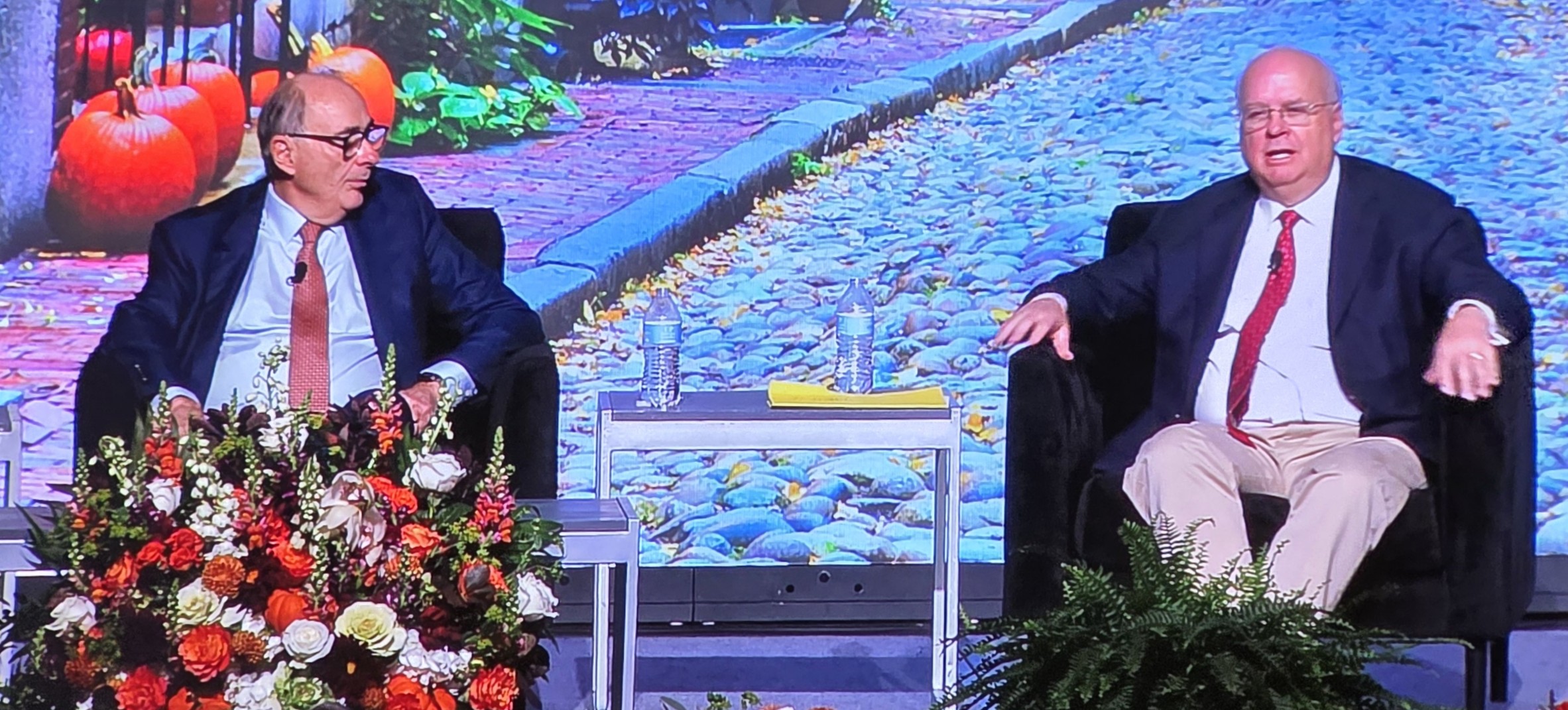
On the eve of the midterm elections, there may be larger issues but none may approach the convergence of economic development, technology, politics, and local concerns quite like data centers. Certainly, data centers have become a steady rallying cry in advertising and on soapboxes during various campaigns at all levels of government. In fact, some campaigns may have turned based on the stance candidates took on the issue. Some public officials may be ousted by the stance they have already taken. Two well-known political strategists – David Axelrod and Karl Rove – weighed in on data centers at the annual meeting of the American Property Casualty Insurance Association in Boston. David Axelrod, left, and Karl Rove at APCIA’s annual meeting in Boston “It’s a big issue,” said Axelrod, formerly chief strategist and senior advisor to former President Barack Obama. “It’s been a winning issue for people because they feel a loss of control. They feel that this is being done to them, and not with them.” Axelrod acknowledged data centers are needed to accommodate the massive power demand artificial intelligence has required of critical infrastructure, but people need to feel they are participating in the process. Without a lot of oversight from the federal level, governance of data centers will be done on a state-by-state basis, said Rove, former senior advisor and deputy chief of staff for former President George W. Bush. There will be winners and losers, but the winners will be the friendliest, which can be done while still keeping in mind the concerns and safety of constituents, he said. Rove called out Texas Gov. Greg Abbott for putting a moratorium on data centers until developers demonstrate plans for water usage, power use and sharing capacity, local buy-in on locations, and property-tax obligations without the use of tax incentives. “If you go around to all of the big boys in this business, they’ll say yes to every one of those,” Rove said. “And it is going to be a huge economic driver for the states that figure that out.” “Everyone involved needs to be politically sensitive to why people are so resistant to it,” Axelrod added. The pair of what many may consider unlikely friends also chimed in on AI – another hot-button issue that is not likely to be handcuffed by any regulation at the federal level. “Nothing’s going to happen at the federal level the next two years,” Rove said. “If it doesn’t happen at the federal level, it’s not going to be industry-wide.” AI will evolve at lightning speed during the next two years of the administration so revisiting regulation after that may be difficult, he added. The matter, therefore, will be left up to the states. “I think that issue is so complex that it really cries out for presidents to be conveners of stakeholders to set rules of the road,” Axelrod said. “I think the president has put his thumb on the scale for the industry. I think going state by state is harder, but in the absence of federal leadership – and I don’t know that we’re going to get it for the next two years – I think you’re going to see states intervening in different ways.” Topics InsurTech Data Driven Artificial Intelligence
Data Centers, AI Become Local Political Issues Without Federal Regs
Full Article
Original Source
Read the full article at Insurancejournal →KhanList aggregates and links to publicly available news content. We do not host full articles from third-party sources. Always verify important information with original sources.