
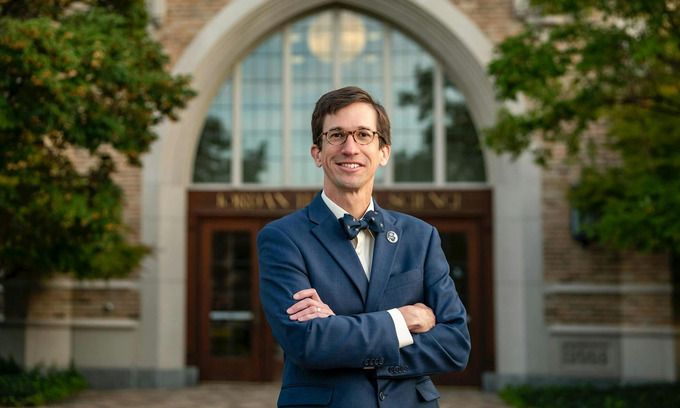
Dartmouth College Provost Santiago Schnell resigned Wednesday after a faculty-led investigation concluded he used artificial intelligence (AI) to substantially alter his published writing, violating university and publisher integrity standards. An independent committee organized last month by Dartmouth President Sian Leah Beilock determined that Schnell "fell short of the standards set forth" in multiple university policies, according to The Dartmouth, the daily student newspaper at Dartmouth College, an Ivy League institution.The committee concluded that "the Provost used AI to meaningfully alter his writing in violation of at least one publication's AI use and/or disclosure requirement, failed to disclose his use of AI in clear violation of a national newspaper's stated policy, was not forthcoming about his AI use, and fell short of the standards set forth by Dartmouth's Code of Ethical Conduct, the Academic Honor Principle, and Geisel's Policy on Expectations for Professionalism for Faculty, Non-Faculty Academics, and Staff."President Beilock, who has publicly advocated for greater AI adoption across the university, stated that Schnell "has resigned as provost and is leaving the university out of respect for his colleagues and the institution."In a memo to students, faculty, and staff, Beilock wrote that "I expect our senior leaders to hold themselves to the highest standards."Schnell's departure preempted a faculty no-confidence vote scheduled for later this month. Professor Santiago Schnell, provost of Dartmouth College. Photo courtesy of the college's website The controversy ignited in August when news outlet Semafor reported that Pangram, an AI-detection tool, flagged at least 80% of an editorial Schnell wrote for The Washington Post as AI-generated.Weeks later, The Dartmouth used the same tool to analyze nine of Schnell's professional publications. The analysis reported that Pangram classified 96% of his writing across these works, including two academic mathematics papers, as AI-generated.He admitted using AI for writing assistance but insisted the tools did not replace his research, authorship, or intellectual judgment. This defense failed to placate students and faculty, who argued his actions violated the campus honor code, which requires students to strictly disclose generative AI use, and demanded his dismissal.Following the backlash, Beilock formed an advisory panel of faculty and alumni to investigate. Opting against AI detectors due to reliability concerns, the committee instead reviewed Schnell's articles, publisher policies, communications, and Claude account records.Investigators reported that Schnell failed to fully cooperate."Although he did provide his Dartmouth-issued laptop for inspection, the Provost did not, upon request, provide logs of his use of personal LLM accounts that he used for his academic and public writings," the committee's report stated."The Provost also failed to make himself available at the time requested or to propose additional times that he could meet to discuss his AI use across his recent writings."History professor Matthew Delmont, the associate dean of faculty for international and interdisciplinary studies, will immediately step in as interim provost through June 2028.In an email to The Dartmouth, Delmont said he will "work closely with President Beilock, the deans and the excellent Provost's Office team to continue supporting our faculty and staff colleagues so that we can all support our students.""I feel a sense of responsibility and accountability for the university, and I am proud to serve as interim provost," Delmont wrote.
Dartmouth provost resigns over AI use in published articles
Full Article
Original Source
Read the full article at E →KhanList aggregates and links to publicly available news content. We do not host full articles from third-party sources. Always verify important information with original sources.