
Interviewing Daron Acemoglu is a race against the clock. The Nobel laureate in economics has many ideas, and each deserves an unhurried conversation, but his schedule runs from one appointment to the next and forces him into a draconian management of time. Even so, Acemoglu engages in the dialogue, pays attention to every question and avoids dispatching it with ready-made answers.His latest book, What Happened to Liberal Democracy?, traces the past, present and future of liberalism and democracy, two of the pillars of the modern age. It also analyzes the causes behind the decline of the liberal order and the rise, almost in parallel, of extreme nationalism and neo-fascist governments around the world. They are worth reviewing: the concentration of wealth and an unstoppable rise in inequality; changes in the organization of work driven by globalization and technological automation; the loss of community ties; the rise of social media; migration challenges; and a politics dominated by money and spectacle, and by a social engineering imposed from above that has distanced the majority, particularly the working classes, from decisions that dramatically affect their lives. As if that were not enough, there is now the irruption of AI.More than a meditation, What Happened to Liberal Democracy? is closer to a work of political and economic philosophy. Nor is it a page-turner that carries us from leap to leap across stories and places, like his previous bestseller, Why Nations Fail, co-written with the political scientist and economist James A. Robinson. Its ambition is more complex than revisiting the origins of prosperity and poverty. It is a journey to the roots of modernity that critically examines some of the central ideas of the West over the last four centuries and proposes a program to rescue liberalism, which Acemoglu considers “one of the most important human inventions.”When the Zoom window opens, Acemoglu appears in his office at the Massachusetts Institute of Technology, where he teaches. He wears a black-and-white checked shirt that matches a knit tie, also black, and holds a can of San Pellegrino sparkling water. On the desk, to his left, sits a copy of his book.Question. What led you to write this book? What questions or concerns prompted it?Answer. I believe, in a nutshell, that liberal democracy is one of the most important human inventions. Our lives would be so different without the institutions of liberal democracy and the aspirations of liberal democracy. We take it for granted, but it’s more important than many technologies that are used daily. And liberal democracy has delivered in terms of really changing our lives. But right now it’s in crisis, and I’m not sure that it will survive through the end of the next decade. And that’s why I wrote the book.Q. What were the immediate concerns driving you as you wrote it?A. If you look at surveys throughout the industrialized world, people have a much more negative attitude towards democracy. They have much less trust in democratic institutions. They are much more polarized, which circumvents what’s necessary for democratic governance — some sort of compromise. These are not just empty words. In election after election, we see lower turnout and dwindling support for centrist parties, in preference for either extreme right or, occasionally, extreme left anti-establishment parties that want to fundamentally weaken, change or destroy liberal democratic institutions. And moreover, this is not just a vibe. If you look at many things that were essential for the success of liberal democracies (shared prosperity, high-quality public goods, effective governance), all of those, according to objective metrics, are doing really badly.Q. In that sense, Brazil’s election is an exceptional and encouraging development. How do you see it?A. I think it is a mistake to think that all we need to do is repeat what [Joe] Biden did in 2020 against [Donald] Trump, or what Lula just pulled off against [Flávio] Bolsonaro. It’s not enough to defeat anti-democratic, anti-liberal parties and candidates in elections. Because if you do that, but you don’t have a viable, feasible plan of rectifying the problems of liberal democracy, all it will do is that it will mount the discontent even more for the next four years, which is exactly what happened in the U.S. This is exactly what happened in Brazil after the first Lula election. Lula almost lost to Flávio Bolsonaro, which is just remarkable after what his father [Jair Bolsonaro] did. And Trump won in 2024 with the voters fully understanding that he was a dangerous candidate. I don’t think anybody was under any illusion. The same thing is going to happen in France or in Germany, perhaps in Spain at some point. So those are really dangerous times. That’s why I think what we need isn’t just to repeat Lula and repeat Biden, but to develop a workable, inspiring governing philosophy for liberal democracy that’s appropriate for the times.Q. Elections in Spain are on November 29, so it’s a very critical moment. At the end of your book, you argue that liberalism, if it’s to remain relevant and even a governing ideology, must confront five challenges. Could you briefly summarize them, and why are they so urgent now?A. I think the bigger picture is, I argue, liberal democracy must inspire, must bring people together and must recreate institutions and practices for the age of AI that go back to its founding principles, which are to support shared prosperity and high-quality public goods, and provide effective voice and self-government to people. So the five challenges that I outline in the last chapter are essentially ingredients for achieving that objective.I argue that we have to leverage community, which liberal democracy used to do before and has left by the wayside. It has to work with communities in a way that doesn’t allow them to extinguish freedom, individual freedom (sometimes it is sacrificed), but still allows communities to have self-government. And that’s where we see the importance of the liberal part of liberal democracy.Challenge three is about building voice and citizenship, which is the democratic part of liberal democracy. Part of the reason why we have so much inequality, so much failure of effective public goods throughout the industrialized world and so much dissatisfaction among people is because they feel they don’t have a voice. And I think that voice, to be meaningful, really needs to coalesce around local priorities, but also build up to some notion of citizenship, so that the electoral processes can encourage both local and national politicians to serve those aims.The fourth one is shared prosperity, which is what I have emphasized as one of the foundational pledges of liberal democracy. And the reason why that’s a big challenge is because AI complicates that. The final one is public services: how we can provide effective public services while still remaining true to dissent and diversity within these nations and communities.Q. Throughout the book, there is a tension between community and the individual.A. Correct. A hundred percent.Q. Is there any way to balance both in this tribal era? Today we don’t live in communities; we live in tribes.A. Yes, I think there is. Once you start emphasizing the importance of community, it will also become more salient that you have to make sure those communities live according to some broad liberal principles. For example, if we put community on the back burner, we don’t need to worry about how immigrant communities (recent immigrant communities that are still influenced by Islam, and sometimes that belief becomes very strong) deal with problems, because we’re not giving them autonomy. Or traditional communities that may be against transsexuality or other individual rights, because we’re not giving them enough room. Once we start giving them enough room for self-government, then it becomes very apparent, and first order, to actually make sure that individual freedoms are protected. And that starts building both sides of that trade-off: both community rights, but also individual rights.Q. Can you give an example of a place or society where this is happening, besides Ireland?A. Switzerland, I think, is a great example. Switzerland puts a lot of emphasis on local community and local governance. Referendums on local matters is one aspect, but citizenship matters a lot. Participation in the community is very strongly encouraged. But it is within very broad confines of liberal values, so that those local communities never take people’s freedom of religion, freedom of association, freedom of thought away from them.Q. In my country, we have a saying: “We are not Swiss.” Meaning that it’s very difficult to be like the Swiss.A. Ha ha. I understand… There is a lot of cultural diversity that we have to recognize and that we have to celebrate. But we also have to work hard at getting lessons from different cultural contexts that are generalizable. So I think some aspects of the Swiss experience are about being Swiss, but some of it is about local participation.Q. We see deep dissatisfaction and declining trust in France, the United States, Germany, Latin America and the Arab world. It feels as though the post-war liberal order, and even the post-Cold War order, has lost its ability to include and represent broad majorities. What is at the core of the crisis?A. I would say it’s all about the modernization process that is associated with the rise of post-industrial society. Changes in economics brought about by digital technologies and globalization have increased inequality and made creating shared prosperity harder, and at the same time elevated those with managerial, technical and specialized knowledge. And the social changes associated with that are that those groups, which are typically college-educated groups, became both very influential and very separate from the rest of society, in particular from the working class. Their influence is most clearly seen in center-left politics, which is the beating heart of liberal democracy: social democratic parties, the Labour Party in the U.K., Democrats, socialists in Spain and France, which used to get most of their votes from the working class. And now they get almost all of their votes from the college-educated, and the working class has left the center-left. And that is associated both with the culture wars and with the passive attitude of the center-left towards growing inequality and stagnation of the earnings and opportunities for non-college workers.Q. Non-college workers feel betrayed by liberal elites.A. And you can sympathize with that. Until Trump’s election, the Democratic Party didn’t understand or didn’t even recognize the plight of non-college workers. It is both economic and cultural. They have simultaneously fallen behind, both absolutely and relatively. And at the same time, they have been experiencing cultural change that they perceive as disempowering, because it’s associated with their values becoming less popular and being often told that their values are wrong.Q. The midterm elections in the United States will be an important test. What do you think is really at stake?A. It is absolutely essential that the anti-democratic (and in this case, doubly anti-democratic and anti-liberal) forces are defeated. Trump and the Republican Party that has become Trump’s party should be defeated. But that is not enough. In fact, it’s a dangerous victory for the center-left if they interpret it as “OK, everything can go back to normal.” It will not go back to normal.Q. It didn’t go back to normal with Biden.A. It did not go back to normal with Biden. The only hope is to take that as a first step, and then, on the basis of that, start changing what liberal democracy is trying to do in a way that can bring the working class back to the center of center-left politics and the center of liberal democracy.Q. Many people say that we need to restore the social contract in order to save democracy. You make a more unsettling argument: that social contracts, and the idea that liberalism depends on them, are part of the problem, with roots going back to the Enlightenment. What exactly do you mean, and what is the alternative?A. It’s a complicated argument, unfortunately, because I do agree that something about what we collectively believe in needs to change, and that’s why I call it the social compact. You could call it social contract, except that social contract gained a specific meaning in Enlightenment philosophy. It’s an implicit contract that we are supposed to have signed, even though none of us signed, that tells us what we owe to society and what society owes us, and what’s right, what’s wrong. In Kant’s version, it’s the right moral rules that we should always follow. In Rousseau’s version, it’s the general will. In Locke’s and Hobbes’s versions, it’s some cousin of that. But the problem is that it’s always top-down. It doesn’t ask people’s opinion, and it doesn’t try to convince them. There are some rules that are fair and just, and social contract is achieved by following them. It’s not going to succeed because we need to convince people to make compromises around shared values, and it has to be a bottom-up process, not a top-down process.Q. What did we lose as local associations, unions, forms of belonging and networks of solidarity weakened?A. We’ve lost a lot. The decline of community has many causes, but one of them is that we participate much less in community and associations, including trade unions, but other things too. Churches, sports clubs, local things that enabled people to help each other or to get together around a common purpose were a very important part in which people became excited and participatory in the community. The evidence, which is not in my book because I’m working on it at the moment, shows that when associations decline, communities become less powerful in dealing with adversity, and many of the social problems become more likely. And I think associations are the tip of the iceberg. We really need to give people purpose and some shared goals and values around which they can collaborate, cooperate, exchange ideas. That’s what we have to do. And I think, at its best, that’s what liberal ideas did. And we have to go back to them, even though the times that we’re living in, with AI and social media, are very different from the early 20th century.Q. I want to push back a little bit. Is that really something we can achieve? Can we go back to community at a moment when social media is fragmenting society, atomizing everything, and AI promotes, or even promises, a world in which we don’t even have to work?A. You’re right to question that. And I’m not optimistic, but I’m hopeful. I’m not optimistic because I definitely don’t think that’s where we’ll end up if we don’t do anything. But I am hopeful that what I’m saying is feasible. People are dissatisfied with social media, and they are missing many of the things that real-world social networks gave them. So if there are alternatives to social media for people to form bonds, and they are attractive, and social media is regulated, I think there is hope for that. And I argue at length in the book how it is possible to steer AI in a different direction, so that it doesn’t become a job killer but becomes a complement to building shared prosperity. Again, that’s not where we’re going. So it’s a big lift that I’m asking from civil society and from governments to make that happen, but it is feasibleQ. What role can civil society play, for instance, in the United States, where everything seems to be in the hands of just five or eight guys in Silicon Valley?A. That’s exactly the role that civil society can play. It’s not the first time in American history, or in world history, that a sort of oligarchy has taken control of both economic and political power. And the only way out of that is civil society. That’s what we saw, for example, with the Progressive Era. In the Gilded Age, we had the same problem of a small number of multimillionaires and big companies becoming both economically and socially dominant and controlling politics. But civil society reaction changed politics, ultimately brought us three presidents bent on changing the system, changed legislation and transformed the rest of U.S. politics.Q. It seems very hard.A. It is hard. So if your question is whether what I’m proposing is likely to happen by itself, or easy, the answer is no. If your question is whether what I’m saying is possible: yes.Q. My question is different. The U.S. has been a stable democracy for over 200 years, without revolutions, unlike many other parts of the world. Is the program you propose, a compact society based on community, feasible without a revolution?A. I think so. In fact, revolutions rarely work, because they polarize, and I think we need to reduce polarization. And if you look at people on the left and the right, they are hugely polarized, but there are so many things that are in common. They are all dissatisfied about the same things: lack of jobs, low-quality schooling, low-quality public services, politicians who lie, politicians who are serving the oligarchy. So yes, we need radical change, but it doesn’t need to come with revolution.Q. You say that the response cannot come from social engineering from above, but from working-class liberalism. Is working-class liberalism sufficiently organized today, through unions and parties, to take on that task?A. Absolutely not.Q. Where should the rebuild begin? And, looking again at the midterms, what kind of outcome or political mandate could open space for these reforms?A. I think the best lessons we can learn from history are from the rise of social democracy. Before social democratic parties formed, in their current form, in Scandinavia, there was no hope for the system to evolve in that way. So that was an innovation, an institutional innovation. And it has to come from civil society, and it has to come from the center-left changing its focus. There are many talented center-left politicians, but they have to break out from their current focus of just speaking to their base, and try to broaden the base. And I think that’s the first step.Q. One last question: how much time do we have to steer the direction, and what leaders can represent this kind of change?A. I don’t know what leaders; we will have to see. But time: I think we don’t have much, because democracy is getting weaker and AI is becoming more dominant. But it’s not a matter of weeks or months. I think we have several years, but we don’t have 10 years. So it is urgent.Q. People say that AI is going to annihilate every one of us in maybe five years.A. Exactly. So we have to act before then.Sign up for our weekly newsletter to get more English-language news coverage from EL PAÍS USA Edition
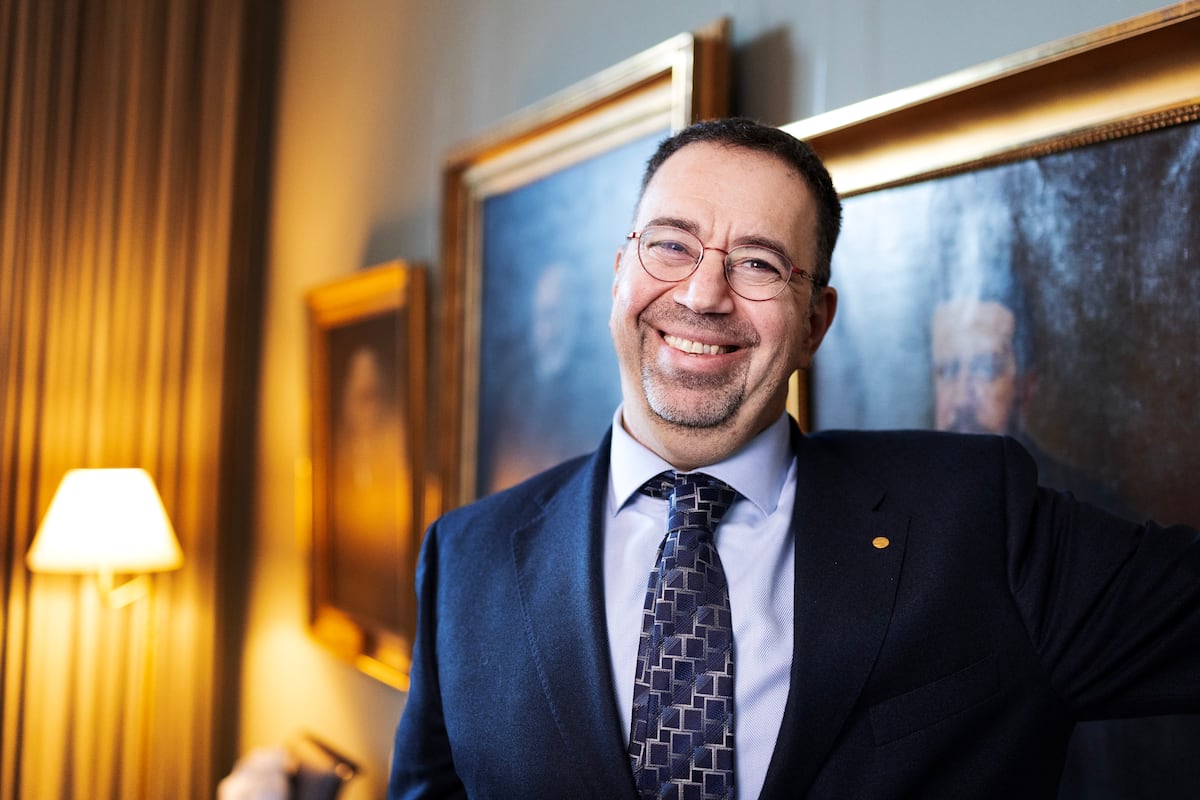
Daron Acemoglu: ‘If Democrats think everything can go back to normal, it will be a dangerous victory’
Full Article
Original Source
Read the full article at English →KhanList aggregates and links to publicly available news content. We do not host full articles from third-party sources. Always verify important information with original sources.