
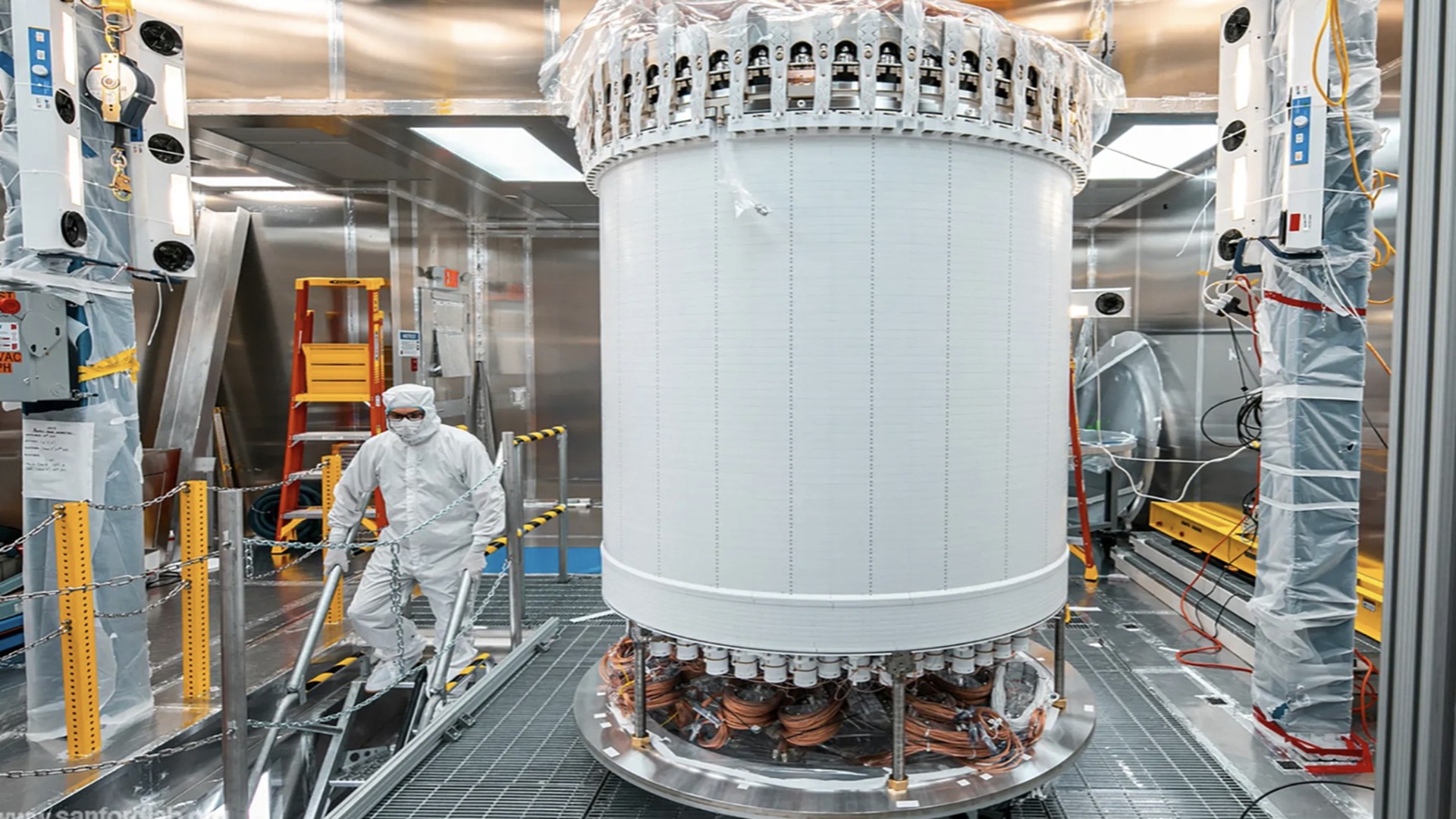
A dark matter detector buried nearly a mile underground has recorded a single particle event that could be a sign of dark matter. The event, detected by the LUX-ZEPLIN (LZ) experiment, is difficult to explain using known background signals from normal matter. However, the result does not yet meet the statistical threshold required to claim a discovery. The signal has a significance of 2.6 sigma, meaning researchers cannot rule out the possibility that a rare background process produced it. Still, scientists say it is the most compelling hint of dark matter reported by LZ to date. The result comes from 220 live days of data collected between March 2023 and April 2024. Researchers presented the findings at the 2026 TeV Particle Astrophysics conference in Japan. One event stands out LZ is designed to search for WIMPs, or weakly interacting massive particles, a hypothetical class of particles that could make up dark matter. The experiment uses 10 tonnes of ultrapure liquid xenon to look for tiny flashes of light produced when particles interact with xenon atoms. The detector sits nearly a mile below ground at the Sanford Underground Research Facility in South Dakota. The thick layer of rock shields it from cosmic rays, while a water tank and outer detectors help block or identify other particles that could mimic a dark matter signal. The newly identified event appeared in a region of the data where researchers expected dark matter interactions to occur and where competing background signals were low. “We’re very intrigued to see this event in the data, in the region where we expect dark matter to show up and the competing backgrounds are very low,” said Rick Gaitskell, a professor at Brown University and the spokesperson for LZ. “With only one event, we don’t want to get ahead of ourselves. We are not claiming to have seen dark matter. But we have seen something interesting that we want to share with the scientific community for their input.” Researchers spent months investigating whether the event could have been caused by a conventional background process. “It’s genuinely thrilling to consider whether this might be an early glimpse of dark matter finally revealing itself,” said Luiz de Viveiros, associate professor of physics at Penn State and member of the LZ experiment. “We’re still racking our brains over whether some rare background process could account for it, but so far nothing has turned up.” Signal needs more evidence The event has a global significance of 2.6 sigma after accounting for the look-elsewhere effect. That is well below the 5-sigma threshold generally required to claim a discovery in particle physics. Researchers estimate there is approximately a 0.5% chance that the event could be explained by known backgrounds. That makes it unusual, but it does not eliminate the possibility that an unidentified background process produced the signal. If the event was caused by dark matter, the WIMP would likely have a mass of at least 200 GeV/c2, or more than 200 times the mass of a proton. It would also point to a specific type of interaction between WIMPs and ordinary matter beyond the simplest model. LZ is an international collaboration of 250 scientists and engineers from 39 institutions. Penn State researchers have contributed to the detector’s construction, cryogenics and liquid xenon systems, as well as background modeling, detector calibrations and statistical analyses.Get the latest in engineering, tech, space & science - delivered daily to your inbox.With over a decade-long career in journalism, Neetika Walter has worked with The Economic Times, ANI, and Hindustan Times, covering politics, business, technology, and the clean energy sector. Passionate about contemporary culture, books, poetry, and storytelling, she brings depth and insight to her writing. When she isn’t chasing stories, she’s likely lost in a book or enjoying the company of her dogs.
Dark matter finally found? Detector spots rare particle event with no source
Full Article
Original Source
Read the full article at Interestingengineering →KhanList aggregates and links to publicly available news content. We do not host full articles from third-party sources. Always verify important information with original sources.