
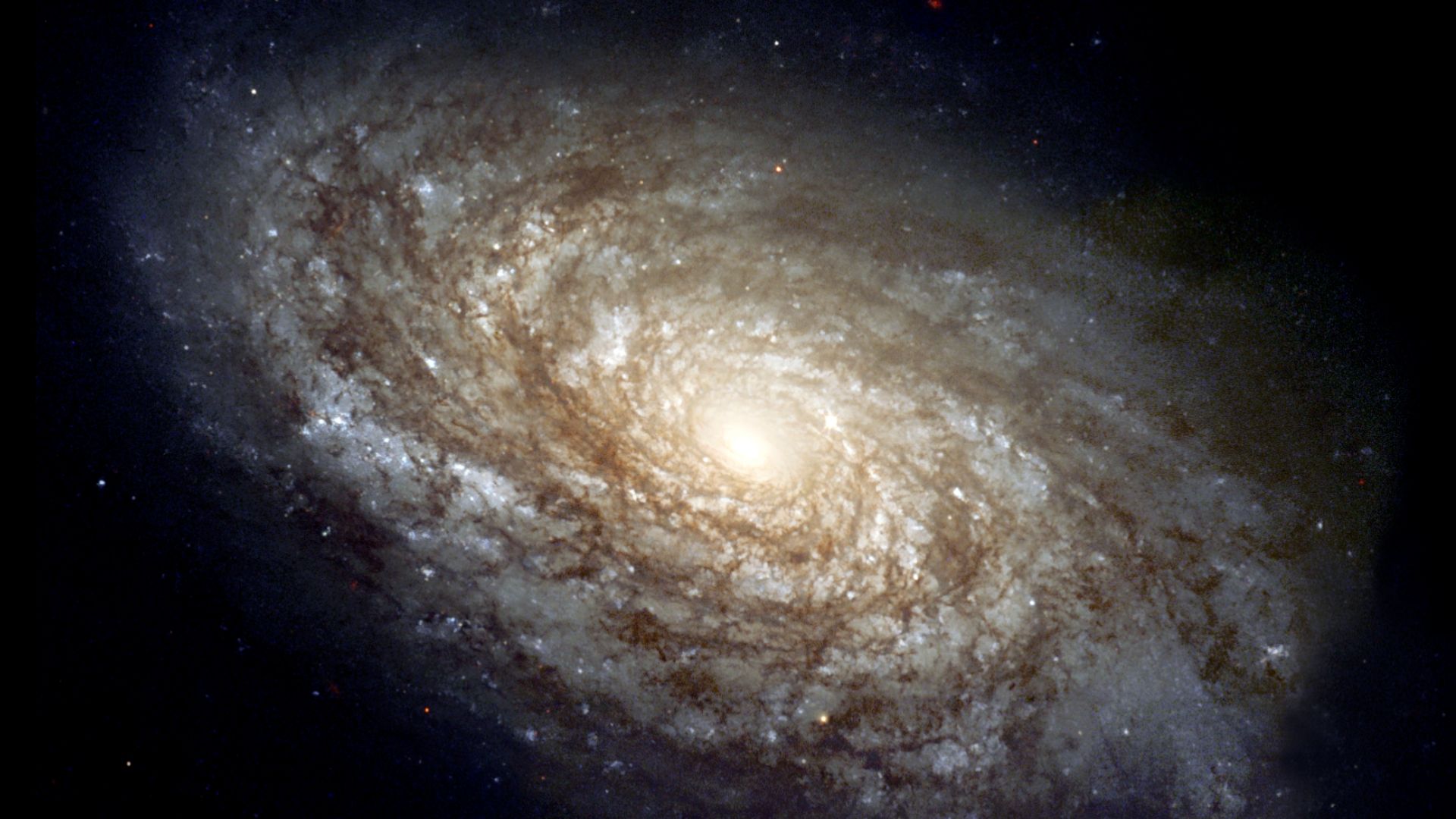
A nearby dwarf galaxy may harbor a dark matter core roughly 78,000 light-years across, according to one model fitted to new telescope observations. The galaxy, known as UGCA 320, appears to have a broad region of nearly uniform dark matter density that extends well beyond most of its stars. Led by Qinwei Yuan of Nanjing University in China, astronomers combined optical observations from the MUSE instrument with radio measurements from the MeerKAT telescope to track how gas moves through the galaxy. Their findings, posted to arXiv on November 11, suggest that the dark matter is less concentrated at the center than a widely used model predicts. The team used MUSE to track glowing hydrogen gas in the inner galaxy and MeerKAT to follow neutral hydrogen farther out. The two sets of observations let the astronomers measure how quickly gas orbits at different distances from the center, producing what is known as a rotation curve. The researchers then estimated how much gravity the visible stars and gas contributed. After accounting for ordinary matter, they used the remaining gravitational pull to infer how dark matter was distributed. A conventional cold dark matter profile, which predicts a sharp rise in density toward the center, predicted faster rotation in the inner galaxy than the team observed. Models with flatter centers fit the data better. Two models point to an unusually large core The team’s main estimate put the core radius at about 24,850 light-years. A second model fit the rotation data equally well and yielded a radius of roughly 39,000 light-years, which translates to about 78,000 light-years across. The difference comes from how quickly each model assumes dark matter density falls at greater distances. “Such a large dark matter core radius is uncommon among dwarf galaxies,” the researchers wrote. Half of UGCA 320’s starlight comes from within about 6,600 light-years of its center. Even the smaller estimate puts the core radius at nearly four times that distance. Dark matter particles could help explain the size Repeated bursts of star formation and supernova explosions can drive gas out of a galaxy’s center. The resulting changes in gravity can redistribute dark matter and flatten a central density peak. The researchers found that existing simulations of this process generally produce cores much smaller than the one inferred in UGCA 320. The team also considered warm and fuzzy dark matter, but the particle masses needed to explain the core were difficult to reconcile with other observations. A third possibility, self-interacting dark matter, was more consistent with the findings. In that scenario, particles scatter off one another and redistribute energy, making it easier to form a broad core. The galaxy’s rotation gives astronomers a way to test those explanations, while the identity of the particles remains an open question. Finding similarly large cores in other dwarf galaxies could help astronomers test whether dark matter particles interact with one another. Get the latest in engineering, tech, space & science - delivered daily to your inbox.Atharva is a full-time content writer with a post-graduate degree in media & amp; entertainment and a graduate degree in electronics & telecommunications. He has written in the sports and technology domains respectively. In his leisure time, Atharva loves learning about digital marketing and watching soccer matches. His main goal behind joining Interesting Engineering is to learn more about how the recent technological advancements are helping human beings on both societal and individual levels in their daily lives.
Dark matter core may span 78,000 light-years in China-led dwarf galaxy study
Full Article
Original Source
Read the full article at Interestingengineering →KhanList aggregates and links to publicly available news content. We do not host full articles from third-party sources. Always verify important information with original sources.