
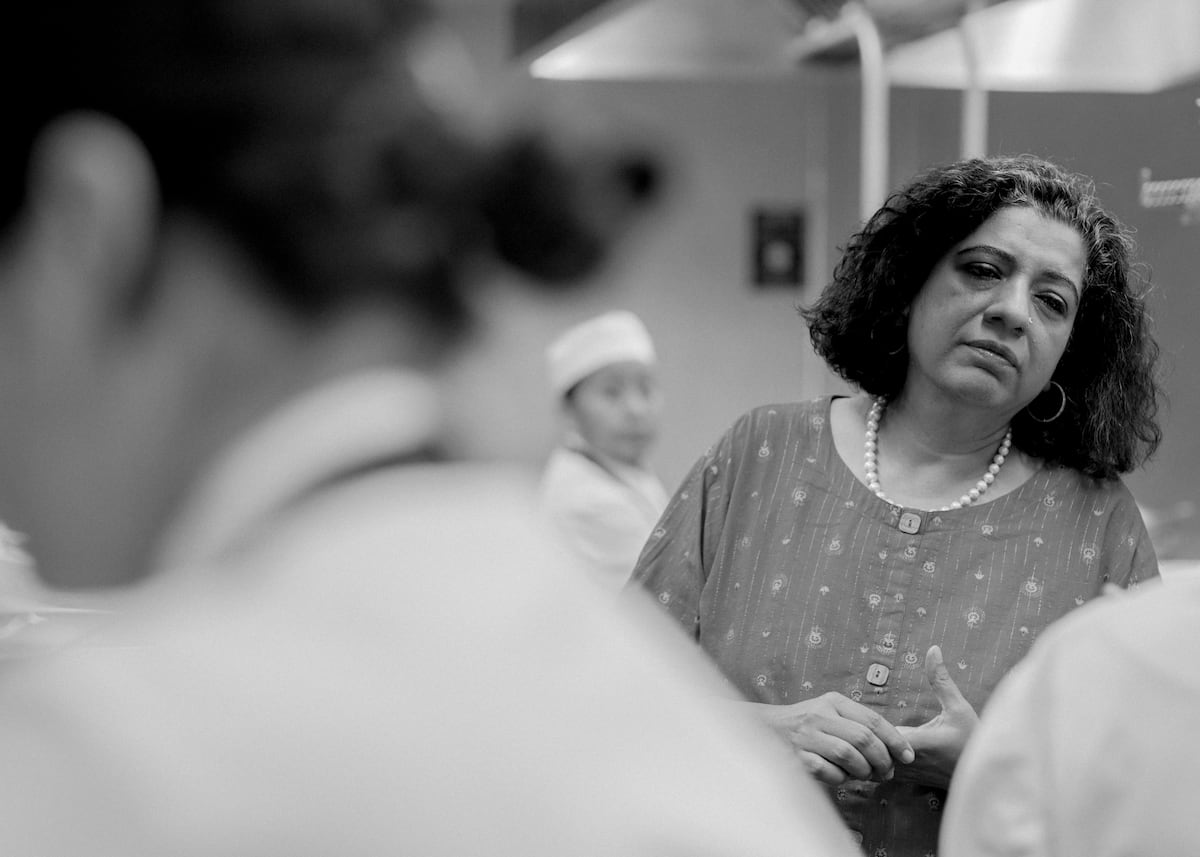
Political rebellion does not always rise from below. And it may be fought in the kitchen before it ever reaches the barricades. Asma Khan, 57, whose Indian cooking rooted in the traditions of Bengal and Rajasthan has earned a place of honor on London’s culinary scene, never attended culinary school.Her talent was forged out of necessity, as a way to overcome loneliness and sadness, and food has always been, for her, an expression of love and social justice. What she serves, she says, are the recipes of mothers and grandmothers.“There are so many things that connect us, whether you’re Spanish, Italian, Colombian, or Mexican,” she explains from one of the tables at Darjeeling Express, her restaurant in the heart of London’s Soho district. “It’s all those ingredients that are part of your food, that run through your blood, that are in your DNA. Your cells are built from food that isn’t what restaurants serve. Nobody in the restaurant business today cooks the food our mothers made. Food that is beautiful, fragrant, pure, almost built in layers. It’s not trying to impress anyone. It simply wants to feed, nourish, heal, and it’s filled with love.”The name of her restaurant, Darjeeling Express, comes from a small steam locomotive that Asma rode as a child with her family, gradually leaving behind Kolkata’s oppressive humidity and climbing, amid the mournful huffs of the train, toward the clean, cool air of the Himalayan foothills. “I would shout my name out the window, and the mountains would echo it back,” she recalls.Born into a wealthy, intellectual Muslim family with socialist beliefs and high-caste status, Asma had the misfortune of being born a second daughter in a country where having one daughter can be seen as a major financial burden, and a second can spell ruin for many families.“It’s not that anyone explicitly told me I wasn’t wanted, or that I was a burden on the family,” she says. “But you sense it in the way people talk about you, in everything you hear... in the small details. In your father’s friend describing having two daughters as watering your neighbor’s garden, spending time and effort raising them only for them to leave with their husbands, while the family is expected to provide an enormous dowry.” “What made things even harder was that I wasn’t very attractive,” she adds. “If I’d had fairer skin and been thinner, with beautiful hair, maybe people would have liked me more. People are quick to judge, and if you’re the second daughter, that judgment is even harsher. My parents were wonderful, and they raised all of us to feel equal to one another, but society, our extended family, and especially my grandparents never let it go. ‘You’re so dark, no one will ever marry you,’ my paternal grandmother used to tell me.” Determined to throw herself into her work, she began contributing to the pages of the Indian magazine Sunday. But it was not long before her mother arranged what seemed like a chance meeting with Mushtaq Khan, a young economics professor: he was intelligent, deeply committed to politics, and driven by a strong sense of social justice. During his university years, he had flirted with radical Marxism.It was an arranged marriage, though not a forced one. The Khans moved to the university town of Cambridge, England, where Mushtaq had secured an academic position. Asma spent her time, often alone for long stretches, earning a law degree. But sadness weighed heavily on her. Gray skies, gray days, cold weather, and short winter days. And food that she found bland and uninspiring.“Cambridge was an emotional shock. It was so cold, with all those leafless trees. The people were so inhospitable, and the food was terrible. I thought I was going to die. The Bible, the Quran, and the Torah all describe hell as a place of fire. For me, it was the cold winter of Cambridge,” the chef jokes.Returning home Asma found her way back home. But her goal was to save a marriage that her own unhappiness was beginning to undermine. The secret to overcoming loneliness lay in food. In the ancestral recipes preserved by the women in her family. They all rallied around her. Each of them shared their culinary alchemy with the young woman, giving her the tools to fight the homesickness that had taken hold of her.“At first I was a disaster, and my hands were covered in burns. But I learned very quickly, because I knew Cambridge was waiting for me,” says Asma. “The isolation, the silence, the gray towers, the gray sky, the leafless trees. And I knew that food was my only way home. Every time I cook, I feel my mother is close to me. It’s as if I can smell her beside me, just as I did 30 years ago.” “I didn’t learn from professionals,” she continues. “I learned from people who loved me intensely, who taught me because they wanted me to be happy. They knew I was going to cross oceans, and they gave me the gift of their recipes so that whenever I felt lonely, I could cook them. So that whenever I was sad, I could cook them. Back then there was no internet, no WhatsApp. I couldn’t just pick up the phone and talk to them. All I had was food.”The club of the “second daughters”From Cambridge, the Khans, now parents of two sons, moved to London, where Mushtaq secured a position at the prestigious School of Oriental and African Studies (SOAS), the university institution that for many years trained British officials before they embarked on careers across the far reaches of the Empire.Meanwhile, Asma was quietly weaving her own revolution. Many of the housekeepers and nannies caring for children at the same school attended by her two sons came from South Asia, from India, Pakistan, Bangladesh, and Sri Lanka. Little by little, she began reaching out to them. Gently. Discreetly. She would invite them to her home for tea or organize afternoon gatherings on the terrace of a local café.As she broke down the social and economic barriers that would have made such encounters impossible in the societies they had all left behind, Asma was also secretly hosting supper clubs in her home, without her husband’s knowledge. These improvised dinners, attended by as many as 40 guests through word of mouth, allowed her to test the recipes she had brought with her from her native Kolkata.Many of the women, like herself, had traveled halfway around the world carrying the secrets of their mothers and grandmothers, and they asked Asma to let them work with her in her home cooking lab.“It’s the greatest achievement of my life,” Asma says passionately. “The mutual embrace of this group of women — we were able to see ourselves as equals, even though our life journeys had been different. Some of them never went to school. Others suffered abuse or fled violence. They didn’t receive love. Many of them are also second daughters. They have endured hunger and physical and sexual violence. I didn’t have to go through all that, obviously, but on our culinary journey we’ve come to be one and the same.” Vivek Singh, the chef who shook up the traditional, long-established Indian dining scene in Britain with his restaurant The Cinnamon Club and later with the group of venues known as The Cinnamon Collection, recognized a generosity in Asma’s food and recipes that led him to support her.After several difficult attempts, accompanied by her loyal circle of friends, Asma experimented with a series of pop-ups in Soho pubs before finally managing to open her own restaurant. Reluctantly, her husband contributed money and support, although his culinary tastes were decidedly simpler than the sophisticated, home-style yet enchanting cuisine that Asma was offering.There, on many evenings, you can find her moving from table to table, passionately explaining the dishes she has just served, telling customers why her mother used a particular ingredient, squeezing in among diners to share her gift for conversation and her love of the colors, flavors, and aromas of a menu that combines Kolkata street-food traditions, such as panipuri, with the refinement inherited from the Indian royalty to which her family once belonged.“To me, food is magical,” she says. “It has power. It tells a story. And when I began this journey, I could already see society changing. People were eating dinner in front of the television, and some children were eating with an iPad in front of their faces. I saw it in my own children. I told myself that I wanted no part of that, and I threw myself into the restaurant business.” The early years were difficult and full of mistakes for a passionate cook with little experience of the realities of running a restaurant. Many of the women on her loyal team split their time between the kitchen at Darjeeling Express and the jobs they already had, which they did not yet dare to give up completely.That changed when Fay Maschler, the legendary restaurant critic for the London Evening Standard and an undisputed authority on who was in and who was out in London’s dining scene, walked through the restaurant’s doors. Her review was glowing. Almost overnight, the line of people waiting to get in multiplied.And the women who had joined Asma on her journey committed themselves to it full-time. There were only women in that kitchen. No voice carried more weight than another. All of them shared difficult pasts, all members of a club whose only admission requirements were hard work and solidarity with their fellow travelers.“All of us are Londoners,” says Asma. “Something like this could only have happened in London. Back where we come from, no one would have allowed us to break down all these barriers, tear down the walls, lift the veil, and embrace one another. Society and our families would have judged us. Here, no one has. We broke every chain and we are free. And equal. When I work in the kitchen, I earn the same salary as they do.” Today, Asma is the author of bestselling cookbooks, including Monsoon; a recipient of honors from the British royal family; a sought-after guest on television and in the media; and the subject of selfie requests from actors, writers, and celebrities eager to be photographed with her.London adores her. And she, in turn, adores a city she considers the culinary capital of the world. But Asma Khan knows that one day she will return to India.“Even the dust in the air knows my name. Here, when I walk down the street, I am truly a foreigner. I always will be. I’m an important part of British culture, but my skin is dark, and my accent is unmistakable. Home is the courtyard of my family house, where the trees I watched grow still stand, where I know when the fruit will appear, and where I recognize the sound of the birds,” she says. “If someone asked me where home is, I would say Kolkata without a moment’s hesitation.”Sign up for our weekly newsletter to get more English-language news coverage from EL PAÍS USA Edition
Darjeeling Express, the acclaimed London restaurant where immigrant women rewrote the rules
Full Article
Original Source
Read the full article at English →KhanList aggregates and links to publicly available news content. We do not host full articles from third-party sources. Always verify important information with original sources.