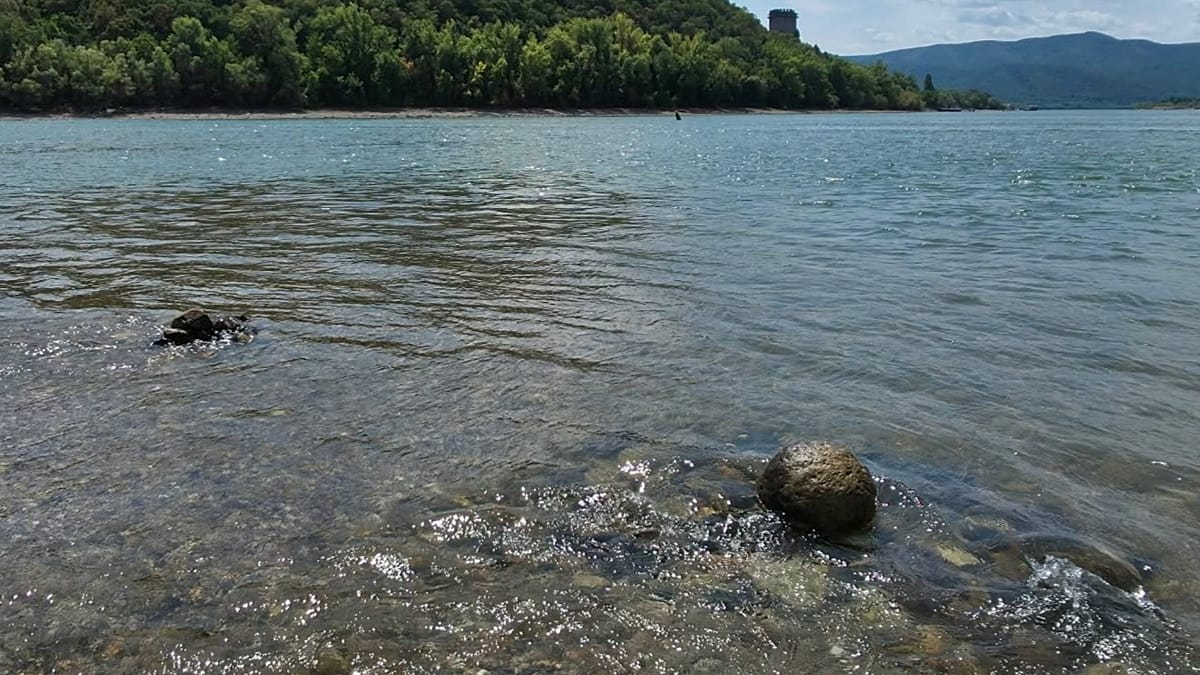
Budapest's Danube River level dropped to record lows this week, reaching 23 centimetres on Wednesday (29 July). The previous lowest water level, 33 centimetres, was recorded in 2018. ADVERTISEMENT ADVERTISEMENT By Wednesday lunchtime the water level had risen slightly, to 25 centimetres, but no significant improvement is expected. What is more, the summer’s second major heatwave is just now reaching Hungary. As the Danube recedes, more and more of the riverbed is being exposed. The situation is so extraordinary that the president of the Hungarian Cyclists’ Club, Gábor Dezső Kürti, was able to cycle along the riverbed all the way from Budapest to Vác. A few days ago, a Euronews reader came across a strange, perfectly shaped stone on the riverbed near Visegrád, which immediately caught his attention. Danube drought exposes everything from shipwrecks to centuries-old projectiles The reader also informed the Mátyás Király Museum in Visegrád about their discovery, and on first look it appears it could be a catapult projectile. The museum’s director, archaeologist Gergely Buzás, tells Euronews that such finds are not uncommon in the area; after all, Visegrád Castle was bombarded with hundreds of stone balls during each siege, so they also have a few similar projectiles in their storeroom. The museum’s experts will go out next week to examine the stone sphere to confirm their prediction. How old it is can only be guessed at, not measured. According to Buzás, what can at least be said is that such projectiles were used up to the 16th century at the latest. But it could go back much further, since a fort already stood here in Roman times and stone-throwing machines were already known then. So if it is confirmed that this really is a catapult projectile, it was made at least 400, and possibly as much as 2,000 years ago, and has been lying on the bed of the Danube ever since. Discoveries of this kind are not isolated now: last week a Second World War shipwreck also emerged from the drying bed of the Danube near Mohács. No end to the drought in sight From the area where the mysterious stone sphere was found, the Danube Bend, the European Union’s Copernicus satellite earth observation programme published a satellite image on Wednesday. The montage shows the same stretch of the Danube in an image from 14 July 2025 and another from 25 July 2026. Comparing the two images, it is clear that this year there is much less water in the Danube than there was last July. Sandbanks have emerged on the river’s bends, making navigation on the Danube extremely difficult. It is no coincidence that on some stretches neither cargo nor passenger vessels can operate, and restrictions on river traffic have also been introduced in Budapest. The head of the Ministry Responsible for the Living Environment, László Gajdos, declared a state of heightened alert in the fight against drought on Wednesday. In the morning the minister announced that "in 66 of the country’s 84 water-shortage management districts, the drought index is above the triple threshold value laid down in law", meaning that three quarters of the country are suffering severe water shortages. According to the weather forecasts, there will be no rain at all over the next two weeks. The heatwave that began on Wednesday is expected to reach its peak in about a week, with maximum temperatures of around 39 degrees in the capital. Some relief is expected only towards the end of next week, and even then maximums of 31–33 degrees are still to be expected. This isn't just a run of bad luck with the weather. According to a World Weather Attribution analysis published last week, Europe's droughts this year have been driven less by a shortage of rain and more by extreme heat, which pulls moisture out of rivers, soil and vegetation far faster than usual. Scientists found such intensely evaporative conditions are now up to 80 times more likely than before humans started heating the planet with fossil fuels.
Danube drought exposes everything from shipwrecks to centuries-old projectiles
Full Article
Original Source
Read the full article at Euronews →KhanList aggregates and links to publicly available news content. We do not host full articles from third-party sources. Always verify important information with original sources.