
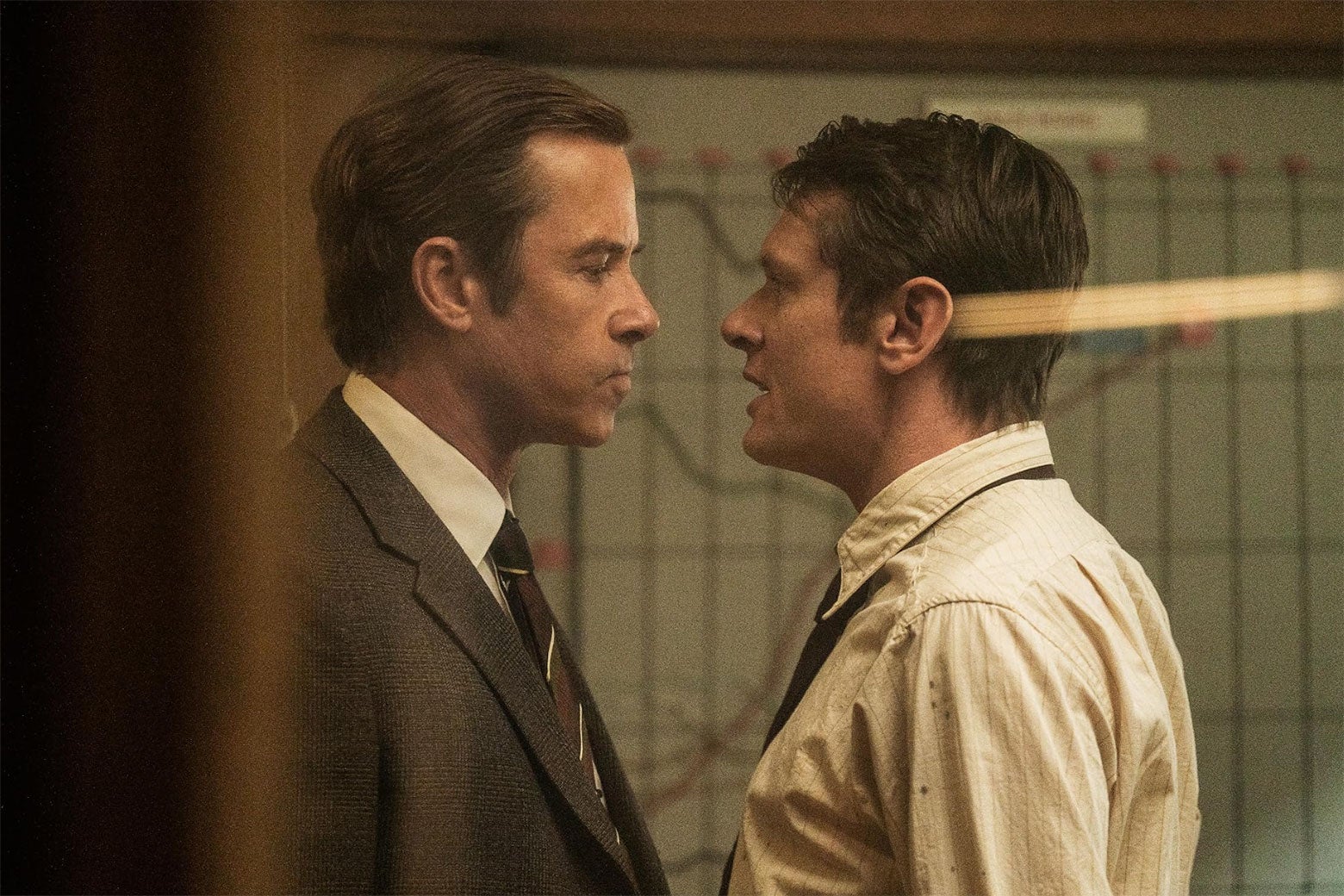
Movies Danny Boyle’s Controversial New Movie Is Like Trainspotting for Tabloid Journalism Newspapers may be dying, but at the Toronto film festival, the presses were still humming. By Enter your email to receive alerts for this author. Sign in or create an account to better manage your email preferences. Unsubscribe from email alerts Are you sure you want to unsubscribe from email alerts for Sam Adams? Sept 22, 20264:31 PM Anthony Dickenson/Netflix Sign up for the Slatest to get the most insightful analysis, criticism, and advice out there, delivered to your inbox daily. Perhaps the hourlong lines to buy Criterion Collection Blu-rays should have been a dead giveaway, but one of the surprising winners at the Toronto International Film Festival this year was physical media. Like most festivals, TIFF’s projectors have gone fully digital, but onscreen, print journalism in particular was alive and well. Or at least alive. Danny Boyle’s Ink, which is loosely adapted from James Graham’s Tony-winning 2017 play, charts Rupert Murdoch’s takeover of the Sun, which ravenously ambitious editor Larry Lamb (Jack O’Connell) turned from a flagging broadsheet into a ruthless tabloid that within a decade became the bestselling tabloid in the U.K., a title it held for 42 years. Naturally there’s some handwringing about the deterioration of journalistic standards, culminating in the disastrous 1969 kidnapping of Muriel McKay. (McKay was mistaken for Rupert Murdoch’s wife, and the movie blames the Sun’s reckless reporting for her eventual murder.) But from Trainspotting onward, Boyle’s morality plays have always done battle with his love of the vulgar and grotesque. The Sun may be a den of iniquity—an overhead shot during one particularly rowdy office party shows a man vomiting in one bathroom stall and Lamb vigorously screwing a female editor in the next—but their critics are prigs and stuffed shirts, a cordon sanitaire of Oxbridge grads. Watching Lamb assemble his team of frustrated Fleet Street hacks and incentivize their worst instincts is like running Citizen Kane at triple speed. When his union printers balk at one particularly salacious front page, Lamb literally gets his hands dirty, tamping down the linotype and slathering it in oily ooze. (Guy Pearce’s Murdoch is surprisingly subdued by comparison, which Pearce says he based on watching contemporary footage of the real Murdoch rather than styling the performance to match his reputation.) Boyle used some murky shortcuts of his own, employing what the credits call “technicians” to turn actors into A.I. likenesses of Margaret Thatcher and the Kray twins. By Boyle’s estimate, the nearly two-hour movie includes “about 30 seconds” of generative A.I., which was also used to create the mice he regularly shows crawling around the Sun’s filthy offices. (“It’s very good for animals,” he told the audience when the film premiered at the Telluride Film Festival.) At TIFF, Boyle declined to address the “wider question” of A.I.’s place in the world, saying only that he made sure that the tech was never used to put an actor out of work. But a person in the theater had a more direct idea, yelling out, “Never do that shit again.” At one point, Ink frames a triumphant Lamb with sheets of fresh newsprint rushing by as fast as the rotary presses can go. But in the Belgian movie Le Faux Soir, merely putting out a single paper is an agonizingly long and complicated process, because the would-be publishers are doing it as an act of rebellion in the middle of the Nazi occupation. Based on a real event, Michaël R. Roskam’s movie makes drama out of the tiniest details of midcentury printing. (If you don’t know what a flong is on the way in, you’ll be an expert by the time you leave.) But it’s also attentive to the nuances of editing and writing, because the purpose isn’t just to replace one day’s issue of Le Soir, a national daily that had been turned into a Nazi propaganda outlet; it was to make their version funny. The resistance printers use paper to communicate as well, cramming tiny notes into crevices in the walls, and at one point, one of their comrades smuggles out contraband materials by claiming he’s using them to reinforce his children’s deteriorating shoes. In both movies there’s an almost erotic charge to watching a fresh issue roll off the presses, hours of sweat and grit condensed into one rapidly reproducible and easily distributed product. The films are not nostalgic for the circumstances, but they are enthralled by the machinery, its thunderous rattle and deafening clanks, like a lumbering locomotive that runs on knowledge. There’s no such clatter in Magazine, which picks up the story at a New York literary quarterly in the 21st century. But the sweat still flows, as summer interns compete to see which of them will snag one of the tiny but prestigious publication’s few staff positions. The year being 2011, the music is great but the media men are still shitty, as Nora (Lily McInerny), the latest arrival at Platen, quickly finds out. (The journal takes its name from the roller inside a manual typewriter.) Her supervisor, Thomas (Joshuah Melnick), is only a few years older than she is, but when they start up a workplace affair, the vibes are bad from the start, although it takes her a while to catch on. From his point of view, a man in his mid-20s who makes $27K a year doesn’t have enough power to be worth abusing. But the issues run all the way up the magazine’s tiny ladder, to its dandyish editor in chief, Mickey (Jake Lacy). Given that writer-director Alexandra Pechman is a journalist who once worked at the Paris Review, it’s not hard to guess what her inspirations might be, but the movie feels less like a tell-all than a fairy tale, one of the dark ones where the heroine escapes death but not lasting injury. An industry reckoning isn’t far off, but for her, at least, a happy ending will have to wait. Journalism Media Movies Film Festivals
Danny Boyle’s New Movie About Rupert Murdoch Has Earned Raves, but One Aspect in Particular Is Controversial
Full Article
Original Source
Read the full article at Slate →KhanList aggregates and links to publicly available news content. We do not host full articles from third-party sources. Always verify important information with original sources.