
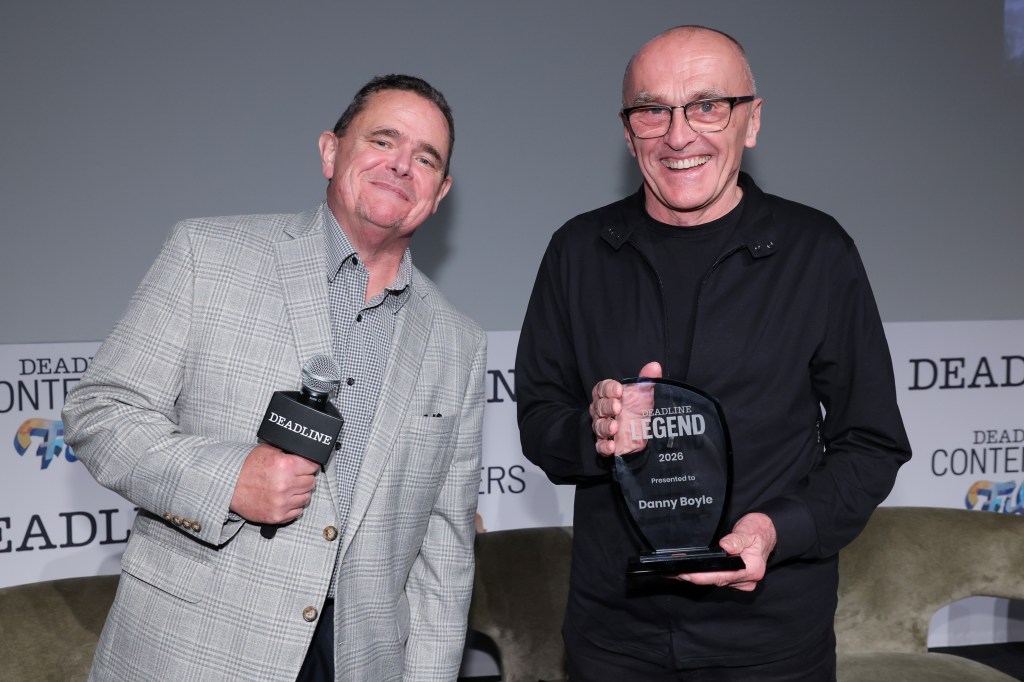
Danny Boyle says he used to believe that he that he never made the same film twice, thus a filmography that includes hit movies across genres like Shallow Grave, Trainspotting, 127 Hours, The Beach, 28 Days Later and of course Slumdog Millionaire, the 2009 Best Picture Oscar winner that also won him Best Director. But Boyle, speaking onstage Saturday after receiving the Deadline Legend Award during Deadline’s Contenders Film Los Angeles awards-season event, said he was set straight on that idea long ago. “I can’t remember if it was a press conference or a Q&A in Paris, and this French journalist stood up at the back and said, ‘This is nonsense, Mr. Boyle’,” he recalled. “And I said, ‘Excuse me, what?’ And she said, ‘All your films are exactly the same.’ She said, ‘They’re all about, and it’s usually a guy, who overcomes, who faces insurmountable odds and overcomes them.’ And with that she walked out.” He continued, “Ever since then I’ve accepted that she’s absolutely right — they are all about the same thing, really. And you do realize, and you can see in other filmmakers as well. You’re desperately trying to make a different film, and they basically turn out the same in a way. They’re the skeleton or the the kind of architecture of them is the same somehow. I have to hold my hand up and admit that. So if you keep buying tickets to go and see the films, thank you.” Watch on Deadline Boyle’s latest entry on his list is Ink, based on Hames Graham’s Tony-winning play about Rupert Murdoch and editor Larry Lamb’s efforts to revive the British newspaper The Sun, ushering in a new kind of tabloid journalism with lurid headlines and questionable tactics. Graham adapted the screenplay for the pic, which opened this year’s Venice Film Festival and is gearing for its December 11 release in theaters. In Ink‘s case, the underdogs in question are Guy Pearce’s Murdoch and Jack O’Connell’s Lamb, who are faced with the daunting task to make inroads against a dozen UK paper including what Doyle called “the Real Madrid” of publications at the time, The Mirror. “One of them from Australia, and the other one from Yorkshire in the north of England, with a plan to beat [The Mirror] in a year, in just one year, to overtake it in a year,” Boyle said in conversation with Deadline’s Mike Fleming Jr. “And what they did in order to do that was, in my contention and James’, is that they invented the tabloid vernacular, the language, the the vocabulary, the techniques of the tabloid, and they began to use it. And it connected with what people in Britain wanted, who were still in a dreary world of paternalism and postwar ‘we know what’s best for you’ kind of mentality, and they suddenly found a kind of liberation.” That’s in the first half of the film, which he said “I hope is very very funny because it employs the tabloid techniques to to gain your trust really, but through your pleasure. Then it begins to change a little bit when you find out some of the things that they’re up to and some of the costs of what that approach entails.” Boyle during the conversation also confirmed that headlines that appeared in the movie’s epilogue that have been redacted in UK versions of the film because of stringent libel laws will be shown in the U.S. versions. He also said a difference from Graham’s play is Claire Foy’s character Jules Davies, a composite of several women who worked at The Sun including one that had an affair with Lamb. Lamb’s son objected to the inclusion, Boyle said, because he thought it disparaged the memory of his mother, “which is absolutely right,” the director says. “The film’s about Larry Lamb and his reputation and his behavior. And he was a public figure. And it’s only right and proper that we have the right to investigate him,” Boyle said. “He changed British society significantly in many ways, as much as Margaret Thatcher changed British society.” Thatcher also appears in the film. “We didn’t want an impersonator to play her, so we actually re-created her, the real Margaret Thatcher. But we didn’t ask Margaret Thatcher’s estate because these powerful people, we have to be able to investigate them, and provided you do it truthfully and responsibly …. I think it’s right to have that kind of artistic license. In fact, it’s crucial to freedom and artistic freedom that you do have that license with public figures. Boyle also provided an update on a third installment of the 28 Years Later franchise, after he and Alex Garland brought back the franchise in 2025. A second movie, Nia DaCosta’s 28 Years Later: The Bone Temple also penned by Garland, hit theaters this past January. “Alex has written a fantastic script. Seriously, he’s written a fantastic script, so we’ve got to raise the money to make it,” Boyle said. He also confirmed that Cillian Murphy, who appeared in the 2002 Boyle-directed franchise starter 28 Days Later, was game to return. “I mean, he’s up for it, and it’s a fantastic part — Alex has written this fantastic part for him,” Boyle said. “Those of you who saw [Bone Temple], he’s teased at the end of that, and then the third film does complete the story in a beautiful, mathematically perfect way in which the circle is closed in a way that even Chris Nolan might admire, actually, because it’s perfect. So let’s hope it all comes together.” Check back Monday for the video of the conversation.
Danny Boyle Talks ‘Ink’, The Common Architecture Of His Movies And More ’28 Years Later’ As He Receives The Deadline Legend Award
Full Article
Original Source
Read the full article at Deadline →KhanList aggregates and links to publicly available news content. We do not host full articles from third-party sources. Always verify important information with original sources.