
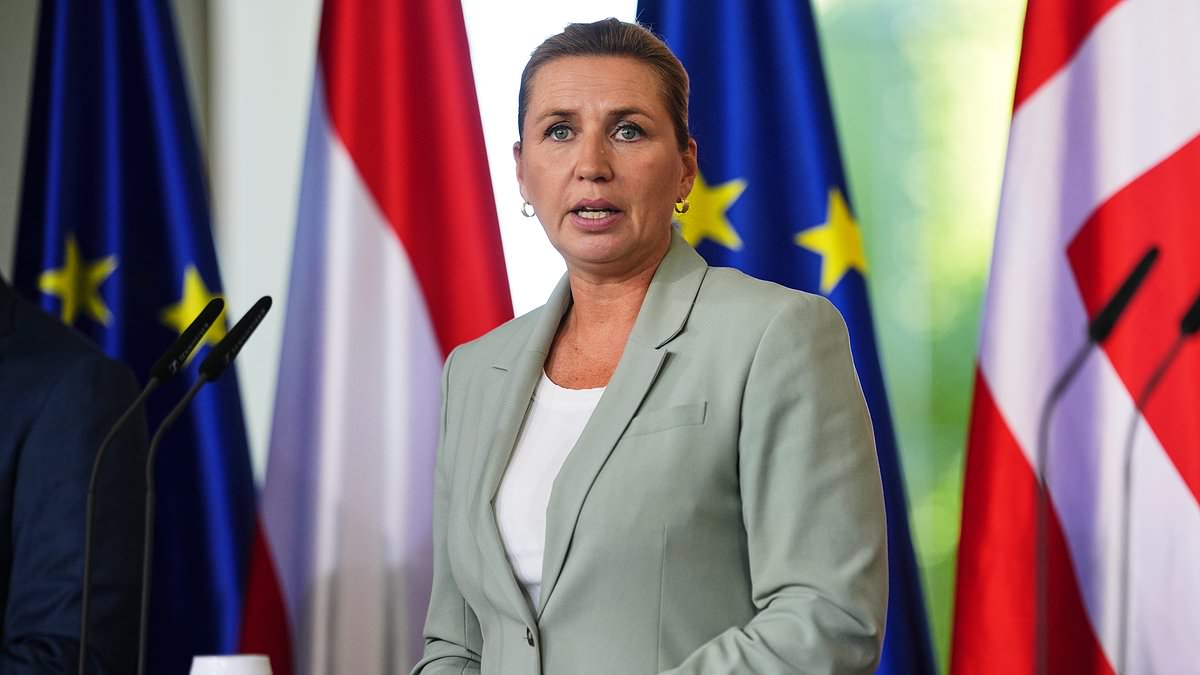
Danish Prime Minister Mette Frederiksen said on Tuesday she refused to be equated with the far-right after remarks she made last week about defending European values and culture. 'I would like to make it clear that I do not wish to be lumped together with conspiracy theorists, far-right extremists or fascist movements - I have nothing good to say about any of them,' Frederiksen wrote in a lengthy post on social media.'There is nothing wrong with wanting to hold on to the country you love,' she argued.Speaking on November 17 on a Danish political podcast, Frederiksen, of the Social Democrats Party, said she was 'not (a) supporter of a great replacement of the population'.'We are a Danish society and our origin, our descent is ethnically Danish,' she said, a day after unveiling her plan for a European migrant centre in Rwanda, which she has advocated for more than six years.'I am Danish and I am European, I believe in Danish and European values, and I do not want to compromise on them,' the prime minister said.'The majority culture I want to see in Europe in the future is this one.'Her remarks were hailed by the Danish branch of the anti-immigration movement Generation Identity. Danish Prime Minister Mette Frederiksen said on Tuesday she refused to be equated with the far-right after remarks she made about defending European values But they made few waves otherwise in Denmark, where successive left- and right-wing governments have pursued a hard line on immigration for more than three decades.On Tuesday, however, an op-ed written by a Norwegian survivor of the 2011 Utoya attacks in Norway sparked debate.In July that year, neo-Nazi Anders Behring Breivik gunned down 77 people, most of them teenagers at a youth wing summer camp on the island of Utoya.Breivik, a fervent opponent of multiculturalism, committed the deadliest peacetime massacre in Norway's history.'I never would have believed I'd hear a European leader, let alone a social democrat, borrow the words from (the great replacement) theory,' Tarjei Jensen Bech wrote in Danish daily Politiken.'I don't believe you mean the same thing as Breivik,' he wrote.'The 'great replacement of the population' is not a neutral term. It has a history, and that history led to the deaths of young people on Utoya,' he wrote.Interviewed by TV2 television, Deputy Prime Minister Pia Olsen Dyhr, the leader of the Socialist People's Party, said she was 'not going to use this term'.Frederiksen's remarks about protecting European values and the 'great replacement' came amid a legal row over migrant 'ghettos'.On Monday, Denmark's Supreme Court ruled that the landlord of a social housing did not discriminate when he evicted 'non-Western' tenants, saying the criterion was 'neutral'.It came as a huge win for MPs who have been working to rid the country of 'ghettos' as Denmark pursues an increasingly hard line on immigration. Seven families from Helsingor, north of Copenhagen, had their leases terminated in 2022 under a 2018 law.This law states that all social housing estates where more than half of residents are 'non-Western' must rebuild, renovate and change the social mix by renting at least 60 per cent of the homes at market rates by 2030.The law is aimed at combating segregation and 'parallel societies' in disadvantaged neighbourhoods.'Non-Western' is one criterion the Danish government uses to define 'transformation areas', which it previously termed 'hard ghettos'.In Helsingor, the landlord Boliggarden announced in early 2020 that it would carry out extensive renovations on seven stairwells - 96 apartments in total.It terminated the leases of those tenants, most of whom were of foreign origin.Seven families argued they had been discriminated against based on ethnic origin and took legal action.Eddie Khawaja, the former tenants' lawyer, said the question before the Supreme Court was simple: 'It's about whether the criteria regarding the tenants' origin is neutral or not.'But the Supreme Court on Monday upheld two lower court rulings in favour of the landlord.'The Supreme Court notes that applying the criterion of the law involves dividing people into two groups (people who are immigrants and descendants from non-Western countries, and all other persons).' Seven families from Helsingor, north of Copenhagen, had their leases terminated in 2022 under a 2018 law Protest signs read 'They tried to bury us. They didn't know we were seeds' and, centre, 'Where should we otherwise stay, Lars?''Both groups include a very large majority of different ethnic origins, and there will simultaneously be persons with the same ethnic origin in both groups.'The judges also noted that there had been 'no information about the ethnic background of the residents who have been evicted'.It therefore concluded that 'the category 'immigrants and descendants from non-Western countries' provided for in the social housing law must be regarded as a neutral criterion and not as a criterion relating to ethnic origin'.'We're obviously disappointed,' one of the plaintiffs, Riad, said.Denmark has pursued a hard line on immigration for more than three decades.The 2018 law has been widely criticised by tenants and tenants' associations, but it has broad political support.Some 11,000 people across Denmark will have to leave their apartments to be rehoused elsewhere by 2030 to comply with the law, according to tenants' associations.According to Statistics Denmark's definition, 'non-Western' countries include every country in the world except the 27 member states of the European Union, as well as Andorra, Britain, Iceland, Liechtenstein, Monaco, Norway, Northern Ireland, San Marino, Switzerland, the Vatican, Canada, the United States, Australia and New Zealand.
Danish PM slams claims she is 'far-right' after vowing to defend European values and culture amid row over migrant ghettos
Full Article
Original Source
Read the full article at Dailymail →KhanList aggregates and links to publicly available news content. We do not host full articles from third-party sources. Always verify important information with original sources.