
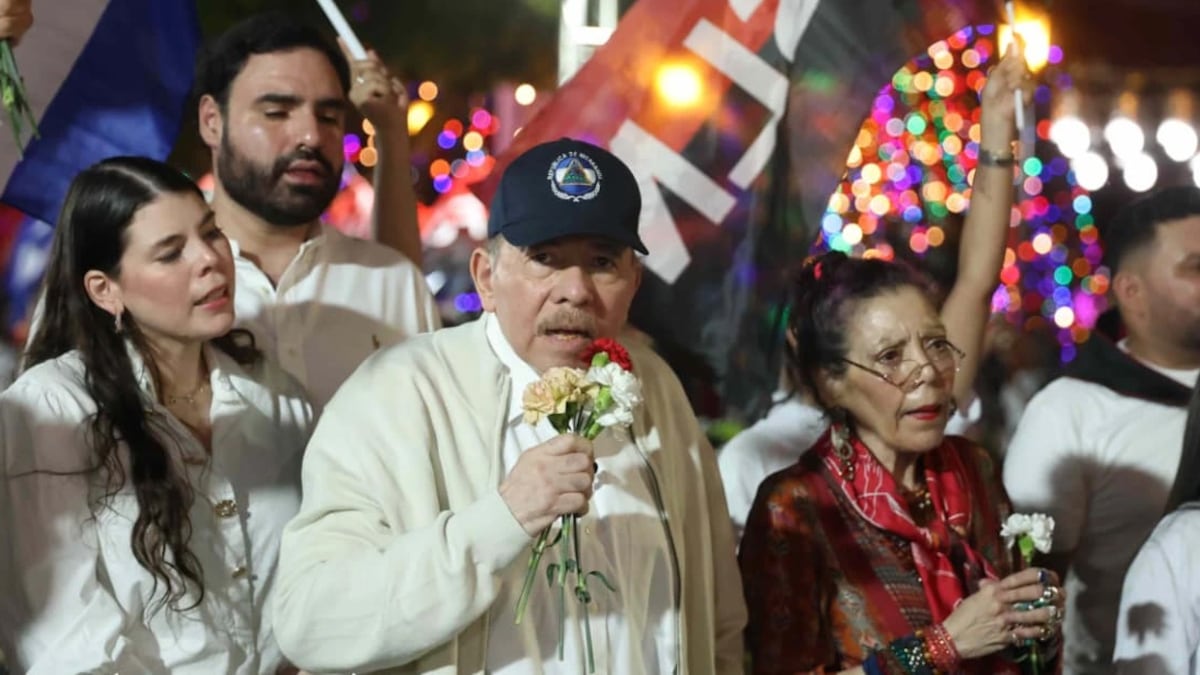
Daniel Ortega reappeared in public on the night of Monday, November 9 after 68 days of uncertainty about his health. He was seen in the old Plaza de la Revolución in Managua, the capital of Nicaragua, to preside over a tribute to Carlos Fonseca, one of the founders of the Sandinista National Liberation Front (FSLN), the party he controls. The president appeared visibly weakened: the Nicaraguan strongman, who will turn 81 this Wednesday, walked extremely slowly, with short steps, his complexion pale and expression somewhat disoriented, at one point holding a bouquet of flowers up to his mouth as if it were a microphone, despite already wearing one on his jacket lapel.At an event announced the afternoon before by his wife, co-president Rosario Murillo, amid growing rumors about his health, Ortega made a brief reappearance. He arrived at the square accompanied by dozens of members of the Sandinista Youth, one of his daughters and other relatives, who surrounded him during a short walk around Fonseca’s mausoleum, whose anniversary is one of the regime’s main annual commemorations.However, there was no speech this time. Ortega barely managed a few disjointed sentences while Murillo watched him constantly, her expression at times appearing anguished. ‘Carlos, here are the young people, those who will never forget you, those who will never betray you, those who will always be loyal to you, to the death,’ Ortega said in a voice slower than usual, while the official broadcast avoided close-ups and favored aerial drone shots and wide framings.Record absenceOrtega had not appeared in public since September 2, when he presided over an event marking the 47th anniversary of the Nicaraguan Army. Since then, his absence became the longest since he returned to power in 2007, surpassing his own record of 61 days, set in 2024 and repeated in 2026. The leader’s disappearances have become increasingly frequent and prolonged: before 2020 his absences did not exceed 37 days, but later reached periods of 52, 55 and 61 days, culminating in the 68 days of this latest absence. His public appearances have also collapsed.According to a tally by the newspaper Confidencial, Ortega had appeared only 11 times in 2026 up to that point, compared with an average of 26 appearances between January and October of each year from 2018 to 2025. The prolonged absence of the strongman also kept him away from events he traditionally attended. For the patriotic holidays in September, Murillo announced that the presidential couple would receive, as in most years, the Central American torch, but the September 12 ceremony ended up taking place without either of them. Their children Maurice and Camila Ortega Murillo showed up in their place.But beyond his physical absence, Ortega’s unusual political silence stood out amid a succession of international events that in earlier times would have prompted fiery speeches against the United States and other adversaries. During these 68 days, the regime refused to receive Natasha Franceschi, the ambassador-designate sent by Donald Trump, prompting Washington to recall its top diplomat in Managua, Elias Baumann, for consultations. Neither Ortega nor Murillo have offered public explanations for a decision announced by Washington itself, which deepened the bilateral diplomatic crisis.They also did not respond to statements by Colombian president Abelardo de la Espriella, which reignited tensions over sovereignty of Caribbean waters, the subject of a historic dispute between the two countries. Murillo, who effectively handles the regime’s daily communications by herself, considerably toned down her usual confrontational rhetoric toward Washington, while continuing her attacks on the Nicaraguan opposition.State secrecyOrtega’s health is managed with total secrecy and repeatedly fuels intrigue about his condition. The regime never releases medical bulletins about the leader nor explains his prolonged public absences. The secrecy extends to his inner circle and has turned any change in his physical appearance or Murillo’s political moves into grounds for speculation about his ailments and a potential succession.This time, suspicions intensified particularly after — during Ortega’s disappearance — the National Assembly unexpectedly approved a new constitutional reform that eliminated the vice presidency and established so-called ‘presidential designates,’ just 20 months after the reform that created the co-presidency. Opposition analysts interpreted the move as another attempt by Murillo to reorganize power shares among family members and close allies to shield a dynastic succession in case of her husband’s definitive absence.The uncertainties also have a medical backdrop. An investigation published last May by the outlet Divergentes revealed that Ortega has a VIP suite set up to treat his ailments at the Carlos Roberto Huembes Hospital, the National Police’s medical center. Hospital sources and people close to the power circle confirmed he suffered a relapse in mid-2025, was hospitalized for at least five days between September and October that year and, during the first quarter of 2026, visited the hospital once or twice a week to receive medical attention and preventive care under strict security measures.Sign up for our weekly newsletter to get more English-language news coverage from EL PAÍS USA Edition
Daniel Ortega reappears in Nicaragua looking weakened after more than two months of absence
Full Article
Original Source
Read the full article at English →KhanList aggregates and links to publicly available news content. We do not host full articles from third-party sources. Always verify important information with original sources.