
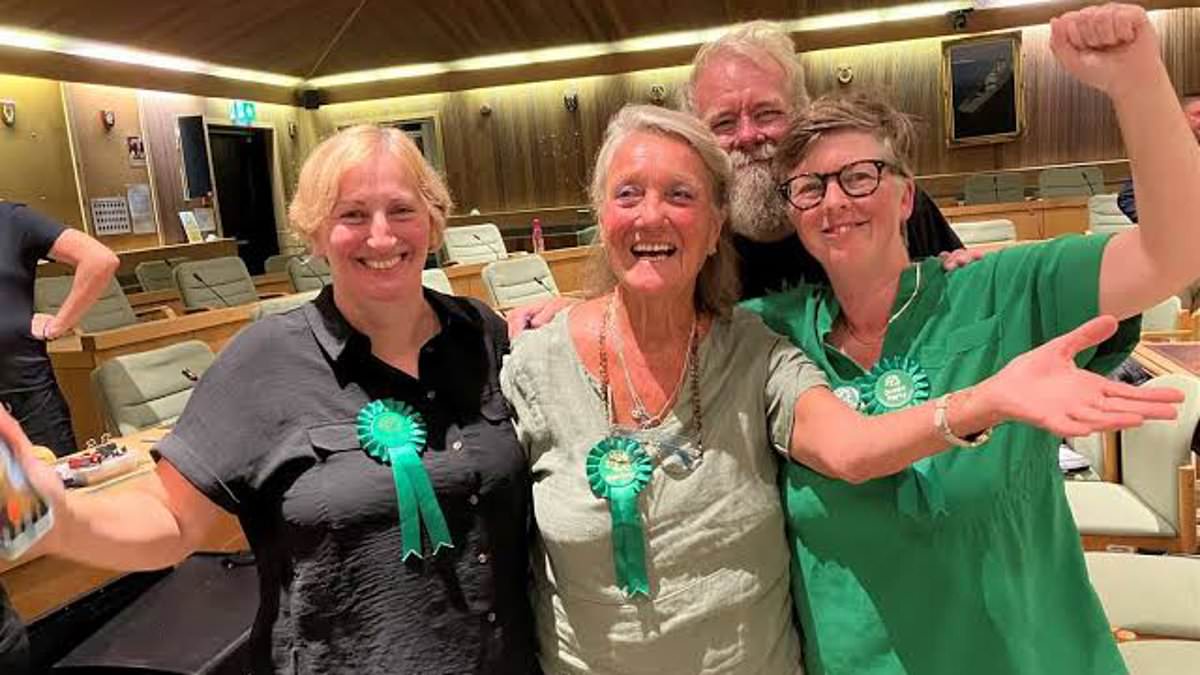
The skies over East Kent’s chalk downs are vast.The villages above the white cliffs, with their brick-and-flint houses and low-steepled churches, are small-c conservative places.East Kent, which I used to represent in the European Parliament, is wary, bolshie, patriotic and self-reliant.Yet the voters of Guston, Kingsdown and St Margaret’s-at-Cliffe – three handsome villages clustered near the beach from which cross-Channel swimmers set out – are now represented by a Green councillor.How did that happen? Well, our first-past-the-post voting system can throw up curious results. On Thursday, the Green candidate got 28.8 per cent of the vote, the Reform candidate 27.5 per cent, the Conservative 17.1 per cent, Labour 14.6 per cent and Restore 10.7 per cent. In other words, the three Right-of-Centre parties won over 55 per cent of the vote among them, but split it so that a candidate with half their combined vote took the ward.What if something similar were to happen nationally? What if the main Rightist parties divided the vote so that the Left got in on a very low turnout, as happened in 2024?I have no party affiliation. I sit in the House of Lords as an independent peer. Indeed, my partisan glands were cauterised when I took over running the Institute of Economic Affairs, an educational charity. I simply observe the irony. Three parties that talk a great deal about ‘putting country before party’ are doing the opposite.For much of the past half century, the Left-of-Centre vote in this country has been slightly larger than the Right-of-Centre vote; but it was divided, with Labour, the Lib Dems and the Greens all fishing in the same pond while the Conservatives had a monopoly on the Right. Ingrid Dodd, centre, celebrates winning the Guston, Kingsdown and St Margaret's-at-Cliffe by-election for the Greens - the first time the party has won thereAt the next election, we seem likely to get the opposite: Leftist voters piling in behind one party while the Right shatters.Those Kentish villages are not so different from swathes of Middle England. Indeed, most things that have happened to England happened to Kent first. Might the Right-of-Centre parties learn from the Dover result? Might they reach some kind of accommodation? It is hard to see it happening. There is bad blood between Restore’s Rupert Lowe and Reform’s Nigel Farage. There is bad blood, too, between Farage and Kemi Badenoch.On paper, an agreement, even if unofficial, not to contest unwinnable seats, would make a huge difference. Reform and the Tories have a complementary electoral geography, the former strong in northern England, the industrial Midlands, Wales and the old Red Wall, the latter in the southern shires and suburbs.Only in a stretch of eastern England, running from Lincolnshire through East Anglia and Essex, down to Kent and East Sussex, are both the Tories and Reform competitive. Almost everywhere else, it is obvious who would stand aside.Restore is trickier. It is hard to see that party picking up any seats beyond the one it already holds: Great Yarmouth, where Lowe is popular as the local MP.Yet, if the party were to get 5 or 6 per cent of the vote, that might tip the result in several constituencies. Majorities are now lower than they have ever been, reflecting the multiplicity of parties.Still, if at the next election Restore fought only two or three Norfolk seats, and the Tories and Reform some 350 each – contesting a few East Anglian and Essex constituencies against each other, but standing aside where it was clear that they could not beat the other party – they would almost certainly get a majority.Parties cannot transfer their voters. Some Reform supporters cannot forgive the Tories for what they see as 14 wasted years. Some Tories see Farage as a crook and a megalomaniac. We should not simply add the opinion poll scores together, because many voters would pull away from anything that looked like a coalition.The alternative, however, is for all three parties to go toe-to-toe in every seat, producing Dover-style results around the country. Is that really what their supporters want?Lord Hannan of Kingsclere is an independent peer and director of the Institute of Economic Affairs.
DANIEL HANNAN: If the three parties on the Right can't do a deal, the Left will take power again
Full Article
Original Source
Read the full article at Dailymail →KhanList aggregates and links to publicly available news content. We do not host full articles from third-party sources. Always verify important information with original sources.