
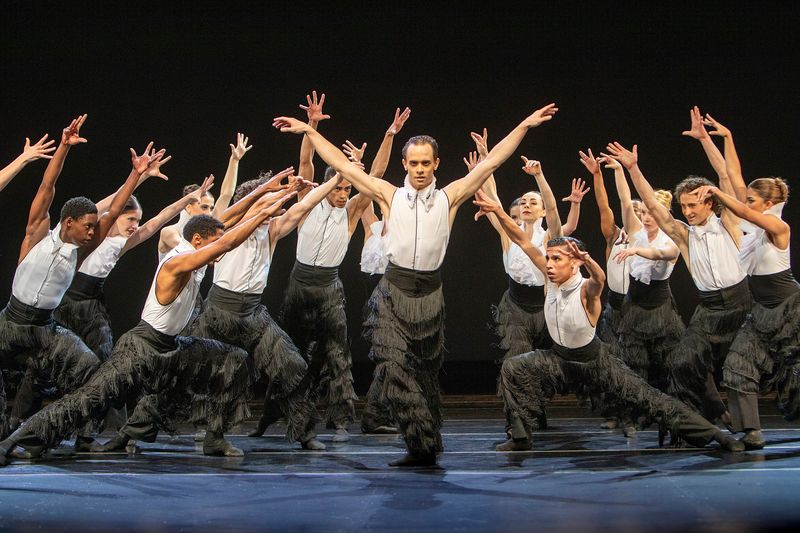
In Greek mythology, Elysium – or the Elysian Fields – was a place akin to heaven, a paradisiacal afterlife reserved for favoured souls. It existed not in the celestial skies, but somewhere at the edge of Earth, a physical realm where spring sprung eternal and those few privileged souls were guaranteed a kind of endlessly joy-filled, carefree existence. In other words, it was a kind of nirvana or utopian ideal. Which is why in modern parlance, “Elysium” has come to signify a state of bliss.Elysium is also the very apt title of Cape Ballet Africa’s latest production, a quadruple bill that not only showcases exquisite dancing that expresses the incomparable joy of using the human body to express emotion through movement, but also puts together on stage the work of four choreographers whose distinctive styles each in some way represent ballet’s capacity to contain a dynamic and often thrilling conversation between classicism and more contemporary dance forms.The programme, showing at the Baxter in Cape Town until 10 October, kicks off with George Balanchine’s immaculate Allegro Brillante, which is danced to Tchaikovsky’s Piano Concerto No. 3 and in about 13 minutes pulls together so much of classical ballet’s beauty and grace. Paige McElligott and Gabriel Fernandes da Silva in Allegro Brillante by George Balanchine. (Photo: Helena Fagan)Though it requires rigorous dancing, is fast-paced and technically demanding, Balanchine’s 70-year-old masterpiece also celebrates dance as a tool of liberation, and illuminates the body’s expansive ability to express emotions in ways that words cannot.Cape Ballet Africa’s dancers certainly set the mood with this one – their dancing is simultaneously slick and jaunty and the ensemble brings to the work a sense of joy that’s as fresh and invigorating as it must have felt to audiences who first saw it performed in New York in 1956.Allegro Brillante is followed by an exquisite new work by Northern Ballet resident choreographer Kenneth Tindall, who spent two weeks working with the Cape Town dancers. He even had them padding around barefoot on the beach as part of a process of finding those organic, authentic impulses that make the work – We Met at the Moon, Briefly – feel so marvellously personal. Danced to Bryce Dessner’s Beautiful Hands, Gustave Rudman’s River and Max Richter’s She Remembers, Tindall’s new piece is a fantastic (and gorgeous) synthesis of athleticism and graceful technique, with a wondrous pas de deux at its heart. There is a vaguely futuristic atmosphere, enhanced by the metallic sheen of the costumes, very edgy, and visually very appropriate for a work that takes the audience on such a energetic, energising journey. Jan Kotzé and Maryana Pobuta in We Met At the Moon, Briefly. (Photo: Joan Ward) While the work makes tremendous demands in terms of technique, it’s ultimately the emotional gravitas that makes your heart soar. Tindall has worked in lots of gliding, sliding and extensions of legs and feet, and his choreography is packed with captivating patterns and formations that make every moment riveting to watch.There’s no flab, no excess in Tindall’s work, but the dancers are afforded great opportunity to demonstrate poise and flexibility, while reaching all the time for a state of transcendent bliss which the choreography is striving to capture.Watching, you cannot help but feel the lightness in the dancers’ steps, the sense of uplift in their bodies, as though their desire to reach that otherworldly state of nirvana is absolutely urgent. By the end of it, you in the audience, are completely transported.Danced to Enrique Granados’s Valses Poeticos (or “Poetic Waltzes”), the third part of the Elysium programme is the acclaimed three-man ballet, Remanso, choreographed by the Spanish master, Nacho Duato. The ballet seizes inspiration from the great Spanish poet and playwright Garcia Lorca, who used the word “remanso” – a term to describe calm, still water in a river – to convey a state of respite, reflection and tranquillity. Remanso had its world premiere in 1997 in New York, where it was created for the American Ballet Theatre. Since then, it’s been revived and restaged numerous times around the world, and was performed in South Africa last year as part of Cape Ballet Africa’s exhilarating Breathwords programme, when Duato oversaw the work in person.Playful, punctuated with wit, and quite athletic, Remanso includes the use of mimed gestures that might put you in mind of techniques from silent comedies. In other moments, the imagery hints at inspiration from surrealist painters like René Magritte and Max Ernst. A square wall, almost like a canvas, serves to hide and reveal the dancers who disappear behind it and then reappear in various ways, a theme of tongue-in-cheek hide-and-seek that feels like a metaphor for life itself. It’s wonderfully quirky, and a thrilling demonstration of the ways in which human bodies can be used to say things that – almost 30 years after they were first expressed – still feel original and are still able to convey something profound about what it is to be alive.The three dancers – Jan Kótze, Joshua Williams and Nicolas Laubscher – work so tightly and sensitively together, and breathe such exuberance into Duato’s piece which in turn feels like an incredible testament to dance’s capacity to generate joy and express the otherwise unsayable.Jan Kotzé, Joshua Williams and Nicolas Laubscher in Remanso by Nacho Duato. (Photo: Helena Fagan) The fourth part of the Elysium programme is by Michelle Reid, a Cape Town choreographer who is incredibly skilled at combining whimsy with sophistication, always grounding her dancers in emotionally layered sequences that are complemented by an engaging and evocative gestural language. Seeing Reid’s new work, Duende, alongside three scintillating pieces by such vaunted international choreographers is a fitting acknowledgement of her stature as one of our country’s finest. Never mind her ability to keep the dancers on their toes and make them delight so thoroughly in what they’re doing.A Spanish word, “duende” refers to a mysterious power – some unspoken allure, charisma or magic, even a charm that has the ability to move an audience deeply. It can also refer to a kind of spirit creature, a goblin or imp, or to a surge of deep, raw emotion felt in flamenco music. In Reid’s piece any or all of these connotations is appropriate.Working with three compositions by the guitarist and composer Estas Tonne, Reid has the dancers, dressed in strikingly frizzy black pantaloons, literally and figuratively shimmy and sashay onto stage. Recognisably Spanish rhythms have been ever so slightly tweaked and twisted, infused with hints of parody, head bobs and shoulder shrugs, so you know from the get-go that you’re in for a treat, are meant to have as much fun as the dancers seem to be having. Nicolas Laubscher in Duende by Michelle Reid. (Photo: Helena Fagan) This infusion of humour – subtle, sophisticated and smart – adds an edge that also serves as a strand of narrative tension that bubbles under throughout the piece. It felt to me like Reid had taken the machismo, bravado and danger of bullfighting and transformed what is effectively a dance of death into a dance of seduction, a celebration of aliveness. The energy and joie de vivre of the dancers is absolutely contagious, never mind how sexy and fabulously synchronised they are, how attuned to the rhythms and aligned with Reid’s vision. And while it is light, frothy and seems to unleash pure joy into the atmosphere, there’s a real frisson, an energy between the musical notes and between the dancers, a vigour and energy that could only have emanated from Reid’s wonderful imagination.It’s cheeky, sexy, utterly seductive and just so beautiful to watch, the kind of dancing that makes you feel alive, fills you with bliss, and not only makes your heart beat faster but makes you want to dance in your seat. The effect is to be thoroughly seduced by what is absolutely a Michelle Reid signature – her ability to combine bodies and music and use dance as a means of taking audiences with her to another realm. Presumably, that realm is Elysium itself. No matter what your mood when you step into the theatre at the start of the show, you will exit feeling elevated – lighter, freer, transported to a more blissful state. DMElysium is at The Baxter in Cape Town until 10 October.
DANCE REVIEW: Elysium — 4 dances of bliss and seduction, transcendence and joy from Cape Ballet Africa
Full Article
Original Source
Read the full article at Dailymaverick →KhanList aggregates and links to publicly available news content. We do not host full articles from third-party sources. Always verify important information with original sources.