
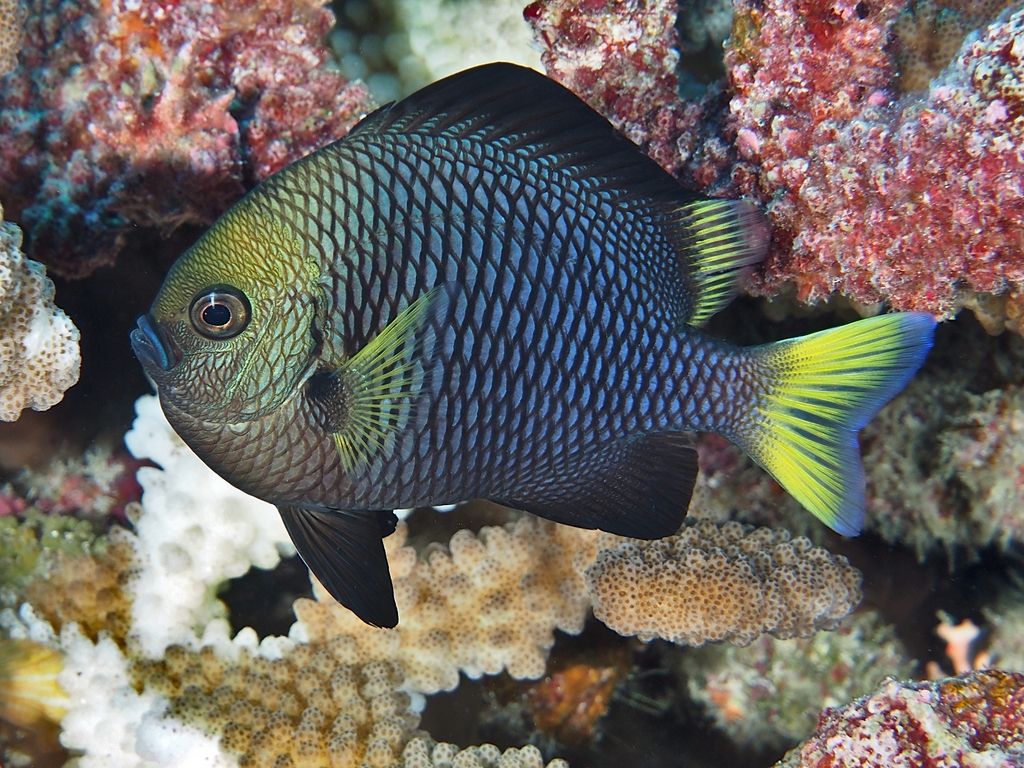
A new study finds that a coral-associated damselfish may help hasten the healing of wounded corals.The research showed a 55% faster recovery rate from larger coral wounds in the presence of damselfish, and a 38% faster rate of healing for smaller wounds.Algae living within wounded corals exhibited decreased photosynthetic efficiency, an energy source vital to coral healing, when damselfish were absent.Scientists say the findings could inform conservation management plans, focusing more attention on preserving fish habitats to better protect corals. Corals share a close bond with the fish dwelling among them and the algae living within them. According to a new study, that relationship could be even stronger than previously known, with fish aiding coral tissue repair and damage recovery, particularly in higher-stress environments. The study, published on July 8 in Biology Letters, concluded that the yellowtail dascyllus (Dascyllus flavicaudus), a type of damselfish, helps heal injuries on Pocillopora spp., a genus of stony coral largely found in the Indo-Pacific Ocean. “Surprisingly, we found that the bigger the wound, the faster the recovery,” said Hayden Vega, lead author of the study and a Ph.D. student at the University of California, Berkeley, in the U.S. Previous research has shown that coral-dwelling fish aid in the cleaning of coral wounds and help corals tolerate warming oceans. But the new evidence of wound healing via tissue repair suggests that interactions between these organisms could be more beneficial than previously thought, especially under stressful conditions. Yellowtail dascyllus (Dascyllus flavicaudus) damselfish swim around coral in French Polynesia. Image © mndiminuco via iNaturalist (CC BY-NC 4.0). “These positive interactions between species under stress end up creating a network of resilience in ecosystems,” Vega told Mongabay during a Zoom call. Vega thinks this sort of supportive relationship could extend beyond yellowtail dascyllus and coral. He hopes the findings will prompt researchers to look more deeply at mutualistic benefits shared between other marine species, particularly in warming oceans, with research results then applied to conservation management plans. This is not the first time researchers have found that the damselfish provides benefits to its coral host. A 2022 study concluded that damselfish help corals withstand heat stress when water temperatures are elevated. The new study adds another dimension to this relationship: The fish may also help coral recover after they are physically injured through predation, pollution, coastal development, tourism activities and damage caused by the movement of fishing boats. Andrew Shantz, a marine ecologist and senior research scientist at the University of Hawai’i in the U.S., who was not involved in the recently published study, told Mongabay over Zoom that the wound healing findings may be broadly applicable to damselfishes living among corals across different regions, including the tropical Pacific, the Indian Ocean and the Great Barrier Reef. He suggested that other fish that live in or around corals may provide similar benefits. Microscopic view of a coral damaged by a coral-eating snail. The microscope uses fluorescence to visualize proteins in coral cells, making it easier to see wounds and missing tissue, some of which can be seen in the dimmer areas of the image. Image courtesy of Hayden Vega. Producing healthy coral tissue To better understand the role of damselfish in coral healing, Vega’s team collected 72 corals of identical size from Mo’orea, French Polynesia, and divided them into small, large and “no wound” categories. One subset of each group was then observed under controlled laboratory conditions with fish, and a second without fish. The researchers photographed the wounded corals daily and measured how much tissue had regenerated over 21 days. The corals with small wounds healed 38% faster in the presence of fish than those without fish. Among the corals with larger wounds, healing was 55% faster with the fish than without. The researchers also examined how the presence of damselfish affected the algae that inhabit corals’ thin-layered tissues. These algae use photosynthesis to convert sunlight into energy vital for coral tissue repair. The scientists wanted to know how efficiently the algae used light for photosynthesis. Higher photosynthetic efficiency means the algae are directing more of the available light into photosynthesis, helping them produce more energy for the coral, while reducing the risk of corals suffering light-related damage, according to Vega. In the presence of damselfish, photosynthetic efficiency remained unchanged across wound size; but in the absence of the fish, photosynthetic efficiency declined as wound size increased, the study found. Yellowtail dascyllus swimming over coral, Rarotonga, Cook Islands. Image © cotinga via iNaturalist (CC BY-NC 4.0). Tracing the ‘how’ While the researchers found that photosynthetic efficiency and coral healing improved in the presence of damselfish, they don’t yet understand the precise role the fish played. Vega told Mongabay that he identified three possibilities: Damselfish feces may supply nitrogen and phosphorus that act as fertilizer for coral’s symbiotic algae; fish movement could be increasing water flow around corals, improving the uptake of nutrients and oxygen; and fish may be contributing directly to wound cleaning. Shantz added that the reason larger wounds appear to heal more quickly than smaller ones may simply be a matter of geometry: The thin layer of tissue with a larger perimeter appears to fill in more quickly than the smaller wound. The next step, he said, would be to investigate precisely how fish promote wound healing. To better understand that mechanism, researchers could use isotope-based chemical tracers to determine whether nutrient-rich fish waste ends up in new coral tissue or its symbiotic algae, he suggested. Other tests could be devised to see if the effect is driven by nutrient supply, better water flow, wound cleaning or some other phenomenon. Damselfish, like corals, face serious risk With threats to corals escalating, Shantz said the current study’s findings may apply to conservation and marine protected area management across the tropics. “Conservation plans could potentially be [designed] around preserving the habitat of these fish, as much as it is about corals,” he said. But damselfish themselves face rising threats. Their bright, vivid colors and small size make them attractive for ornamental purposes, with damselfish counting among the more than 1,800 species and 20-30 million tropical marine fish collected annually for aquariums. Wounded experimental Pocillopora fragment from the study. The image was made using micro-photogrammetry, a process where researchers use a microscope to take thousands of photos and stitch them together to create an image of the whole fragment. Image courtesy of Hayden Vega. Anikuttan KK, a senior scientist who heads a damselfish hatchery at the Central Marine Fisheries Research Institute based in India, told Mongabay by phone that nearly 90% of damselfish used for ornamental purposes globally are wild-caught, captured from their natural habitats. He noted that breeding them in laboratory conditions for the aquarium industry could help prevent damage to corals and other marine organisms, and protect broader ecosystems. “Often, destructive methods like dynamite and poisoning are used to catch damselfish despite a ban on employing these methods,” he said. He added that the new study’s findings may offer justification for better enforcement of damselfish protections. Idrees Babu, a marine biologist who investigates coral reef health and conservation for India’s Department of Science and Technology, told Mongabay that stressors, such as rising ocean temperatures and ocean acidification, can reduce coral health and make them more vulnerable to disease. “When corals are injured their wounds can be taken over by [foreign] algae or pathogens, which can make recovery more difficult,” Babu said. A coral that closes a wound faster may spend less time exposed to other threats in natural settings, suggesting that speed of tissue repair is important for overall coral health, he added. According to Babu, the new study adds an extra dimension to researchers’ understanding of the ways coral-associated fish influence the health of their hosts. He said he hopes this study will lead scientists to further examine multiple coral stressors, including warming, injury, sedimentation and predation. Banner image: A yellowtail dascyllus (Dascyllus flavicaudus) damselfish swims around coral in Rangiroa, French Polynesia. Image by © Florent Charpin via iNaturalist (CC BY-NC 4.0). If Florida reefs aren’t protected, storms will increase flooding & costs: Study Microbiomes may be corals’ secret weapon against climate change: Study Citations: Vega, H., Osenberg, C. W., Seifert, A. W., Munk, N., & Stier, A. C. (2026). Coral-associated fishes accelerate coral wound healing and photosynthetic recovery. Biology Letters, 22(7). doi:10.1098/rsbl.2026.0177 Shantz, A. A., Ladd, M. C., Ezzat, L., Schmitt, R. J., Holbrook, S. J., Schmeltzer, E., … Burkepile, D. E. (2022). Positive interactions between corals and damselfish increase coral resistance to temperature stress. Global Change Biology, 29(2), 417-431. doi:10.1111/gcb.16480 Feedback: Use this form to send a message to the editor of this post. If you want to post a public comment, you can do that at the bottom of the page. Credits Topics
Damselfish-assisted repair of wounded corals surprises scientists
Full Article
Original Source
Read the full article at News →KhanList aggregates and links to publicly available news content. We do not host full articles from third-party sources. Always verify important information with original sources.