
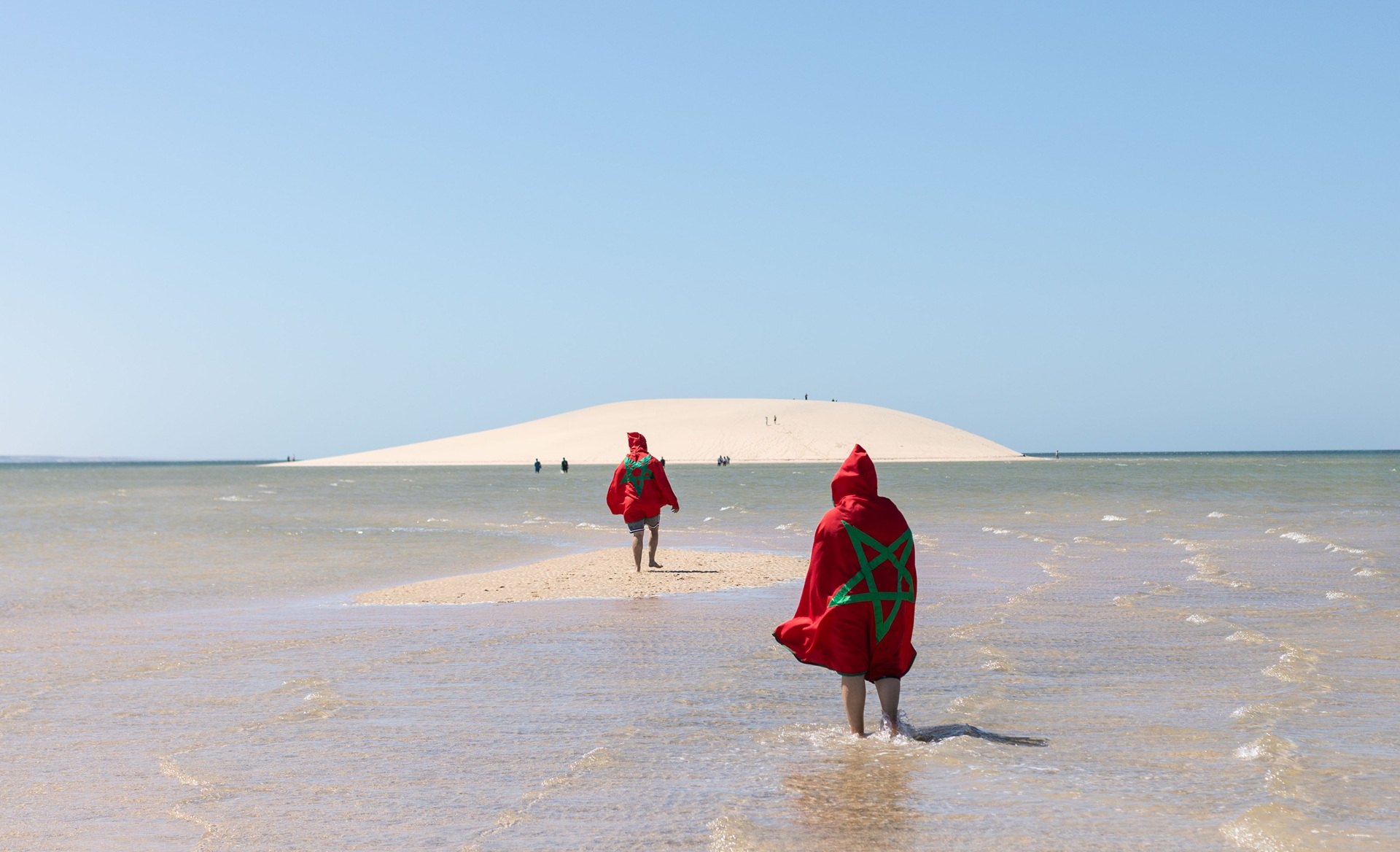
When Mireille Malbos first arrived in Dakhla more than a decade ago, she found a city that was still largely undeveloped. “When I moved here, there was practically nothing. I have witnessed enormous development. I love this place because it is peaceful and the quality of life is exceptional. The natural surroundings are beautiful: the sea, the lagoon and the dolphins,” she told Middle East Eye. A French entrepreneur and owner of a guesthouse, Malbos has witnessed first-hand Dakhla’s transformation into one of Western Sahara’s main tourist destinations. Located at the territory’s southern tip, on a windswept peninsula extending into the Atlantic, the city has attracted growing numbers of foreign visitors, from kitesurfers to tourists seeking tranquillity and a closer connection with nature. Yet for many Sahrawis, this idyllic image bears little resemblance to their reality. New MEE newsletter: Jerusalem Dispatch Sign up to get the latest insights and analysis on Israel-Palestine, alongside Turkey Unpacked and other MEE newsletters For Yahdih Essabi, a Sahrawi journalist and human rights activist, Dakhla first appeared not as a tourist destination but from behind the bars of a prison cell. Arrested in 2021 by Moroccan authorities on allegations of filming military installations in the area, Essabi had never set foot in Dakhla before. He still recalls what he describes as an inhuman and degrading treatment in prison: food, water and sleep deprivation, psychological abuse, insults targeting his Sahrawi identity and the denial of medical care. “I also remember the pressure and threats from prison staff. I was told not to speak about what was happening inside,” he told MEE. Essabi has since been forced to leave Western Sahara for his own safety, as Sahrawi independence campaigners have faced continuing repression by Moroccan authorities. 'The alternative to diplomacy is war': Polisario warns of risks after collapse of Western Sahara UN mission Read More » These sharply contrasting experiences reflect the competing realities that coexist in Western Sahara, a territory shaped by more than five decades of conflict. Western Sahara is a UN-designated non-self-governing territory whose decolonisation process remains unresolved. The region has been largely controlled by Morocco since 1975, while the Polisario Front, the Sahrawi nationalist movement, continues to seek self-determination for its people. The question of Western Sahara has recently returned to the international spotlight after the UN Security Council failed to renew the mandate of Minurso, the mission monitoring the ceasefire between Morocco and the Polisario, raising fears of a resumption of hostilities. The move came amid growing international backing for Rabat’s autonomy proposal for the territory, rejected by the independence movement. To secure this support, Morocco has sought to showcase its administration of the territory through a series of large-scale projects, presenting them as a model of sustainable development. But Sahrawi rights advocates question both the impact of this strategy and who ultimately benefits from it. The ‘Dubai of North Africa’ Dakhla has become one of the clearest expressions of this strategy. Over the past decade, the city has undergone a dramatic transformation, fuelled by billions of dollars in public and private investment. The plan includes turning Dakhla into a major ecotourism hub, which some Moroccan officials have described as a "Dubai of North Africa". Yet the strategy, which relies on a broad range of foreign investors, including firms from Europe, the US, China, the UAE and Israel, has raised questions about compliance with international law and its implications for Sahrawi rights. ‘There are places where Sahrawis cannot move freely. This is particularly true of areas where natural resources and tourist activities are located’ - Rachid Sghir, a Sahrawi from Dakhla “Foreign investments are not automatically illegal, but they become so when they contribute to consolidating an unlawful situation or undermine the right to self-determination, particularly in the absence of the consent of the Sahrawi people,” Andrea Maria Pelliconi, a lecturer in human rights law and global justice at the University of Southampton, told MEE. New resorts, residential neighbourhoods, port infrastructure and desalination plants are reshaping the urban landscape and the territory’s economy. But the process often results in the displacement or marginalisation of Sahrawi communities and the restriction of access to land and resources. According to Rachid Sghir, a Sahrawi born and raised in Dakhla, indigenous Sahrawis - who now form a minority following decades of demographic change - are increasingly marginalised, both in terms of rights and economic opportunities. “We do not enjoy full freedom of movement in our own territory. Restrictions apply not only within the city but also in the surrounding areas,” Sghir told MEE. “There are places where Sahrawis cannot move freely. This is particularly true of areas where natural resources and tourist activities are located.” A kitesurfer at Dakhla beach in Morocco-administered Western Sahara in October 2019 (Fadel Senna/AFP) “The system does not simply control people's movements and activities,” Sghir added. “There is also constant psychological pressure.” A 2024 report by UN Secretary-General Antonio Guterres highlighted the economic marginalisation of the Sahrawi population. “Reports described investments as frequently prioritising interests that do not address the needs of the local Sahrawi population, exacerbating economic disparity and hindering equitable development for all Sahrawis,” the report stated, also noting that natural resources are being exploited without meaningful consultation or participation by affected communities. Concrete in the desert Today, Dakhla is one vast construction site. Along the main road leading from the town centre, at the tip of the peninsula, towards the tourist resorts overlooking the bay, the desert landscape is punctuated by buildings under construction and an expanding network of roads. Satellite imagery analysed by Placemarks, a project that studies environmental change in Africa, shows that urban expansion began in 2016 and accelerated sharply from 2023 onwards. In one peripheral area of the city, for example, around 130 hectares - equivalent to more than 180 football pitches - have already been divided into plots. Around 100 hectares of this land could be developed. Buildings currently occupy just two hectares, but if the site were fully developed, the built-up area could increase more than thirtyfold Satellite imagery of the coastal area north of Dakhla in 2016, showing largely undeveloped land, with only a limited road network and scattered buildings (Placemarks) The same area in 2026, showing the expansion of the road network, the subdivision of land into plots and the emergence of new buildings along the coast (Placemarks) Real estate developers are actively marketing Dakhla to foreign investors through luxury residential projects aimed at wealthy buyers. “Immerse yourself in unparalleled luxury in our seaside villas, where crystal-clear waters stretch as far as the eye can see. This stunning residence offers spacious, elegant rooms, carefully designed to provide breathtaking views of the surrounding landscape,” reads one of the advertising signs for Blue Bay Residency. Along the bay, amid the desert dunes, numerous resorts have sprung up in recent years, offering all-inclusive packages featuring kitesurfing lessons, yoga classes and evenings celebrating Moroccan food and music, transforming the coastline into a tourism hub aimed primarily at foreign visitors. Morocco names new highway in occupied Western Sahara after Donald Trump Read More » Yet the rapid pace of development is raising concerns over its environmental footprint, including land degradation and growing pressure on scarce water resources. While Dakhla is marketed as a model of sustainable development centred on ecotourism, renewable energy and environmental restoration, the Moroccan document underpinning the strategy also warns that unchecked tourism growth and infrastructure expansion could damage the region's fragile desert and coastal ecosystems. “Today, the population increase is choking the city, causing alarming pollution levels, particularly at the level of the lagoon - which is a unique environmental and tourist site - but also in other sensitive areas, such as the Sarga and the White Dune,” the document states. One development near the White Dune illustrates these concerns. Just metres from the White Dune Canyon eco-resort stands the unfinished shell of what was meant to become another ecotourism complex, covering approximately 3.5 hectares. The area surrounding the White Dune tourist site in 2015, before any urban development took place (Placemarks) The same area in 2025. It now hosts the White Dune Canyon eco-resort and the remains of another resort development that was never completed and appears to have been abandoned (Placemarks) Excavation and terracing works began in 2018 and continued until 2022, dramatically altering the landscape without the project ever being completed after financial disputes among the investors. Today, instead of the planned tourist complex, extensive concreted surfaces scar the landscape overlooking the Dakhla lagoon. Consolidating the occupation Between 2016 and 2025, the number of overnight stays in accommodation establishments rose from around 98,000 to 468,000, partly driven by the introduction of new low-cost air routes connecting Dakhla with several European cities. International airlines such as Ryanair and Transavia, along with accommodation and travel platforms including Airbnb, Booking.com and Tripadvisor, already market Dakhla as an integral part of Morocco, further blurring the territory's disputed status. Critics contend, in fact, that Morocco’s tourism plans in the region mainly serve a political agenda by shaping perceptions of the kingdom's presence in Western Sahara. A 2026 report supported by the European Parliament's Greens/EFA Group argues that Rabat uses tourism development in Dakhla to reinforce its claim over the territory, recasting it as a sustainable tourism destination rather than an occupied land. ‘Tourism can help normalise Morocco’s presence by presenting places such as Dakhla as unequivocally Moroccan’ - Andrea Maria Pelliconi, lecturer in human rights law “Tourism under occupation does not require convincing visitors that Morocco has legal sovereignty over the territory. It can operate in a much simpler way: by creating an experience in which that question hardly ever needs to be asked,” the reports states. This transformation is actively engineered through state policies, including the allocation of land belonging to the state’s private domain to investors at what the report describes as “symbolic” prices, while depriving the indigenous Sahrawi population of control over its own resources. According to Pelliconi, “tourism can help normalise Morocco’s presence by presenting places such as Dakhla as unequivocally Moroccan”. “Airlines, tour operators, online platforms and international tourists can all contribute to this process, often without intending to take a political position,” he told MEE. “Many visitors may not even realise that Western Sahara is a non-self-governing territory whose status remains unresolved.” Beneath the image of prosperity, tranquillity and natural beauty promoted by Moroccan authorities and experienced by many foreign visitors, Dakhla's transformation has therefore become inseparable from broader questions of dispossession, representation and self-determination for many Sahrawis. “It is painful for us to see other people arriving in our territory, enjoying its resources and landscapes, while the Sahrawi population is left marginalised,” Sghir said. This investigation was developed with the support of Journalismfund Europe.
Dakhla: The Western Sahara city Morocco wants to turn into a tourism powerhouse
Full Article
Original Source
Read the full article at Middleeasteye →KhanList aggregates and links to publicly available news content. We do not host full articles from third-party sources. Always verify important information with original sources.