
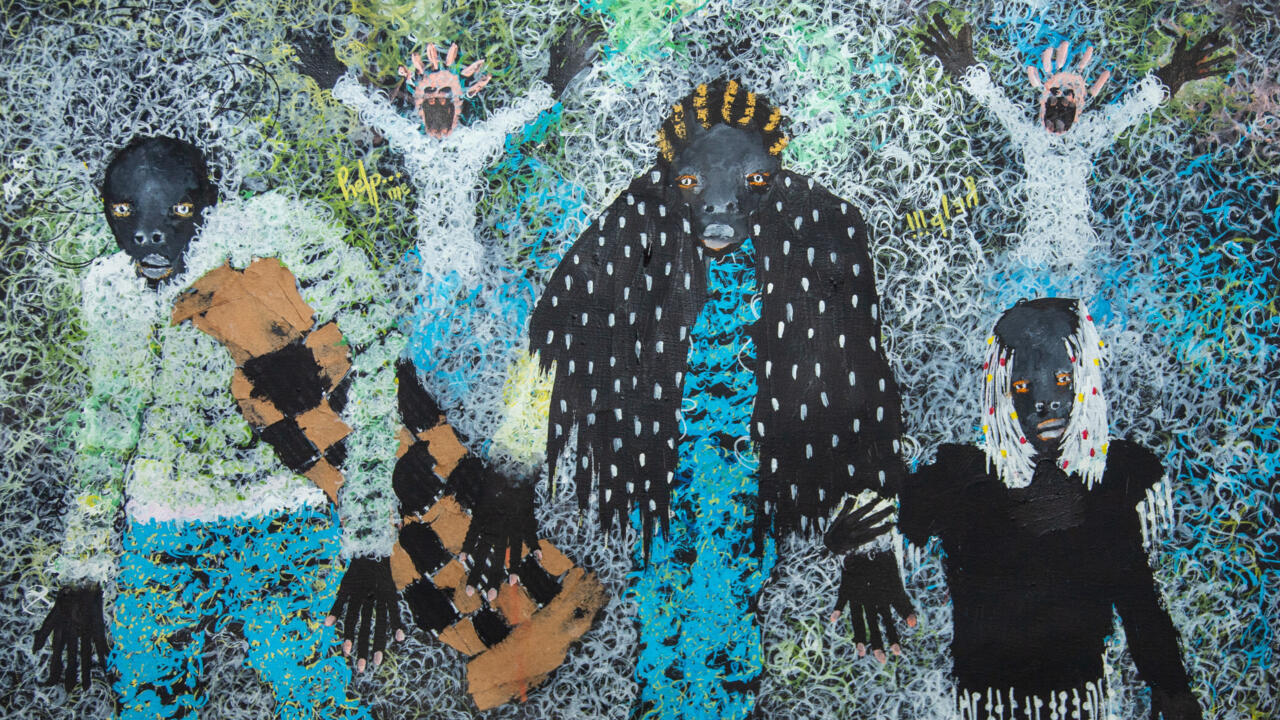
Senegal’s capital is hosting Dak’art, the 16th Dakar Biennale of Contemporary African Art. Inspired by a concept more usually found in the realms of science and philosophy, this year's theme of "Antifragility" sees artists from across the African continent and its diaspora use their practice to draw strength from suffering. Coined by Lebanese American mathematical statistician Nassim Taleb, "antifragility" refers to the concept of something that actually becomes stronger under pressure – as opposed to either breaking, or being resilient and bouncing back. While it's a term usually found in the worlds of philosophy and psychology, or engineering, risk analysis and computer science, for the Dakar Biennale's artistic director Morad Montazami antifragility was the perfect theme for this year's event. "By using the word anti in front of the word, it’s not about using force to overcome something, it’s about embracing and celebrating fragility to become stronger," he told RFI. Essentially, he wanted artists to explore the power in fragility: the idea that what doesn’t kill you makes you stronger. "Something that breaks or shatters upon impact is considered fragile. Something that withstands that impact is considered robust or solid," explains Montazami. "But there is a third scenario in which, through an impact, one becomes stronger and is able to reverse the force of that impact, trauma, or disorder to derive benefits from it." Guinean-American artist Hady Barry presents "Eldest Daughter" at the Dakar Biennale 2026, an installation that brings together five works conceived as a single whole. © Hady Barry From the track to the gallery: Dakar's autumn in the spotlight Strength and fragility For Montazami, "art is not a luxury; it is a necessity in order to survive" in an age of conflict. He says there is no denying the political aspect of the Dakar Biennale. "We can't escape politics due to the multiple crises, territorial wars and invasions that extend from Congo to Sudan, Palestine and Iran," he said, adding that his own heritage has forced him to examine the links between the Middle East and the African continent. "It is by being political that we will also succeed in creating communities of solidarity, communities of support, to consider ways of living together and inhabiting a world that is increasingly unstable." He believes in using contemporary art to reappropriate these global crises and understand them, saying that while we cannot ignore what’s going on in the world around us "we can stop ourselves from being reduced to victims". He points to Senegalese artist Cheikh Ndiaye’s installation of a tree "growing" inside the expanse of Dakar's National Art Gallery, the city's former law courts, which is hosting the biennale. The tree is "repairing itself" with new branches – and the help of artisans and orthopaedists, using branches collected from the surrounding area. The work evokes the possibility of healing through imagination and mutual support, echoing the Senegalese proverb: "Man is a remedy for man". The themes of strength and fragility are also reflected in the work of Moroccan artist Safaa Erruas, who uses cotton in her sculptures. "Cotton thread is inherently fragile, but it is capable of creating this chrysalis cocoon, which offers a sense of refuge," Montazami says. Morocco: bridging Africa and the world through contemporary art Emerging talent The work of Ernest Breleur, a painter and sculptor from Martinique, also draws on the theme of resilience. His giant suspended mobiles are made of fantastical toys, giving them a childlike sensibility. "In Martinique there was no tradition for sculpture because it was forbidden during the years of slavery," Breleur told RFI, pointing to the everyday added to his creations. “With all the wars and social systems collapsing around us, I’m trying to enchant the world once more." Although the biennale is welcoming a few big names in the art world, including Georges Adéagbo and Dominique Zinkpè from Benin, Dak’art is chiefly about fresh talent. Montazami’s curatorial team received nearly 700 applications directly from artists themselves and selected between 40 and 50 for the programme. He said it was important to keep the balance between representing different mediums and art hailing from big African cities versus isolated or less-represented countries such as Martinique, Guadeloupe, Suriname and Mauritius. He points out that New Caledonia is being represented for the first time at the Dakar Biennale, by the artist Stéphane Foucaud. “It’s a biennale to make discoveries, to shine a light on emerging artists who are not necessarily beginners but haven’t been to all the other biennales yet.” Paris fair celebrates modern African artists reinventing traditional crafts 'The spirit of our era' The biennale is also a place to explore ideas about what African art is and how it should be shared, with both African audiences and an international public. Senegalese poet and performer Bocar Niang came to Dakar to participate in a round table discussion and present his oral history museum, which opens in his hometown of Tambacounda on 3 December. It is dedicated to the culture of griots, the travelling musicians and storytellers who keep the tradition of oral history alive in parts of West Africa. But it wasn’t until he was invited to speak at the biennale that he realised the significance of this cultural endeavour. "It’s a concept and project that, to my knowledge, doesn’t exist yet elsewhere in Africa nor in Europe," he told RFI, adding that it "reflects the spirit of our own era". Although Niang completed his masters degree in Paris, where he developed the idea for the oral history museum, he says: "It's a completely new kind of museum, certainly not a colonial-style institution." "In other words," he explained, "it’s not a case of the West coming to build something here, rather it is we who have reflected on the form this museum might take and we have fully accepted the responsibilities to provide an intellectual as well an experimental contribution." On the topic of firsts, Montazami mentions another unique aspect of the Dakar Biennale. This year artworks by patients from Dakar’s psychiatric hospitals are displayed as part of the main programme rather than in a side event, as in previous years. "Our mission... is to demonstrate that art is never an accessory, but on the contrary is part of the lifeblood of history and that therefore obviously, ultimately, all art is therapeutic." The Dakar Biennale 2026 runs until 19 December.
Dakar Biennale sees artists harness 'antifragility' to go from crisis to creation
Full Article
Original Source
Read the full article at Rfi →KhanList aggregates and links to publicly available news content. We do not host full articles from third-party sources. Always verify important information with original sources.