
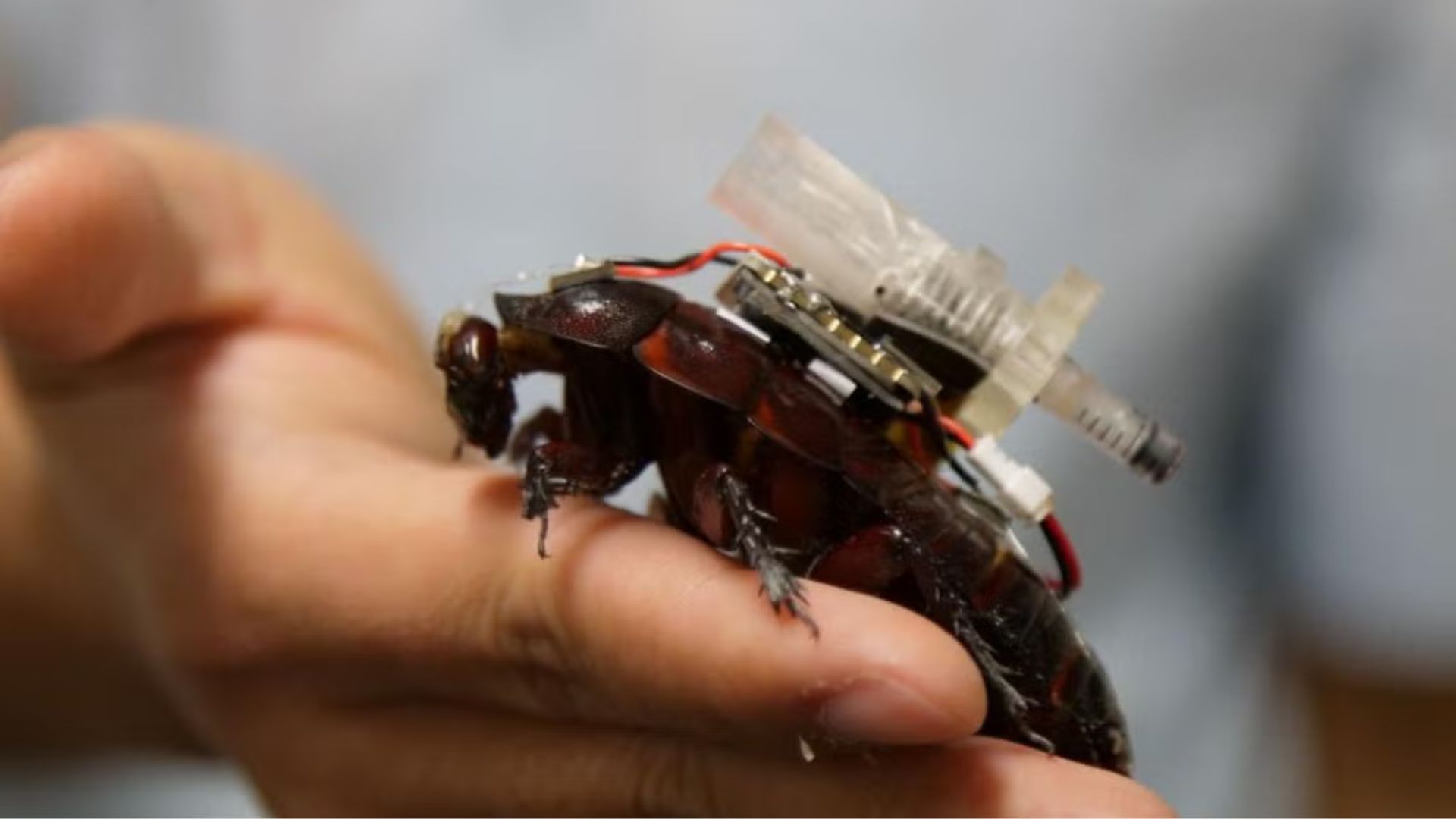
Researchers have developed cyborg cockroaches that could help deliver emergency medical care to people trapped in collapsed buildings, caves, and other dangerous locations. Called Paraborgs, the insects are fitted with miniature electronics that allow researchers to remotely monitor their movements and interact with people who may be beyond rescuers’ reach. The system combines cameras or remotely activated injection devices, turning the insects from simple search tools into potential rescue platforms. Developed by researchers at the University of Queensland and the University of New South Wales (UNSW), the technology keeps critical medical decisions under human control while the cockroaches navigate difficult environments. Robots deliver care Paraborgs combines the insects’ natural ability to navigate cluttered environments with lightweight electronics and remotely controlled hardware. The system is designed to extend cyborg insects’ capabilities beyond simply locating survivors. The researchers used North Queensland giant burrowing cockroaches (Macropanesthia rhinoceros), whose relatively large bodies provide enough capacity to carry specialized equipment. Each insect can be fitted with a lightweight electronic harness supporting either a camera for visual feedback or a custom-built auto-injection mechanism, according to a statement by the team. The Giant Burrowing Cockroach provides greater capacity to carry specialised rescue and medical equipment. The camera-equipped insects could provide rescuers with a live view of difficult-to-access environments, while the injector-equipped versions are designed to deliver emergency medication under remote human supervision. This approach means the insect handles the physical navigation and positioning, while people control critical medical decisions. According to researchers, one of the biggest engineering challenges was getting the cockroaches into the correct position for an injection. The insect must navigate toward a target, approach it closely, remain stable, and activate the injector accurately. In proof-of-concept experiments, the Paraborgs achieved a 95 percent success rate when performing close-range injections from within 15 centimeters of the target. When navigation and injection were combined into a single task, the system completed 72 percent of the trials. The results demonstrate the potential of using biological locomotion as part of a robotic medical-delivery system, although substantial development and field testing would be required before such technology could be used in real emergencies. Insect rescue swarms The concept takes advantage of capabilities that conventional miniature robots can struggle to reproduce. Cockroaches can naturally move through uneven, confined, and debris-filled environments, potentially allowing them to access gaps and spaces where wheeled or larger robotic systems may become trapped. The researchers envision eventually deploying swarms of specialized cyborg insects rather than relying on a single multifunctional machine. Some insects could carry cameras and environmental sensors to locate survivors and assess their surroundings, while others could transport medical or emergency equipment. The technology also builds on earlier work by the University of Queensland team involving cyborg insects. Researchers previously demonstrated controlled climbing using cyborg beetles, while the larger giant burrowing cockroach offers greater carrying capacity for rescue applications. The insects are anesthetized while electrodes, microchips and harnesses are fitted. According to the researchers, they can live for as long as other cockroaches once the harnesses are removed. The long-term goal is not to replace human first responders but to give them another remotely controlled tool for situations in which direct access is impossible. Researchers say specialized cyborg insect teams could potentially be deployed for urban search and rescue, cave emergencies, and disaster response within the next five to 10 years, provided further research and field testing can accelerate development.Get the latest in engineering, tech, space & science - delivered daily to your inbox.Jijo is an automotive and business journalist based in India. Armed with a BA in History (Honors) from St. Stephen's College, Delhi University, and a PG diploma in Journalism from the Indian Institute of Mass Communication, Delhi, he has worked for news agencies, national newspapers, and automotive magazines. In his spare time, he likes to go off-roading, engage in political discourse, travel, and teach languages.
Cyborg cockroaches can act as rescue robots for survivors in disaster-struck areas
Full Article
Original Source
Read the full article at Interestingengineering →KhanList aggregates and links to publicly available news content. We do not host full articles from third-party sources. Always verify important information with original sources.