
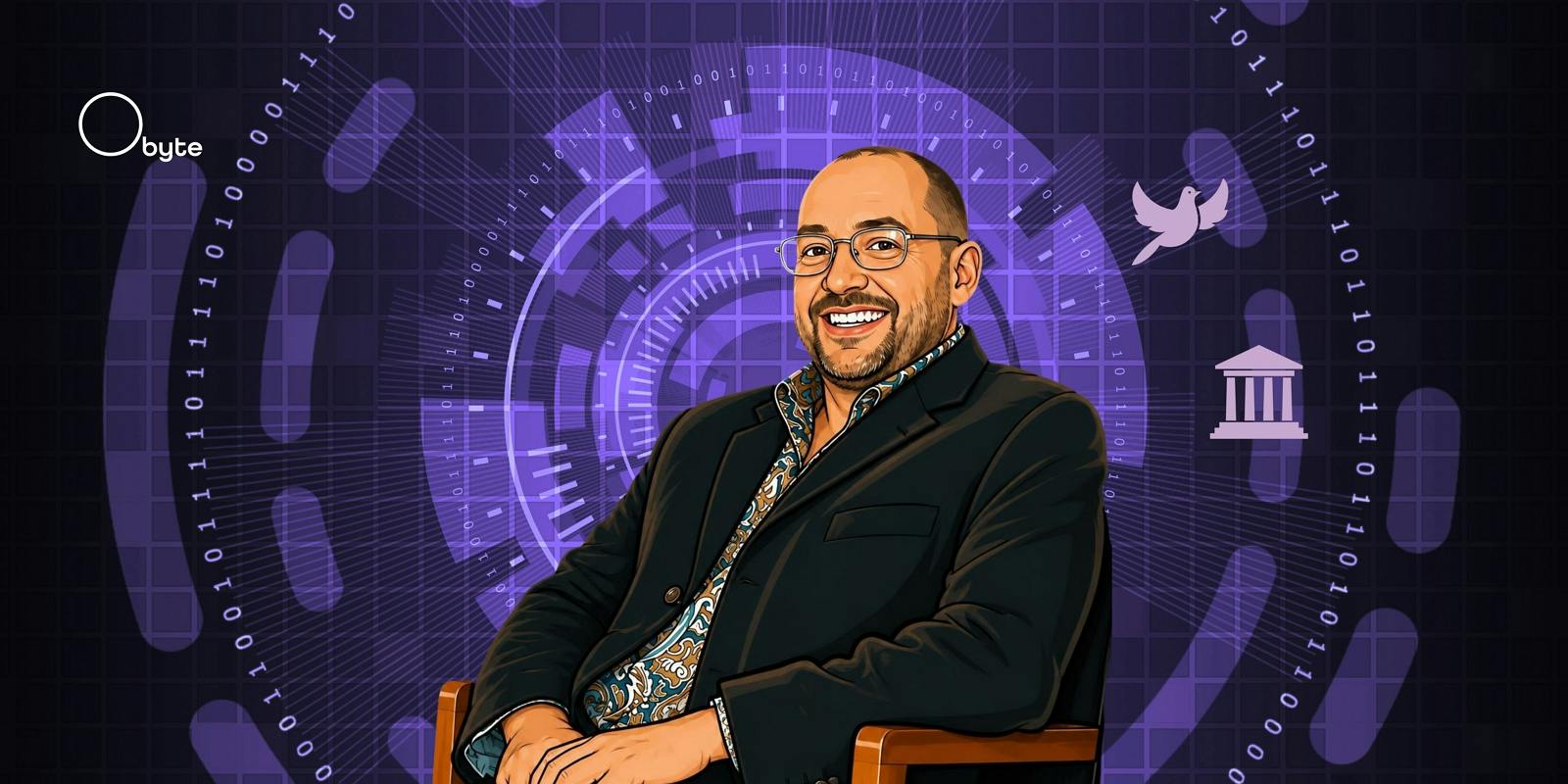
Cyber-libertarianism is a school of thought that sees digital technology as a potential space for individual freedom, self-government, and reduced centralized control. Cryptocurrencies are ingrained with these values, and the activists that made them possible in the first place (the cypherpunks) shared them, too. But they’re not the only ones. Outside the programming and cryptocurrency world, other cyber libertarians have raised their voices as well. Peter Ludlow is one of them.Ludlow was born in 1957 and began his academic path with a B.A. from Bethel College in 1979, followed by a Ph.D. in philosophy from Columbia University in 1985. He’s been a professor of philosophy at the State University of New York at Stony Brook, the University of Michigan, the University of Toronto, and Northwestern University. But his contributions go beyond this area. He’s actually a prominent figure in linguistics. His work on syntax and the philosophy of language studies how language structure shapes meaning. His research connects formal linguistics with broader questions about how humans understand and communicate ideas. Fiction and poetry are also among his skills. As for our topic, he can be considered a cyber-libertarian for his ideas and initiatives around cyber-culture and digital governance. Ludlow & Cypherpunks Ludlow, perhaps much like Perry Barlow, has been one of those figures who—while not programmers or "rebels" per se—have existed within that orbit, constantly drawing nourishment from those ideas and currents. In 1996, long before Bitcoin came along and when the Internet was still a somewhat mysterious thing that was just getting started, he was already publishing the libertarian ideas of the cypherpunks in the book "High Noon on the Electronic Frontier." This is an anthology that explores early debates about life online, including privacy, property rights, hacking, encryption, censorship, and online communities. Ludlow was the editor, and numerous authors and pieces can be found in the book. Among them, by the way, we can find The Crypto Anarchist Manifesto by Timothy C. May (one of the founders of cypherpunks), How PGP Works by Phil Zimmermann, Crypto Rebels by Steven Levy, Achieving Electronic Privacy by David Chaum, and The Economy of Mind on the Global Net by Perry Barlow. This wasn’t a one-time occurrence. In 2001, he published another cyber-libertarian anthology, this time more direct about it from the title: “Crypto Anarchy, Cyberstates, and Pirate Utopias”. By “crypto” here, he referred to cryptography, and not yet to cryptocurrencies; but the cypherpunks were included again. Timothy May repeated, Eric Hughes’ A Cypherpunk Manifesto was there, and A Declaration of Independence of Cyberspace by Perry Barlow was a highlight. The takeaway was that new technologies, such as cryptography, and even alternative methods of governance, including crypto-anarchy, could help shape a freer and more decentralized Internet. Virtual Worlds & Hacktivism The Metaverse, or virtual worlds, has been a big topic for Ludlow. In 2003, he founded the Alphaville Herald, an unofficial newspaper for the Alphaville server of the metaverse The Sims Online, produced by Electronic Arts (EA). He didn’t just report harmless things, though. Usual topics included in-game scams, online prostitution, and social problems in the game itself. After a last report on “racist and transgressive behavior,” he was banned by EA. He’s not even sure that was the reason, as he mentioned in his book "Our Future in Virtual Worlds" (2010), regarding digital governance systems: “Was the publication of this story the reason for my banning? It would seem so, but the problem is that we may never know for sure because such disciplinary processes are never transparent.There is no due process, simply the announcement that someone has been banned with little if any explanation as to why. This is of course an old theme in [centralized] virtual worlds.” For Ludlow, digital governance must be transparent and more decentralized, instead of giving the owners of certain platforms the powers of a “Greek God” to do as they please with users. In his case, instead of giving up, he moved the Herald to Second Life, another metaverse. And that didn’t stop him from also criticizing Linden Lab, the company behind Second Life. Beyond the Herald, Ludlow has also shared several articles and lectures on hacktivism. Among these, his defense of WikiLeaks and the Aaron Swartz case stand out—both linked to freedom of expression and public information. Governance & Crypto Networks It always seemed that Ludlow’s journey would lead to this. His focus on digital governance, decentralization, and virtual worlds converges in his latest work, "Farewell to Westphalia: Crypto Sovereignty and Post-Nation-State Governance," published with Jarrad Hope in 2025. This time, ‘crypto’ does allude to cryptocurrency networks and related technology. In this book, the authors argue that cryptocurrency's important applications could include maintaining decentralized records, transparent policies, and rules encoded through smart contracts. By using this new technology, especially for governance through Decentralized Autonomous Organizations (DAOs), we'd be able to replace the old Westphalian system (separate nations and laws) with freer on-chain communities. “They [these technologies] can enable us to maintain our privacy and demand that governments be transparent. Most importantly, they facilitate exit from governmental systems that do not conform to their citizens’ values. The possibility of exit thus allows governing systems to compete for citizens. Rather than having citizenship determined by terrestrial boundaries, it can be determined by our sense of mutual alignment in terms of politics and values.” The concept is very similar to Network States by Balaji Srinivasan. However, the main difference is that Ludlow and Hope argue that these on-chain communities don't need to become traditional ‘states’ or actually exist in a physical territory. Besides, they show a bright optimism about them: "When they arrive, they will provide us relief from the failures of the Westphalian order, and they will offer creative alternatives for humans to govern themselves in effective-yet-self-sovereign ways." A Place for Decentralized Governance For communities exploring alternatives to traditional state institutions, just like Ludlow, infrastructure matters as much as political ideas. Obyte offers one option through its Directed Acyclic Graph (DAG) architecture, which operates without miners or "validators," and aims to resist censorship by avoiding all middlemen. Its network operates beyond the control of any state or single central party or even multiple central parties, creating room for autonomous digital communities. This decentralization level could give residents and community members absolute independence when coordinating economic activities, managing shared resources, and participating in collective decisions. Governance could rely on transparent, community-driven processes rather than placing every decision in the hands of a central authority. For everyday economic activity, contracts with arbitration provide escrow protection and an independent process for resolving disputes between parties. Together with self-sovereign identities, these tools offer building blocks for communities seeking greater autonomy, privacy, and cooperation across borders. Don’t forget to check out other cyber-libertarians and cypherpunks: John Perry Barlow & A Free Cyberspace Esther Dyson & The Knowledge Age Cypherpunks Write Code Series ** Featured Vector Image by TheDigitalArtist / Pixabay Photograph of Peter Ludlow by Tish Shute / Flickr
Cyber Libertarians: Peter Ludlow & Future Governance
Full Article
Original Source
Read the full article at Hackernoon →KhanList aggregates and links to publicly available news content. We do not host full articles from third-party sources. Always verify important information with original sources.