
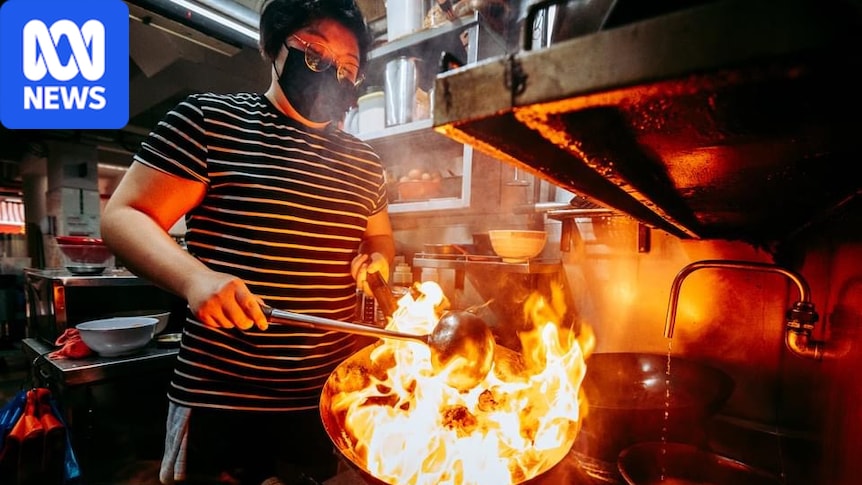
Debbie Yam stands over a raging gas burner, tossing wave after wave of oil and smoking rice in a scorching hot wok.Ten years as a hawker, she no longer singes her eyebrows or hair.Working 70 sweaty hours every week is a far cry from the corporate career she expected to have.After graduating with a business degree, she took over her great-grandfather's hawker stall which was short-staffed."I like to eat the food here … and where else am I going to find these flavours if the shop is going to be closed down?"Singapore hawker food is famed for being delectable and affordable. (Supplied: Martin Ng)But she is unsure whether her great-grandfather's fish-head noodle and stir-fry stall can keep weathering the "cutthroat" industry."If the money doesn't make sense anymore, then there is no amount of passion that can make me drive the project even for another 10 years," she said.Singapore's hawker centres — where individual stallholders sell cheap, freshly-made dishes in government-owned 'community dining rooms' — are an iconic part of the city state's heritage.Hawker centres are government-owned public spaces where neighbours and friends can socialise outside their small apartments. (ABC News: Lachlan Bennett)Its value to social cohesion was why UNESCO inscribed Singapore's hawker culture on its Intangible Cultural Heritage List in 2020.But a price ceiling combined with rising inflation, costs of imported ingredients, and labour shortages leave little incentive to stay.Invisible price ceilingsTo rebuild the nation after World War II, Singapore introduced feeding schemes to sustain time-poor labourers needing a filling and cheap meal.According to the Singapore government's National Environment Agency (NEA), more than 6,000 food stallholders operated across 120 state-owned hawker centres.Jenny Dorsey, a chef and food studies researcher, said government policies designed to keep meals cheap, fixed consumer expectations creating an "invisible price ceiling" for hawkers.Singapore's hawkers used to sell food on the street before the government moved them into permanent centres to regulate pricing and safety in the 1970s. ("Singapore-Food stall-1973-74-WUS08225" by Rainer Halama is licensed under CC BY-SA 4.0.)Over time the NEA wanted hawkers to operate with less state support.While it did not mandate meal prices, stalls at "socially conscious" hawker centres are required to offer a "value" meal which is benchmarked about $S3.50 ($3.93).But the NEA outsourced management of these hawker centres to private companies, which charged higher fees.This downward pressure on price expectations is at odds with rising wages and inflation, risking the "extinction" of the trade, Ms Dorsey said.Roasted meat at a chicken rice stall in Singapore ("Roast meats at a chicken rice stall" by PipeDr3am2000 is licensed under CC BY-SA 4.0)No cap on costsMs Yam's great-grandfather started as a street vendor in 1946.He became a "pioneer" stallholder in 1978 when the government moved food peddlers into permanent state-owned centres to improve sanitation and regulate food standards and pricing.Still leasing that same stall, Ms Yam pays a "legacy" monthly rent of about $S400 ($446).Debbie's great grandfather was part of the 'pioneer' generation of hawkers who moved from the street into a government-owned centre. (Supplied: Debbie Yam)About one-third of stallholders still pay subsidised rates as low at $S192 ($215), while new stallholders bid for leases at market rates."There will be people bidding for the store at $S4,000 [per month]. This is 10 times the difference, so how can they price their food so low?" Ms Yam said.The NEA estimated ingredients to account for just over half of hawkers' operating costs.Hawker cuisine reflects the evolution of cuisines that early migrants from China, Malaysia, and India brought and sold to make a living. ("Singapore 1973-74-WUS08144" by Rainer Halama, is licensed under CC BY-SA 4.0.)While discounted ingredients can be ordered through a government network of bulk suppliers, most hawkers still get cheaper produce through their own suppliers.Ms Yam said many younger hawkers enter the trade because of the low barrier to entry, but few stay.The NEA introduced a Hawker Incubation Scheme in 2018 offering temporary subsidised rent and equipment fit-outs.As of June 2026, it said about half of the 109 aspiring hawkers on the program achieved viability.Debbie Yam has learnt about 150 recipes to operate her great-grandfather's stir fry and fish noodle soup stall. (Supplied: Debbie Yam)A competitive edgeStallholder Kenny Ngoo, 32, has found "fulfilment" serving Korean-inspired fried chicken and rice bowls for between $S8 ($9) and $S11 ($12.30) for a decade.His price list reflects his higher rental of$S3,000 ($3,363), but he believes subsidised rents do not harm hawker culture.Instead of competing with cheap meals, new stalls need to get "creative" and offer a gourmet version of a traditional dish, or experiment with fusion cuisine."I think it's a win-win for both," he said.To remain competitive against cheaper-priced stalls, Kenny Ngoo sells a fusion of Korean-inspired chicken with rice or pasta. (Supplied: Kenny Ngoo)But Mr Ngoo is worried about the loss of diversity in hawker food with the rise in stall chains and commercial franchises that benefit from economies of scale.Part of the appeal is stalls having different recipes of the same dishes, he said.Kenny Ngoo says hawker food could become more standardised as more multi-stall chains that use the same recipes open up. (Supplied: Kenny Ngoo)Next door to Ms Yam's 50-year-old hawker centre is a privately owned food court that is newer, cleaner, and air-conditioned.Ms Yam said while the prices might be similar, the commercial centres lacked heritage and specialised skills, something consumers might not appreciate.The government has promised to invest up to $S1 billion over the next 20 to 30 years to upgrade accessibility and climate resilience at existing hawker centres.Replenishing a workforceJames Sai, now retired, ran his father's coffee stall and worked 12 hours every day, resting only during the Lunar New Year week."In my time, the hawker trade was considered an uneducated, unskilled job without a future," he said.While that stigma is fading, it is still not an aspirational career choice for young people (or their parents), said Mr Sai's daughter Faye, who with her siblings has expanded the business across three stalls.The Sai family served coffee out of a shophouse (right) before moving into a hawker centre under a 1978 government initiative. (Supplied: Faye Sai)According to Singapore's government, the median age of hawkers is 60 years old.A government-funded scheme to match retiring veterans with aspiring hawkers to pass on their signature recipes and skills has only seen only a handful of successful handovers.Besides the gruelling conditions, job insecurity, and lack of employer benefits, not everyone can work in government-owned stalls.Stallholders must spend a minimum number of hours on the premises on days they are open, disadvantaging elderly hawkers and those who cannot work long hours.After university Faye (right) and her siblings (pictured) returned to become the third generation running her grandfather's coffee stall. (Supplied: Faye Sai)Additionally, only Singaporean citizens and permanent residents can rent a stall, and only they and long-term visitor pass (LTVP) holders can work in it.Ms Sai said allowing more foreigners to work could relieve labour shortages for some stalls.But the government is reluctant.Few young people are continuing in the hawker industry where the median age is 60 years old. ("ChinatownDimsumHawker 08.jpg" by Phoebe is licensed under CC BY-SA 4.0)An NEA spokesperson told the ABC allowing LTVP holders to be employed struck a "careful balance" between managing workforce challenges and "preserving the 'local' identity" of hawker culture and heritage.A culinary tapestry worth preserving?Ms Dorsey remembers a hawker selling his grandfather's pig organ soup.She said the family-run stall is the last to serve what used to be a common side dish: sticky rice and chestnuts steamed in pig intestine.Researcher Jenny Dorsey says even as wages rise, consumers remain unwilling to pay more for hawker food creating a price ceiling. (Supplied: Jenny Dorsey)It is a recipe only the stallholder's mother knows, but one that will not be passed down because its preparation was too laborious to be financially viable, Ms Dorsey said."That's a little piece of history that [will be] gone, and this has happened to a lot of different hawker foods across time."Ms Yam says the hawker centre is also where community bonds were forged and fellow hawkers became extended family."It's about visiting the same coffee uncle every single day [who] knows your order just by looking at you."Even her fish supplier — the same one her great-grandfather used — is considering shutting up shop.With the convenience of online shopping and supermarkets, this tapestry of heritage and community was not valued in today's economy, she said.She said society needed to figure out what they valued about hawker culture."Does it mean affordability of food to the masses, or does it mean there is some sort of skills that you are trying to preserve?"Hawker centres are where communities can forge bonds over shared meals, says Debbie Yam. (Reuters: Edgar Siu)Ms Dorsey said the government needed to define what its objectives are."We're kind of in this weird policy tension point that nobody has really resolved," she said.An NEA spokesperson said its policies struck a "careful balance" between keeping hawker food affordable, supporting hawkers, and safeguarding the long-term sustainability" of the trade, and the agency would continue reviewing them.
'Cutthroat' hawker culture fights for survival in Singapore
Full Article
Original Source
Read the full article at Abc →KhanList aggregates and links to publicly available news content. We do not host full articles from third-party sources. Always verify important information with original sources.